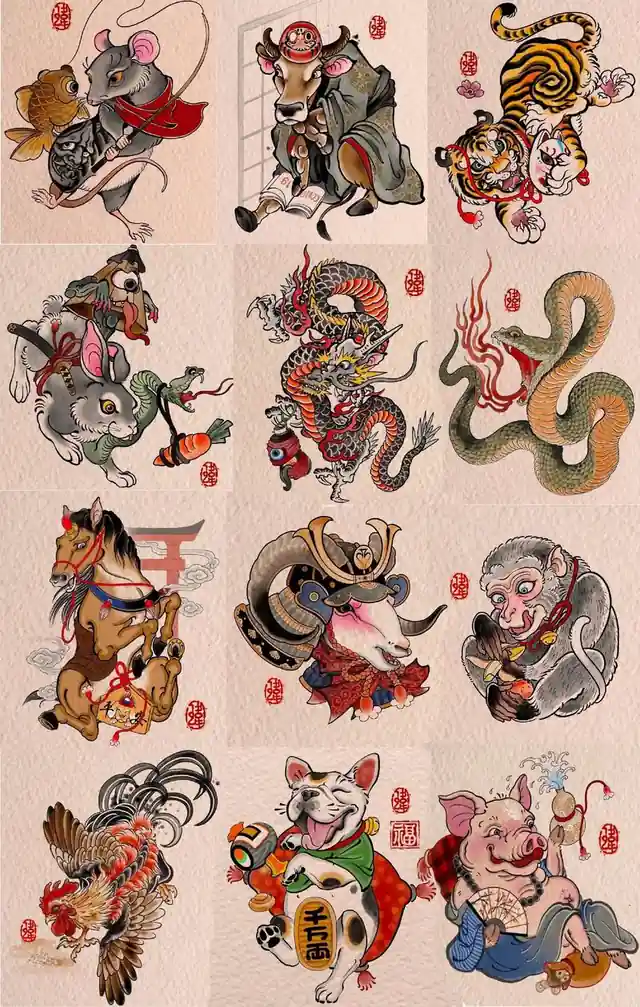
Due to the importance of horses in people's lives, they have been regarded with a sense of worship and respect since ancient times. Both the Han ethnic group and various ethnic minorities hold diverse beliefs and reverence for horses. These beliefs have become a very significant aspect of Horse zodiac culture.
The horse has a very long history, and as the foremost of the six domestic animals, it has exerted a significant and profound influence on all aspects of people's lives. In agricultural production, horses plowed fields and cultivated land for people; in daily life, horses helped people transport goods and travel; in military campaigns, horses fought alongside people in battles across the land. In short, people were inseparable from horses at all times, and they worshipped horses as deities, giving rise to various customs associated with them.
As early as China's first collection of poetry, the Shijing (Classic of Poetry), there is a line that reads: "On the auspicious day of Gengwu, we have already selected our horses." This demonstrates that because the Horse corresponds to the Wu (seventh) Earthly Branch among the twelve earthly branches, people naturally came to regard the Horse as an auspicious omen for the day of Wu.
Horse God
The Horse God, commonly known as the Horse King and also called the Horse Ancestor, Horse Bright King, Horse Lord, or Water-Grass Horse Bright King, is the deity in charge of and responsible for protecting the six domestic animals. As early as the Zhou Dynasty (c. 1046-256 BCE), which was founded on agriculture and placed great emphasis on farming, the government established a system of seasonal sacrifices to the Horse God throughout the four seasons.
According to the "Zhou Li (Rites of Zhou), Xia Guan (Summer Offices), Jiaoren (Horse Officials)," the ritual system of the Zhou Dynasty (c. 1046-256 BCE) prescribed that in spring, the Horse Ancestor God was worshipped; in summer, the First Horse Herder God; in autumn, the Horse She God (regarding the origin of Horse She, there have always been two interpretations: one says Horse She was the first person to ride a horse, while the other says Horse She was the deity residing in the stable, worshipped to ensure the horses could dwell peacefully in their place); and in winter, the Horse Step God was worshipped. In fact, all the deities worshipped during these four seasons were related to horses.
Later, the folk tradition of worshipping the Horse God continued, though the timing varied. Most commonly, the ritual was held on the twenty-third day of the sixth lunar month, known as the Horse King Festival. It was primarily conducted at the Horse King Temple, though some also performed the ceremony in stables. The images of the Horse King across different regions were largely similar: a red face with a curly beard, four arms and three eyes, clad in armor, wielding a sword and halberd, with a fierce and terrifying appearance. Most inscriptions read "Horse King," while some read "Water and Grass Horse Bright King." Additionally, in some areas, an ox was placed alongside the horse beneath the Horse King's statue, fully illustrating that the Horse King was the protector of all domestic animals. Therefore, devoutly worshipping the Horse King, praying for his blessings upon people, and seeking his protection for livestock to remain robust and free from harm were precisely the purposes of people's worship of the Horse King.
Immediate ennoblement
People believe that the Horse symbolizes vitality and prosperity, as well as the ability to take the lead and achieve immediate success. During the Ming (1368-1644) and Qing (1644-1912) dynasties, people combined the Horse and Monkey motifs on jade carvings, a design known as "Ma Shang Feng Hou" (Immediate Enfeoffment). "Ma Shang" means "immediately" or "on horseback," while "Feng Hou" refers to being granted the title of marquis. "Ma Shang Feng Hou" thus signifies instantly receiving a noble title and attaining high official rank. This expression conveys people's aspirations and blessings for a bright and promising future.
Horse Marriage
In China's Inner Mongolia region, there is a custom of horse-riding marriage abduction: the groom rides a horse to the bride's home, places her on the horse, and then the bride's family summons relatives and friends to feign a chase and struggle. It is believed that the more fiercely the groom captures and the tighter he holds on, the happier the marriage will be. One poem describes this lively scene: "The groom takes the lead with a whip on his horse, while the uncles raise their fists with fierce force. After snatching the beauty and returning home, they hold a grand feast with music and candles."
In the Han Chinese wedding customs of the Qinghai region, there is a ritual of drinking "returning horse wine." During the wedding ceremony, after the female guests leave the groom's home and travel a certain distance, some young adults rein in their horses and gallop back toward the groom's house. Upon arriving at the doorstep, the groom's family hands them a flask of wine. The guests, still mounted, drink heartily from the flask, then crack their whips and ride away. After traveling another stretch, they again rein in their horses and return, once more drinking generously on horseback before galloping off. This back-and-forth is repeated once or twice, accompanied by the thundering of hooves and joyful laughter, creating a lively and festive atmosphere.
In addition, there are stories about horse physiognomy, horse racing, as well as the tales of the Horse-Head Fiddle and the Horse-Head Girl (a Chinese folklore figure). It is evident that horses have been deeply integrated into all aspects of people's lives. Horses are no longer merely animals; they have been endowed with a spiritual essence, embodying people's profound emotions.
Further Reading
The "Four-Armed Three-Eyed" Lord Ma (Marshal Ma, a Taoist deity associated with the zodiac sign Horse).
In the old days, many places had horse temples dedicated to worshipping the Horse God. According to legend, the Horse God was Jin Midi, a high-ranking official of the Western Han Dynasty (206 BCE - 9 CE). Jin Midi surrendered to the Han court from the Hun Prince Hunxie during Emperor Wu's reign and was appointed as the imperial horse supervisor. He made significant contributions to the Han Dynasty's horse breeding industry and was later revered as a deity by the common people. Inside the horse temple, there was a statue of the Horse God, with a divine horse standing beside it. The Horse God's statue had four arms and three eyes, hence the popular saying "the Horse God has three eyes." The day for worshipping the Horse God was the 23rd day of the sixth lunar month. Besides farmers, grooms and horse and mule traders also participated in the ritual, with the usual sacrifice being a white sheep. Today, within Guangqu Gate in Beijing, there remains a horse temple enshrining the statue of the Horse God.