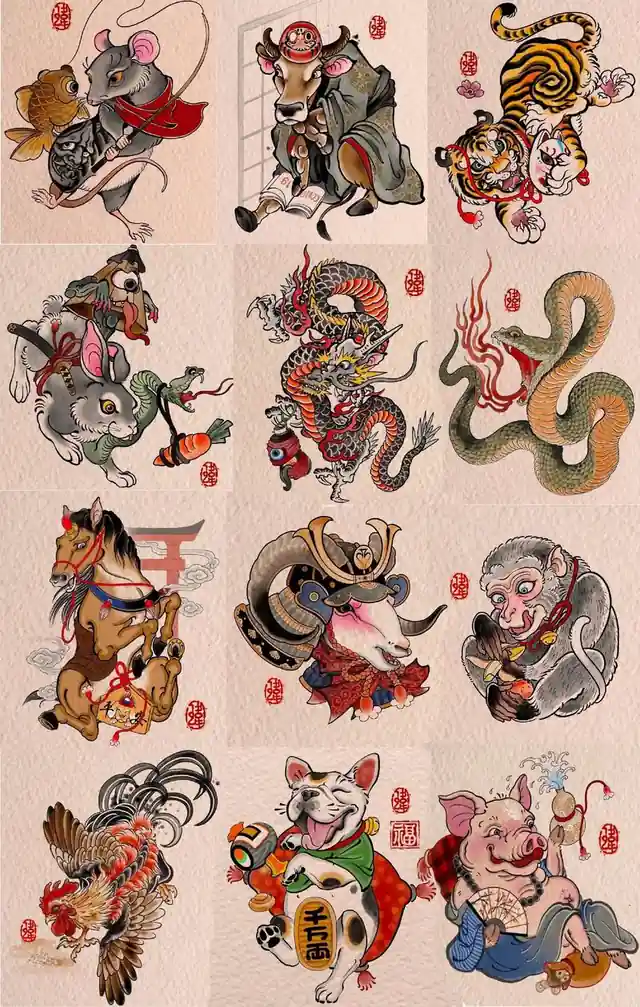
The horse not only occupies a pivotal position in people's daily lives but is also a frequent presence in literature and art. In the descriptions of linguistic art, the galloping horse brings boundless brilliance to the realm of literature.
Throughout history, the arts and literature have consistently featured the Horse as a significant subject of expression. Particularly within the corridors of literary and artistic creation, the Horse zodiac sign follows closely, rising and falling in tandem with the emotions of scholars and refined literati.
In China's earliest collection of poetry, the Shijing (Classic of Poetry), there are numerous descriptions of the Horse zodiac, vividly portraying the horse's image from various aspects such as its coat color, demeanor, and adornments. In the prose of the pre-Qin period, horses were often compared to rare talents, while the horse appraiser Bole became a symbol of a ruler who knows how to identify and employ capable individuals. Qu Yuan's works also frequently use the Qiji (a fine steed) to express emotions and aspirations. For instance, in "Li Sao" (Encountering Sorrow): "Mount the Qiji and gallop freely, come, let me lead the way." In "Huai Sha" (Embracing the Sand): "Since Bole has passed away, how can the steed be judged?" The Qiji is a type of horse, and through this zodiac image, the poet both conveys lofty ideals and high spirits, and reveals the melancholy of unrecognized talent.
In Zhuangzi's "Knowledge Wanders North" (Zhi Bei You), it is said: "Human life between heaven and earth is like a white colt passing a gap in the wall, suddenly gone." Zhuangzi used the image of a white colt passing a gap to compare the brevity of human life. In Zhuangzi's "Horses' Hoofs" (Ma Ti), Zhuangzi extolled the natural state where "horses rub necks together in affection when happy, and turn their backs to kick each other when angry." In Xunzi's "Encouraging Learning" (Quan Xue), Xunzi used a nagging horse to encourage learning: "A fine steed cannot cover ten paces in a single leap; a nagging horse can travel ten days' journey, its success lies in perseverance."
During the Han Dynasty, horses were often associated with warfare. Some poems used horses to express the suffering caused by war, such as in the Han Dynasty Yuefu folk song "Battle South of the City," which describes how "the swift horses died in battle, while the slow horses lingered and wailed," depicting the misfortune and misery brought by conflict. Others used horses to reflect the turbulent social reality and personal ambitions, such as in Cao Cao's poem "Going East and West," where he writes, "War horses never unsaddled, armor never left the side; as old age gradually approaches, when will I return to my hometown?" This conveys the hardships of military campaigns and soldiers' longing for home. In "Though the Tortoise Lives Long," Cao Cao uses the horse to express the aspirations of a determined elder: "An old steed in the stable still aspires to gallop a thousand li; a hero in his twilight years remains vigorous in spirit." Cao Zhi's "White Horse Chapter" further uses the horse to express a tragic and heroic desire to achieve merit and face death bravely: "The white horse with a golden bridle gallops swiftly northwest; ask whose son this is, a wandering knight from You and Bing..."
In Tang Dynasty poetry, the image of the horse is especially bold and majestic, fully embodying the vigorous spirit of the High Tang period. Li Bai's "Purple Piebald Horse" reads: "The purple piebald neighs as it trots, its jade hooves flashing in double arcs. It hesitates to cross the stream, as if cherishing its embroidered saddle blanket. White snow veils the distant mountain passes, yellow clouds shroud the seas and rivers. Wielding the whip, I ride ten thousand miles away—how could I yearn for spring's return?" The Horse zodiac's image—unrestrained and handsome, ambitious, resolute, and empathetic—is truly endearing. Du Fu's "General Fang's Ferghana Horse" reads: "This Hu horse from Dayuan, its lean bones sharp as blades. Its ears are pricked like bamboo shoots, wind whisks beneath its light hooves. Where it gallops, the sky and earth open wide; truly, one can entrust life and death to it. So spirited and swift, it can traverse ten thousand miles with ease." This conveys an equally indomitable momentum. Li He, known as the "Ghost of Poetry," also composed twenty-three poems specifically about horses. The fourth poem states: "This horse is no ordinary steed; the Fang constellation is its celestial origin. Tap its lean bones—they still ring with the sound of bronze." This precisely captures the horse's spiritual essence. The fifth poem reads: "The desert sand is like snow, the Yan Mountains' moon like a hook. When will it wear a golden bridle, galloping swiftly through the crisp autumn?" This expresses the poet's bold spirit and lofty aspirations.
In literary works from the Song, Yuan, Ming, and Qing dynasties, the image of the horse remained elegant and robust. Su Shi's "Riverside Town: Hunting at Mizhou" uses the imagery of riding horses while hunting, with "a yellow dog on the left and a falcon on the right," to express his bold aspirations: "Old as I am, I am stirred with youthful spirit" and "I will draw my carved bow to its full moon, aiming northwest to shoot at the Wolf Star." Xin Qiji's "Eternal Joy: Recalling the Past at Jingkou's North Pavilion" recalls "those days when ironclad horses, like tigers, swept across thousands of miles," symbolizing the iron horse as a representation of the will to resist invaders and serve the country. Gong Zizhen's "Miscellaneous Poems of the Ji-Hai Year" from the late Qing Dynasty laments: "The vitality of the land depends on wind and thunder; the silence of ten thousand horses is truly lamentable! I urge the Heavenly Lord to shake off his lethargy and send down talents of all kinds without restriction." Here, the horse is used to express indignation over the burying and suppression of talent.
Additionally, the image of the horse is richly depicted among nomadic peoples. For example, the Tibetan "Gesar," the Mongolian "Jangar," and the Kyrgyz "Manas" all feature vivid portrayals of the magnificent steppe horse.
The horse's influence on language is also quite extensive, carrying rich meanings in linguistic customs: the grand momentum of "thousands of troops and horses" (qian jun wan ma), the heroic spirit of "wrapped in horsehide" (ma ge guo shi), the chaos and defeat of "men and horses all overturned" (ren yang ma fan), the unrestrained freedom of "a runaway horse" (tuo jiang zhi ma), the innocent purity of "green plums and a bamboo horse" (qing mei zhu ma)... There are also many common sayings: "A good horse never turns back to eat the grass it has left" (hao ma bu chi hui tou cao), "Clothes make the man, the saddle makes the horse" (ren kao yi fu ma kao an), "A swift horse needs only one whip, a straightforward person needs only one word" (kuai ma yi bian, kuai ren yi yan), "Even a good rider may fall, even a sure-footed horse may stumble" (ren you shi shou, ma you shi ti), "To shoot a man, first shoot his horse; to capture bandits, first capture their leader" (she ren xian she ma, qin zei xian qin wang); "Whether it's a mule or a horse, take it out for a walk" (shi luo zi shi ma, la chu qu liu liu)... It can be said to encompass everything, all of which reveals people's immense love for the image of the horse and the important position the horse occupies in people's lives.
Further Reading
The metaphor of "A eunuch buys a horse's bones with five hundred gold pieces"
According to the "Stratagems of the Warring States: Yan Strategy", Guo Wei used the analogy of a swift horse to discuss the issue of talent with King Zhao of Yan, telling the story of offering a thousand gold pieces for a fine horse and spending five hundred gold on a horse's bones: "In ancient times, there was a ruler who offered a thousand gold pieces for a swift horse, but could not obtain one in three years. A man said to the ruler, 'Let me seek it.' The ruler sent him. In three months, he found a swift horse, but it had already died. He bought its bones for five hundred gold and returned to report. The ruler was furious: 'What I sought was a living horse. What use is a dead horse that you wasted five hundred gold?' The attendant replied, 'If you are willing to spend five hundred gold on a dead horse's bones, what about a living one? The world will surely see that Your Majesty can truly appreciate horses, and soon horses will arrive.' Within a year, three swift horses came." Spending five hundred gold on the bones of a dead horse demonstrated the sincere desire for a swift horse. On the surface, this was about buying a horse, but in reality, it was about seeking and recruiting talent. According to legend, King Zhao of Yan heeded Guo Wei's advice and built the Golden Terrace in present-day Yi County, Hebei Province, to attract worthy individuals.