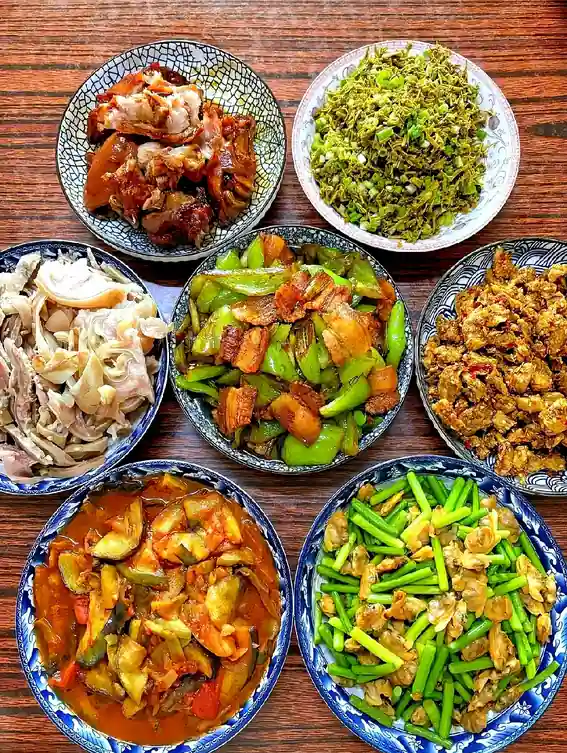
The braised pork hock is cooked until extremely tender and falls apart easily; when dipped in the sauce, it delivers rich, bold flavors with a hint of spiciness, savory sweetness, and a pronounced ginger taste, especially the skin and fatty parts.

This is a dish that wins people over with its sauce, and the key lies entirely in how that sauce is prepared. The method for stir-frying the sauce is similar to that of a Yu Xiang (Fish-Fragrant) sauce, but the difference is that with the generous addition of ginger, the ginger flavor is very prominent. Once the dish is finished, the flavors of saltiness, sweetness, sourness, and spiciness must coexist without interfering with one another, and none of these flavors should become sharp or overpowering. Therefore, making this dish requires the cook to have a good sense of balance, to master the heat, and to know the precise timing for adding each ingredient to the wok. Before you start stir-frying, you must have all the seasonings prepared; otherwise, scrambling to get them ready in the moment will cause you to miss the optimal moment to add ingredients, throw off the overall heat control, and ultimately compromise both the texture and the flavor.
Ingredients
Main Ingredients
1500 g (about 3.3 lbs) pork hind hock
For the best flavor and texture, use a hind leg (back hock) rather than a front leg, as it has a bit more fat, resulting in a richer taste and superior mouthfeel.
Seasonings for the sauce
20 g pickled chili peppers
Sichuan Pixian broad bean paste 20 g
40 g ginger
15 g garlic
10 g (about 2 teaspoons) yellow wine
10 g rice vinegar
15 g (about 1 tablespoon) white sugar
8 g soy sauce
50 g (about 1/4 cup) oil
Use Sichuan-style pickled chilies for this dish; if unavailable, chopped chili sauce can be used as a substitute.
Instructions
Instructions
Braised Pork Hock
Step 1: Scrape off any remaining hairs from the pork hock, rinse clean, place in a pot of cold water with a few slices of ginger, bring to a boil, then reduce to low heat and simmer until the hock is tender and falls apart, about 3-4 hours (Image 1). Remove the cooked hock and place on a serving plate; reserve the cooking broth for later use.
*Soak the pork hock in water beforehand to draw out some blood, and skim off the foam several times while boiling to help remove any gamey smell; when a chopstick can easily pierce through the hock, it's fully cooked.
*The water for boiling the pork hock should just barely cover it.
Stir-fry the sauce mixture.
② Finely chop the pickled chilies and Pixian broad bean paste, and mince the ginger and garlic (Image 2). Heat oil in a wok over medium-low heat, add the chopped pickled chilies and bean paste, and stir-fry until fragrant and the oil turns red, about 20 seconds (Image 3).
*The pickled chilies and broad bean paste must be stir-fried slowly over low heat in warm oil to release their red oil and aroma while removing any sourness; if you use high heat and hot oil, they will quickly burn and the fragrance won't develop.
③ Next, add the minced ginger and garlic, continuing to stir-fry over medium-low heat for about 20 seconds (Image 4). Add the soy sauce and Shaoxing wine, stir-frying over medium heat (Image 5). Finally, add the sugar and 100 g (about 1/2 cup) of the pork broth used to cook the elbow, bring to a boil over medium heat, then add the rice vinegar and cook for about 5 seconds (Image 6).
*When stir-frying the sauce, do not add salt, as the pickled chilies, broad bean paste, and soy sauce already provide enough saltiness.
*Do not use too much soy sauce—ensure the sauce turns red after stir-frying; do not skimp on sugar, as it balances the flavors, but control the amount so the sweetness doesn't overpower the dish.
The meat broth used for stir-frying the sauce is the same broth used to cook the pork hock, so the sauce is made only after the hock is fully cooked.
Pour the sauce over the braised pork hock.
④ Pour the prepared sauce over the pork hock and serve.
A lazy cook's trick
The pork hock can be cooked in a pressure cooker to save a lot of time, just make sure to use a large enough pressure cooker since the hock is quite big—using a small one might exceed the safety line and cause danger. Also, cooking the hock with the bone in makes for a nicer presentation on the plate, but it takes longer; you can ask the butcher to debone it for you when buying, which will further reduce the cooking time.
