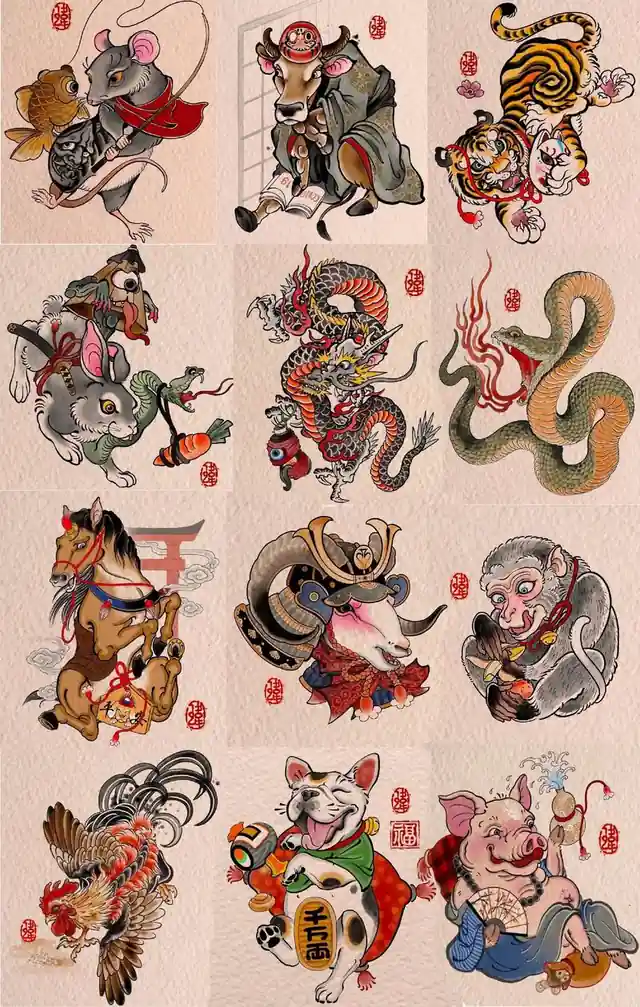
Throughout the long history of human interaction with dogs, people have endowed dogs with a wide variety of symbolic meanings. Dogs were also used as important sacrificial offerings in ritual activities, thus becoming a crucial link between sacrificial customs and traditional Chinese zodiac culture.
Throughout the long course of human historical development, due to their limited strength and inability to correctly understand phenomena such as birth, aging, illness, death, and natural disasters, people performed various rituals to gain power and achieve psychological balance. This led to the emergence of sacrificial ceremonies, and the dog, being the animal most closely associated with humans, naturally became an important sacrificial offering.
Offerings of dogs to the sun and moon.
Historically, the Khitan people of the Liao Dynasty (916-1125) had religious customs of worshipping the sun and the moon. According to historical records: "When the Khitan observed a lunar eclipse, they would prepare feasts that night to celebrate, and the chieftain would hold a banquet the following day." On the eighth day of the eighth lunar month each year, the emperor would kill a white dog seven steps in front of his sleeping tent, then bury the dog with its head down and mouth exposed. Seven days later, on the fifteenth day of the eighth lunar month, which coincides with the Mid-Autumn Festival, a formal moon worship ceremony would take place. This moon worship ritual embodied the Khitan people's belief in the Celestial Dog, reflecting their desire to ward off evil spirits through such devotional practices.
The practice of sacrificing a dog to the Kitchen God.
The custom of using a yellow dog as an offering to the Kitchen God had already emerged during the Han Dynasty in China. According to the "Biography of Yin Shi" in the Book of the Later Han (Houhanshu): "During the reign of Emperor Xuan, there was Yin Zifang, a man of utmost filial piety and benevolence. While cooking on the day of the Winter Solstice Festival (Lari), he saw the manifestation of the Kitchen God. Zifang bowed twice to receive the blessing. His family had a yellow dog, which he then used as a sacrifice. From then on, he suddenly became immensely wealthy, owning over seven hundred qing of land... By the third generation, the family flourished, so thereafter they regularly sacrificed to the Kitchen God on Lari, offering a 'yellow sheep' (huangyang)." The term "yellow sheep" actually refers to a type of dog. The "Jing-Chu Suishiji" (Record of the Yearly Customs of Jing and Chu) by Zong Lin of the Southern Liang Dynasty also contains a related record: "During the Han Dynasty, Yin Zifang saw the Kitchen God on Lari and sacrificed a yellow dog to him, calling it a 'yellow sheep'." This custom persisted into the Qing Dynasty, as recorded in the "Yanjing Suishiji" (Record of the Yearly Customs of Beijing): "On the 23rd day of the twelfth month, when sacrificing to the Kitchen God, ancient people used a yellow sheep. Recently, it is said that the imperial court still uses it, but it is no longer seen among the common people." Using a dog as an offering to the Kitchen God similarly reflects people's wish for wealth and prosperity through the dog.
Ancestral Sacrifice with Dogs.
As early as the Zhou Dynasty in China, some southern ethnic groups had the custom of sacrificing dogs to their ancestors. Certain southern minority groups, such as the ancient Dongyi people, believed that dogs had a close relationship with their ancestors. According to Volume 7 of Bowuzhi (Records of Diverse Matters) by Zhang Hua of the Western Jin Dynasty: "A palace woman of Lord Xu became pregnant and gave birth to an egg, which was considered inauspicious and abandoned by the riverbank. A widow had a dog named Hu Cang, who was hunting by the river, found the abandoned egg, and carried it back in its mouth. The widow found it unusual, covered and warmed it, and it eventually became a child, born lying flat, hence the name. When Lord Xu heard of this, he took the child in. As he grew up, he became benevolent and wise, eventually inheriting the state of Xu. Later, Hu Cang grew horns and nine tails before death, and was actually a yellow dragon. King Yan buried it within the borders of Xu, and the place is now known as Dog Mound." In their rituals of human sacrifice to the earth god, the ancient Dongyi also used dogs as primary sacrificial offerings. Archaeological evidence from the Tongshan Qiuwan sacrificial site in Jiangsu reveals 20 human skeletons, 2 human skulls, and 12 dog skeletons, with both the human and dog heads facing the direction of a large stone. This is interpreted as a sacrificial custom of the Dongyi people, reflecting their ancestors' hope to ward off evil spirits and demons and pray for peace through dog sacrifices.
Shen Ying, a native of Wu during the Three Kingdoms Period (220-280 CE), also recorded in his work "Linhai Shuitu Zhi" (Records of the Lands and Waters of Linhai) that "when parents die, a dog is killed and offered in sacrifice," which is essentially consistent with the description in "Shanhaijing · Nanshan Jing" (The Classic of Mountains and Seas · Classic of the Southern Mountains): "From Mount Tianyu to Mount Nanyu, there are fourteen mountains in total, spanning six thousand five hundred thirty li. Their deities all have dragon bodies and human faces. Their rituals all involve praying with a white dog, with offerings of zong (a type of sacrificial grain)." Both accounts relate to the belief that dogs can dispel disasters and avert misfortune.
Sacrificing a dog to the house (a ritual offering of a dog to appease or bless the dwelling).
Every February in the lunar calendar, the Miao people of Leigong Mountain in Guizhou hold sacrificial rituals at both the head and foot of their villages. It is said that the village head represents the male principle (yang, facing east) and requires a male dog as an offering, while the village foot represents the female principle (yin, facing west) and requires a female dog as an offering. The ceremony is presided over by a shaman, who chants incantations before slaughtering the dogs. A raw sacrifice is performed first, followed by a cooked sacrifice after the dog meat is boiled, along with wine and rice. After the ritual concludes, the entire village participates in a distribution ceremony, dividing the meat among households. The purpose is to seek peace, good fortune, and abundant harvests for the village and its people through the dog sacrifice.
Further Reading
Dog Hanging Mountain Sacrifice (Diao Gou Ji Shan)
The Mountain Worship Festival is the most important ethnic festival of the Qiang people. It is also known as the Mountain Circumambulation Festival or Qiang New Year Festival, held respectively in spring and autumn. The spring ceremony prays for favorable weather, while the autumn ceremony gives thanks to the Heavenly God for the harvest of the five grains. In essence, it is an agricultural activity of spring prayers and autumn thanks, yet it is always imbued with strong religious overtones, reflecting the brilliance of ancient mystical culture. The Mountain Worship Festival can be roughly divided into three types: "Divine Goat Mountain Worship," "Divine Ox Mountain Worship," and "Hanging Dog Mountain Worship." The Hanging Dog Mountain Worship is held annually in the first month of the lunar calendar, lasting for seven days. Before the festival, each Qiang household contributes rice to exchange for a white dog, which is then fattened. On the day of the mountain worship, people gather before a large white stone symbolizing the mountain god, light incense, and hang the white dog on the "Hanging Dog Tree" in the sacred forest. Around the dog's neck is hung a string of ring-shaped bread. After seven days, the white dog dies from hanging, and the people again light incense to worship the mountain god, praying for longevity and bountiful harvests. Today, the rituals of this festival have been simplified.