In people's earliest understanding, they instinctively associated dogs with wind. As traditional Chinese culture further developed, dogs came to be regarded as the wind deity who governs the wind. Both in historical records and in long-standing folk customs, there is evidence confirming the dog as the god of wind.
Oracle bone inscriptions, the earliest form of Chinese writing, contain the first records of the relationship between dogs and wind. For example, oracle bones unearthed at Yinxu in Anyang, Henan, include inscriptions such as: "To the Emperor's Scribe Wind, two dogs" (from "Bu Tong"), "To calm the wind, a dog offered by the northern shaman" (from "Ming Xu"), "To calm the wind, nine dogs offered by the shaman" (from "Ku"), "To calm the wind, three goats, three dogs, and three pigs" (from "Xu"), and "To calm the winds from the four directions, five dogs" (from "Ming Xu"). These are all records of dog sacrifices.
In general sacrificial practices of the pre-Qin period, dogs were often placed after oxen, goats, and pigs. Only when sacrificing to the Wind God were dogs the first choice, with oxen, goats, and pigs rarely used. This indicates that in the primitive thinking of ancient people, dogs were believed to have the power to calm the wind. The Shan Hai Jing (Classic of Mountains and Seas) also records the use of "black dogs" and "white dogs" in sacrifices to the Wind God.
By the Han Dynasty, the relationship between wind and dogs had further developed. According to the "Fengsu Tongyi" (Comprehensive Meaning of Customs and Habits) by Ying Shao of the Eastern Han Dynasty: "The spirit of the Xu hour is the Earl of Wind, therefore sacrifices are made to him on a Bingxu day in the northwest." Related records also appear in the "Houhanshu" (Book of the Later Han), "Treatise on Sacrifices, Part Two": "On a Bingxu day, the Earl of Wind is worshipped at the Xu location." Although it is not explicitly stated that the dog is the Earl of Wind or the Wind God, the relationship between the two has become very clear.
The "Erya · Shitian" (Approaching the Correct · Explanations of Heaven) also states: "Sacrificing to the wind is called 'zhe' (dismemberment sacrifice)." According to Guo Pu's commentary: "In current customs, dogs are dismembered in the middle of the road to stop the wind." Zheng Xuan annotated the "Rites of Zhou · Grand Master of Ceremonies" (Zhouli · Da Zongbo) saying: "Splitting and dismembering a sacrificial animal is done for sacrifice, much like the present practice of dismembering a dog to stop the wind." The "Gongyang Zhuan · Duke Xi's 31st Year" (Gongyang Zhuan · Xigong Sanshiyi Nian) further explains "zhe": "Sacrificing to the wind uses the head, hooves, and hide of the animal, which are broken apart for the sacrifice, hence it is called 'zhe'." "Zhe" can be seen as the peeled hide of a dog, used for warding off calamities and seeking divine aid. Therefore, the "Huainan Wanbi Shu" (Huainanzi's Ten Thousand Arts) states: "Burning the fur and bones of a black dog and scattering the ashes can stop the wind." This essentially reflects a concept of "the wind god as a dog god." In the view of the ancients, killing a kindred being of the wind god, that is, killing a dog, would cause the wind god to take pity on its own kind and cease the wind.
Beyond just wind, according to the Ming Dynasty (1368-1644) work Wuli Xiaoshi (A Small Treatise on the Principles of Things), which cites the Mozi: "Burning black dog skin and scattering its ashes will cause the wind to rise." Therefore, in the ancient Chinese conception, dogs could both raise and calm the wind. So, dogs were used in sacrifices to the Wind God, praying for the cessation of wind damage.
From a scientific perspective, there are three main reasons why the dog was regarded as the wind god.
Some experts and scholars believe that dogs move as swiftly as the wind, a concept further evidenced by the ancient character "猋" (biāo, three dogs running). The Shuowen Jiezi (说文解字, Explaining Graphs and Analyzing Characters) states: "猋 means the appearance of dogs running, formed by three dog radicals." The Erya, Chapter Shi Tian, says: "Fuyao is called Yan (扶摇谓之焱)." Guo Pu annotateShuowen Jiezi Rites), Chapter Yueling, records: "猋 signifies the arrival of wind and rain in full force." Zheng Xuan annotated: "Whirlwind is called ." The Guangyun (广韵) and Jiyun (集韵) also write the character "猋" as "飙." The Guangyun, Chapter Xiao Bu, states: "飙 means wind." The Jiyun, Chapter Xiao Bu, states: "飙 is interchangeable with ." From the formation and evolution of the character "飙" above, the dog was not only a sacrificial offering to calm wind and pray for rain but also the deity of wind and rain. This sufficiently proves the long-standing tradition of using dogs to pray for wind and rain.
From the perspective of China's geographical environment, the position corresponding to the Dog in the earthly branches (Xu, the northwest direction) coincides with the direction of winter cold fronts on the Chinese mainland. Naturally, people would not use a bloody dog to pray for calm winds when the breezes are gentle. However, for strong winds that bring severe temperature drops, people longed for the wind to cease and for warm, sunny weather. The northwest winter winds generally gather in the Xu direction, which should be a significant reason why people regarded the Dog as the Wind Earl (Feng Bo, the god of wind). In the eyes of ancient people, the image of wind closely resembled that of a dog. Volume 2 of "Wuli Xiaoshi" (A Small Treatise on the Principles of Things) states: "The Wind Earl takes the form of a dog." "Qixiu Leigao" (Classified Drafts of the Seven Categories), in the section on heaven and earth, also notes: "The Wind Earl's head resembles a dog." "Yuanshi" (History of the Yuan Dynasty), in the chapter on chariots and attire, records similarly: "The Wind Earl... a divine figure with a dog's head, red hair, a ghostly form, leopard-like hips, red trousers, carrying a wind bag, standing amidst clouds and mist."
Additionally, the "Shan Hui" (mountain hound) recorded in the Classic of Mountains and Seas (Shanhaijing) is also one of the ancient wind deities. It is said that its form has a human head and a dog's body: "Its shape is like a dog with a human face, skilled at throwing, and laughs when seeing people; its name is Shan Hui, and it moves like the wind, bringing great winds to the world when seen."
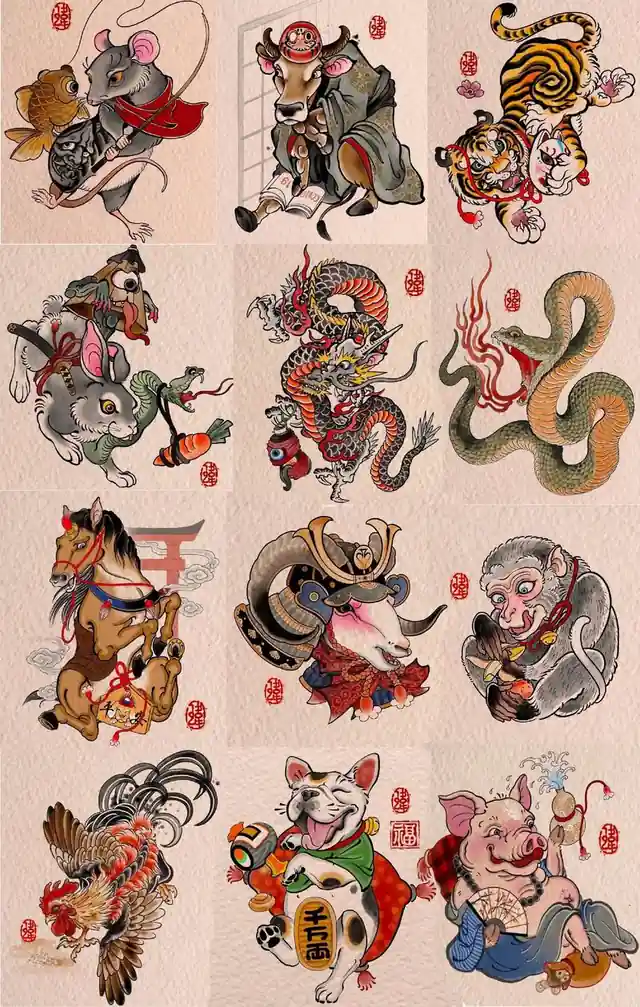
Regardless of the reason, the fact that people regarded the dog as the Wind God (Feng Bo) has remained unchanged. This reflects the supreme reverence people held for the dog, and it also serves as an important reason why the dog was able to be selected as one of the twelve zodiac animals.
Further Reading
The Qiang ethnic group performed dog-sacrificing rituals to pray for wind and rain.
In some economically underdeveloped areas of China, when drought strikes, rain-praying rituals are held, with dogs serving as the primary sacrificial offering. During the Qiang ethnic group's rain-praying ceremony, a dog is carried up a mountain. After paying homage to the Dragon King, the dog is taken to a burning ground and offered as a sacrifice to the Dragon King. Meanwhile, a shaman (Duan Gong) is invited to chant a rain-praying song, with the general meaning: "A drought has come, a drought has come! Oh Dragon King! Crops are withered, grass and trees are yellowing. If there is no harvest in the future, how will we survive? Oh Dragon King, send rain quickly!" The locals believe the Dragon King is most repulsed by the odor of dogs. By offering a dog to the Dragon King, they cause him to smell the dog's stench, forcing him to send rain. This rain-praying ritual of the Qiang people is similar to the dog sacrifice described in the Han Dynasty text "Huainan Wanbi Shu" (The Myriad Arts of Huainan), which mentions "burning the fur and ashes of a black dog and scattering them," except the purpose is not to stop wind but to pray for rain. This fully demonstrates that the custom of dog sacrifice has a long history and has had a significant impact on the daily lives of working people.