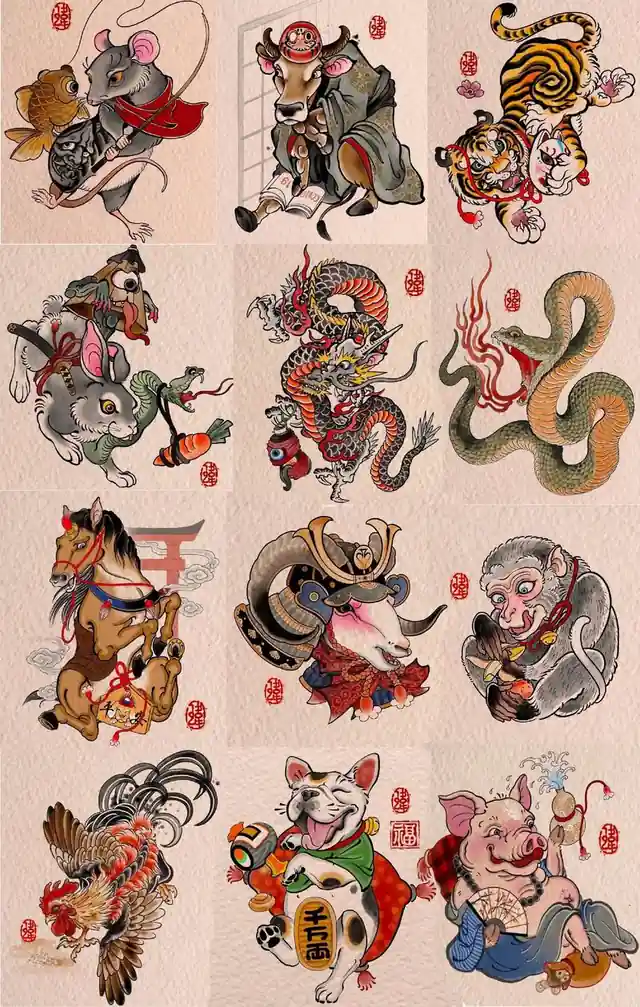
Dogs have a close relationship with people's daily lives, and naturally, the cultural shadow of the Dog zodiac sign is deeply rooted in traditional folk customs. As an important branch of the Twelve Zodiac culture, the Dog zodiac culture not only influences various aspects of people's lives but also plays a significant role in enriching and developing traditional Chinese zodiac culture.
Looking at the twelve animals in the Chinese zodiac, some were kept at a respectful distance due to fear and reverence, while others played a significant and positive role in the course of human development. Among them, the Dog, as the animal most closely associated with humans, undoubtedly made a major contribution to human progress and advancement. For this reason, the culture of the Dog, as an important aspect of traditional Chinese folk customs, permeates all aspects of people's daily practices and traditions.
Festivals Related to the Dog Zodiac Sign.
Among festivals associated with the Dog, the largest is the "Pan Wang Festival" of the Yao ethnic group. On the 16th day of the first lunar month each year, the Yao people hold major activities to honor their ancestor Pan Hu (the Dog God). These activities include three essential rituals: first, performing the primitive sacrificial dance known as the Pan Wang Dance; second, conducting the ceremony of fulfilling vows to Pan Wang by slaughtering an ox as an offering; and third, chanting the "Pan Wang Song." To this day, the traditional clothing of the Yao people retains many patterns related to the Dog.
During the Chinese New Year, the Bouyei ethnic group celebrates the "Eating New Festival." In the evening, they first set up a feast to honor their ancestors, followed by a ritual to honor dogs, and only then can family members sit down to eat. During the dog ritual, an elder places "new grain rice" and three pieces of pork into the dog's food bowl, reciting prayers while watching the dog eat. The meaning of this ritual is to express gratitude to dogs for bringing grain seeds to humanity.
In the Han ethnic group's seasonal customs, the second day of the first lunar month is designated as "Dog Day" (Quan Ri). On this day, people use the weather's condition—whether it is sunny or overcast—to predict whether raising dogs will be prosperous in the coming year, with sunshine indicating good fortune and overcast skies foretelling disaster. During "Dog Day," people devote more attention than usual to their beliefs regarding dogs, hoping that the canine species can achieve better reproduction and development.
Good and ill fortune associated with those born under the Dog zodiac sign.
In the eyes of the ancients, dogs were animals capable of foretelling good fortune and calamity. Because of this association with auspicious and inauspicious events, people often used dogs for divination. To this day, among ethnic minorities such as the Qiang, Miao, and Yao, the custom of dog divination still exists: at the beginning of the first lunar month each year, the Qiang people hold a "dog hanging ceremony" in front of their temples, suspending a white dog upside down from a tree branch with food placed beneath its head but just out of reach. If the dog survives for seven days without dying, it signifies a bountiful year; otherwise, it foretells a year of misfortune. During their reunion dinner, the Miao people also feed the dog first, believing that whichever type of grain the dog eats will become expensive in the coming year. Every year during the "Tasting New Rice" festival, the Yao people first serve a bowl of rice topped with a piece of meat for the dog to eat. If the dog eats the rice first, it predicts a good harvest and low rice prices for the year; if the dog eats the meat first, it suggests that pork prices will rise and the rice harvest will be poor.
Taboos related to the Dog zodiac sign.
Due to the importance of dogs to northern nomadic peoples, as these ethnic minorities gradually moved southward throughout history, customs and taboos related to dogs also increased. Among these, the most common was the prohibition against eating dog meat. Many ethnic groups that relied on hunting and herding for their livelihood forbade the consumption of dog meat. Examples include the Hezhe, Manchu, Xibe, and Oroqen peoples of Northeast China, as well as the Kazakh, Uzbek, and Kyrgyz peoples of Xinjiang. In the view of these ethnic groups, dogs are their closest companions in daily life, playing a significant role in hunting, herding, and guarding homes. They share a deep emotional bond with dogs and cannot bear to kill or eat them.
The Yao, Miao, and Li peoples also revere Panhu, a dog-shaped deity, as their ancestor. As a result, they prohibit beating dogs, scolding dogs, calling dogs by their names directly, and especially eating dog meat. They even forbid watching others eat dog meat, considering it a heretical act. The Lahu people have a legend that human ancestors were raised on dog milk, so they do not consume dog meat. The Pumi people regard dogs as the creators of heaven and earth, who exchanged their lifespan with humans to extend human life, thus dogs have great kindness toward them, and eating dog meat is forbidden. The Hani, Tibetan, Qiang, and Bai peoples also believe that dogs brought grain seeds to the human world. Therefore, they prohibit killing dogs, and when new rice is harvested and cooked, dogs are allowed to eat first.
Auspicious Dog Brings Prosperity.
Dogs are loyal to their owners and highly attuned to human nature, which is why people generally enjoy keeping them as pets. Many people give their dogs affectionate and auspicious names like Wangcai (meaning "prosperous wealth") or Laifu (meaning "incoming fortune"). It is said that the practice of calling dogs Wangcai originated in the Guangdong and Hong Kong regions, where "Wangcai" also carries the homophonic meaning of "woof woof" (the sound of barking). During the Year of the Dog, people give gifts hoping to invoke auspicious words, so dog-themed gifts often feature the character "Wang" (meaning "prosperity"). Phrases like "Heavenly Dog guards good fortune" and "Heavenly Dog ensures safety" have become the most common sayings in couplets.
Further Reading
The interpretation of dreaming about dogs in Dunhuang manuscripts.
Because ancient people believed that dogs could foresee good or bad fortune, they naturally became associated with dreams. Beyond records in books such as Zhou Gong's Interpretation of Dreams (Zhougong Jiemeng) and the Kaiyuan Divination Classic (Kaiyuan Zhanjing), documents unearthed at Dunhuang also contain records of dog-related dreams: Dreaming of a dog biting someone means an honored guest will arrive; dreaming of being bitten by a dog means troubles will be resolved; dreaming of a dog being injured signifies great fortune; dreaming of a yellow dog means all wishes will be fulfilled; dreaming of a puppy indicates joyful events; dreaming of a dog running away brings great profit; dreaming of selling a dog signifies happy affairs; dreaming of a dog vomiting means the household's ghosts have received the dog; dreaming of killing a dog means all endeavors will be smooth and successful. Of course, some dog-related dreams are also considered bad omens: dreaming of a dog biting the sun indicates worry about official matters; dreaming of a dog dying foretells a loss in the family; dreaming of a black dog means the kitchen stove seeks offerings; dreaming of a red dog signifies that disputes will be resolved; dreaming of releasing a puppy indicates urgent matters; dreaming of a dog's teeth means ancestors are seeking food offerings.
In fact, these auspicious or inauspicious dreams related to dogs merely arose because ancient people could not correctly understand the root causes of events, thus linking these occurrences to dogs, which were the animals most closely associated with human life. This was a reverse application of the ancient belief that dogs possess spiritual powers. The relationship between dreaming of dogs and real-life events, however, lacks any scientific basis.