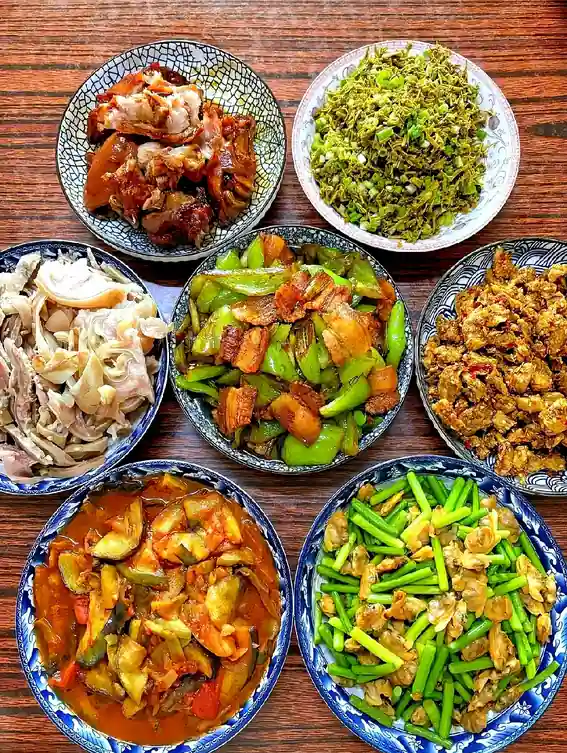
The tofu soaks up the rich, savory sauce, the pork belly is tender and luscious, the pork intestines are chewy and firm, and the meatballs have a satisfying bounce.

The ingredients for this dish are a bit fussy to prepare, but when you bring this one-pot stew to the table—rich pork belly, fragrant sausage, savory meatballs, and tofu bursting with flavorful broth—the moment it hits your mouth, you'll know every bit of effort was worth it!
Ingredients
Main Ingredients
500 g (about 1 lb) of premium pork belly
500 g (about 1 lb) ground pork
500 g (about 1 lb) pork large intestine
1 block of salt-brine tofu (firm tofu)
The pork belly should be thick-cut, and the ground pork should be about 30% fat to 70% lean for best results. For the pork intestines, use the thicker end sections if possible, and do not use gypsum (calcium sulfate) tofu—choose a softer variety instead.
Additional Ingredients
1 block of red fermented tofu (also known as red bean curd)
1 egg
Seasonings
3 star anise
4 bay leaves
20 Sichuan peppercorns
two small pieces of cinnamon bark
soy sauce 25 g (about 2 tablespoons)
30 g (about 2 tablespoons) Shaoxing rice wine
15 g rock sugar (about 1 tablespoon)
high-proof baijiu (Chinese liquor) to taste
to taste
green onions and ginger, each to taste
Red yeast rice, a small amount
Starch, as needed
Adding red yeast rice enhances the dish's color, but it can be omitted if unavailable.
Instructions
Instructions
Preparation
Step 1: Remove the fat from the pork intestines, then rub both inside and outside thoroughly with salt to clean them. Blanch in cold water for 5 minutes, then drain. Change the water and boil for another 20 minutes, then drain again. Let cool slightly before cutting into large sections and set aside (Image 2).
*To make the large intestine more flavorful, leave some of the inner fat on—it really comes down to personal preference.
When blanching the pork intestines for the first time, add scallions, ginger, and high-proof baijiu (Chinese liquor) to remove any off-putting odors—feel free to use a generous amount of liquor. During the second boiling, add only a small amount of scallions, ginger, and liquor to further eliminate any remaining odors, preventing them from affecting the other ingredients.
*Pork intestines are quite tough and take longer to become tender, so to ensure they reach the same level of doneness as the other ingredients, they need to be pre-cooked for a while—this is another reason why the intestines are boiled twice. For the second boil, you can also use a pressure cooker for 5 minutes.
Step 2: Add 1 g salt to the ground meat, crack in one egg, and mix well. Soak some scallion and ginger in water to make scallion-ginger water, mix a little cornstarch with water, then gradually add this mixture to the meat, stirring vigorously in one direction until the mixture becomes firm and springy (Image 3).
*If you season the meatballs with minced scallion and ginger before frying, there may be a few black specks; using scallion-ginger water to season the meat filling works just as well, but do not add too much water or the filling will become too loose.
*First, add the eggs and stir well, then add the starch water based on how loose the meat filling is. Use a generous amount of starch so the meatballs hold together during long simmering; if you use too little starch, the meatballs will fall apart over time.
*After adding all the seasonings, stir vigorously in one direction until the meat filling becomes very thick and elastic—this ensures the meatballs hold together and have a springy, bouncy texture.
③ Remove any remaining hairs from the pork belly skin, place it in a pot of cold water with a little scallion and ginger (Image 4), and cook over medium heat for 10 minutes until about 50-60% done. Remove and immediately brush with soy sauce while still hot; set aside.
Deep-fry
④ Pour oil into the wok and heat to around 60-70% hot (about 350-375°F). Shape the meat mixture into meatballs and carefully drop them into the oil (Image 5). Deep-fry over medium heat until the surface is set and the meatballs are about 60-70% cooked through, then remove and drain (Image 6).
⑤ Keep the oil used for frying the meatballs in the wok. Cut the tofu into large thick slices. Heat the oil until it reaches about 80% hot (around 350°F/175°C), then add the tofu and deep-fry over high heat until golden brown on the surface. Remove and set aside (Image 7).
*Add the tofu slices one at a time to prevent sticking, and during frying, wait until the surface forms a hard crust before gently separating any pieces that stick together.
⑥ After the previous step, place the soy sauce-coated pork belly into the oil used for frying the tofu. Turn the heat to high and fry briefly until the surface turns a deep reddish-brown and the skin develops small blisters. Remove (Image 8) and cut into 1.5 cm thick slices (Image 9). Set aside.
*The oil temperature for deep-frying both the tofu and pork belly is very high, which can be dangerous, so be careful to avoid burns. When adding ingredients to the oil or during frying, take precautions to prevent splattering.
Simmer until the meat is tender and the flavors have melded together.
⑦ After all ingredients are prepped (Image 10), neatly arrange the pork belly, meatballs, and pork intestines in the pot (Image 11).
Step 8: Pour in boiling water until the ingredients are just submerged. Bring to a boil, then add soy sauce, Shaoxing wine, red fermented tofu, rock sugar, and salt to taste. Add star anise, bay leaves, Sichuan peppercorns, cinnamon stick, scallions cut into sections, ginger sliced, and a small amount of red yeast rice. Once it returns to a boil, reduce the heat to the lowest setting, cover, and braise for about 2 hours.
*The final heat control is very important—use the lowest heat possible, keeping the soup at a gentle simmer so the liquid doesn't evaporate too quickly, and the ingredients absorb more flavor during this slow braising process. Add just enough water to barely cover the ingredients; too much water will make the dish taste bland.
Step 9: About 30 minutes before the dish is finished, add the fried tofu and let it braise together.
*Tofu is delicate and will turn mushy if cooked for 2 hours, losing all texture; it also absorbs liquid quickly and can dry out the broth, so it must be added only during the last half hour of cooking.
*In the last half hour, you can turn up the heat slightly to reduce the sauce and intensify the flavors. During the braising process, you can add a few hard-boiled eggs, similar to marinated eggs.
A clever shortcut for lazy cooks.
You can pan-fry the tofu, the pork belly skin, and even the meatballs—doesn't that save a lot of trouble? However, the result won't be as good as deep-frying, and there will be a lot of oil splatter. So, the choice is yours: deep-fry or clean the range hood?
