Pinyin: Zirantong
Aliases
Shisuikuan, Fangkuaikuai.
Source
Sulfide mineral pyrite from the pyrite group of the pyrite family.
Distribution
Produced in Liaoning, Hebei, Jiangsu, Anhui, Hubei, Hunan, Guangdong, Sichuan, Yunnan, and other regions.
Harvesting and Processing
After harvesting, remove any miscellaneous stones.
Medicinal Properties
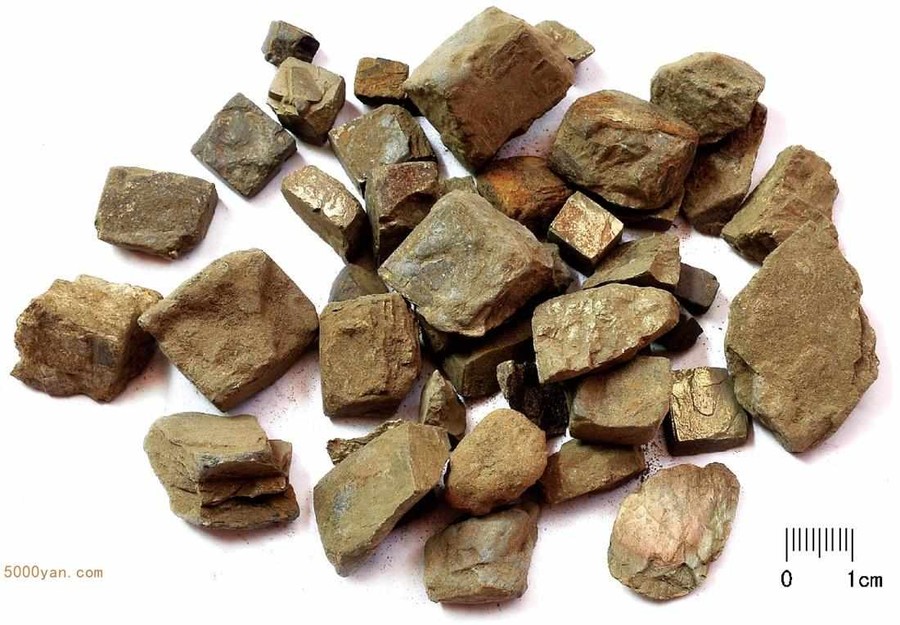
This aggregate forms dense masses. The surface is bright pale yellow with a metallic luster; some are yellow-brown or brown. Without a metallic luster, it has stripes, and the streak is green-black or brown-red. It is heavy, hard or slightly brittle, easily broken, with a yellow-white fracture and metallic luster; or a brown fracture with visible silvery-white bright spots.
Chemical Constituents
The main component is iron disulfide (Fe).2S).
Pharmacology
Has the effect of promoting fracture healing and antifungal activity.
Properties and Channel Entry
Acrid, neutral. Enters the Liver channel.
Functions and Indications
Disperses stasis and alleviates pain, reunites tendons and connects bones. Used for traumatic injuries, tendon and bone fractures, and bruising with swelling and pain.
Dosage and Administration
Oral administration: decoct in water, 10-15 g; or in powder form, 0.3 g per dose. External application: appropriate amount, grind into powder and apply with a suitable medium.
Precautions and Contraindications
Yin deficiency with effulgent fire. Those with blood deficiency and no stasis are prohibited from taking.
Prescriptions
1. For traumatic injuries: Zirantong (pyrite, ground extremely fine, refined by water) together with Danggui (Chinese angelica) and Moyao (myrrh), each 1.5 g. Take with wine in divided doses, and also use the dry powder to rub on the painful area. (Ben Cao Yan Yi) 2. For fractures from falls or blows: Zirantong (calcined until red-hot, quenched in vinegar seven times, then buried in damp soil for over a month before use), Ruxiang (frankincense), Moyao (myrrh), Danggui Shen (Chinese angelica root body), and Qianghuo (notopterygium root), equal parts. Grind into a powder. Take 6 g per dose, mixed with strong wine, twice daily. (Zhang Shi Yi Tong - Zirantong San) 3. For heart pain: Zirantong calcined by fire, quenched in vinegar nine times, then ground into powder. For each pain episode, take a small pinch (about 0.5 g) mixed with vinegar. (Wei Sheng Yi Jian Fang) 4. For goiter below the neck (qi goiter): Place Zirantong in a water jar, and use this water for daily drinking and cooking. The goiter will naturally subside. Alternatively, one can also inhale the smoke from burning Zirantong over a long period. (Zhi Zhi Fang) 5. For all kinds of malignant sores, burns, and scalds: Zirantong and Mituoseng (litharge), each 30 g (both calcined and ground), Gancao (licorice) and Huangbai (Phellodendron bark), each 60 g (both ground into powder). Grind the above four ingredients together into a fine powder, store in a sealed container. Apply with water as a paste or apply dry powder to the affected area. (Sheng Ji Zong Lu - Zirantong San) 6. For stick wounds (from flogging): Zirantong (quenched in vinegar seven times) 15 g, Ruxiang and Moyao each 9 g, Huixiang (fennel) 12 g, Danggui 15 g. Grind the above into a fine powder. Take 15 g per dose, mixed with warm wine. (Zheng Zhi Zhun Sheng - Ruxiang San) 7. For summer-dampness paralysis with inability to move limbs: Zirantong (burned red-hot, soaked in wine overnight), Chuanwutou (processed Sichuan aconite root), Wulingzhi (flying squirrel feces), Cangzhu (Atractylodes rhizome, soaked in wine), each 30 g, and Danggui (soaked in wine) 6 g. Grind into powder, form into pills with wine-paste, each pill the size of a Chinese parasol seed. Take 7 pills with wine; stop if numbness in the limbs is felt. (Gang Mu, quoting Lu Shi Ji De Tang Fang)