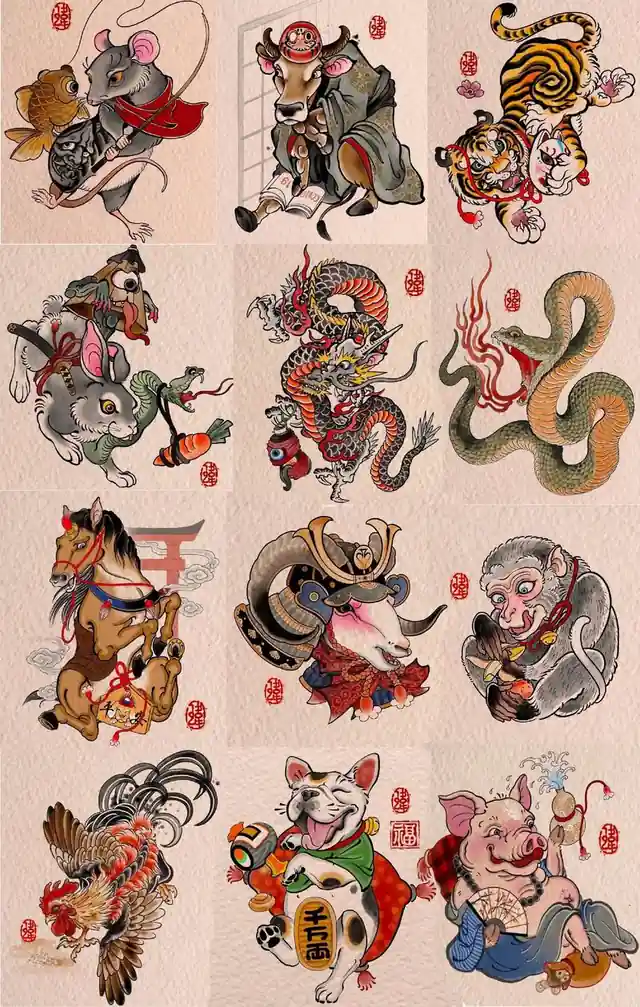
Among the twelve zodiac animals, the Monkey is the one most similar to humans. Whether in numerous mythological stories or from a scientific perspective, the Monkey is inextricably linked to humanity. The belief that human ancestors evolved from monkeys has become a widely accepted notion.
Among the twelve zodiac animals, why was the monkey chosen? It is likely because humans see their own reflection in monkeys: a facial appearance similar to humans, a clever and agile mind, and strong reproductive abilities. Today, humans have long distinguished themselves from other animals, yet the monkey still maintains its original state, which precisely reflects a unique human tendency toward regression, and the belief that "humans evolved from monkeys" remains a common perception. In many Chinese myths and legends, there are also various tales of "monkeys as human ancestors."
According to folklore, monkeys gave birth to humans.
In the Chengdu region of Sichuan in southern China, there is a legend that incorporates monkeys into the myth of Pangu's creation of the world: at the very beginning of Pangu's creation, humans did not yet exist, and the earth was ruled by monkeys. Later, a pair of hairless siblings appeared among the monkeys, the elder brother named Fuxi and the younger sister named Nüwa. Pangu saw hope in them, summoned the siblings, and commanded them to marry. Thus, they became the ancestors of humanity.
In the vast regions of China inhabited by the Han ethnic group, traces of ancient ancestors' reverence and worship of monkeys still remain. The most typical example is at the Huaiyang temple fair in the second lunar month, where a large number of clay toys called "Ren Zu Hou" (Ancestral Monkey) are sold. These "Ren Zu Hou" figurines are shaped like deities, wearing crowns and appearing solemn and dignified. The lower parts of the monkey bodies are all painted with female reproductive symbols, and they are revered by locals as idols of human ancestors.
In China, there are still some ethnic minorities that revere the monkey as their ancestral deity and maintain corresponding traditional customs such as prohibitions on hunting and eating monkeys, as well as festival sacrifices. Tibet, historically known as Tubo in ancient times, had its early inhabitants who regarded the monkey as their ancestral totem. According to the "Tang Shu" (Book of Tang) and the "Zizhi Tongjian" (Comprehensive Mirror for Aid in Government), it is recorded that the ancient Tubo people had a custom of "tattooing monkey faces on their bodies."
The Tibetan ancient text "Xizang Wang Tong Ji" (Record of the Kings of Tibet) contains a myth about their ancestors being transformed from macaques. To this day, the "Tiaoshen" (exorcism dance) ceremony, held during grand celebrations by the Tibetan people, still preserves a dance where performers wear a Monkey King mask.
The Yi ethnic group in southwestern China also has a monkey-worshipping clan called "Anupu," while the Lisu people have a monkey-worshipping clan known as "Mipa." The Nu people, who live along the upper reaches of the Lancang River and Nujiang River in Yunnan, also revere monkeys and are called "Douhuasu." The Kemu people residing in Xishuangbanna and Jinghong counties in Yunnan all worship monkeys and strictly forbid capturing or eating them. The Yao people in Nandan County, Guangxi, refer to their ancestral mother as "Mother Monkey." Additionally, the Tujia and Qiang ethnic groups also have monkey-worshipping clans.
Monkey Transforms into Human
The Yi ethnic group's creation epic "Men Mi Jian Za Jie" (The Book of Origins) records that in the beginning, there were no humans in the world, only monkeys. Through long-term practice, monkeys gradually learned what was edible and what was not, and also mastered the use of fire, eating cooked food, making clothes, and cultivating crops, thus transforming into humans. In Qiang ethnic mythology, it is said that monkeys were created by heaven, with their bodies covered in fur. They were extremely intelligent, capable of making bows and arrows, and possessed great strength, causing the beasts of the forest to fear them and conspire to eat them. Heaven stopped them, saying that the flesh of monkey-humans could not be eaten, only their fur could be plucked as punishment. Another legend holds that in ancient times, a great fire occurred, and the monkey-humans' fur was burned off in the blaze, thus transforming them into humans.
The Monkey teaches people.
According to the Tibetan legend "Gong Gong and Ri Mayi," the earth experienced a great flood in its primordial times. After the flood, only one mountain remained on the earth, and on that mountain lived a female monkey. One day, a crack opened in a stone, and two girls burst forth: one named Gong Gong and the other named Ri Mayi. The female monkey dug "life fruits" from the mountain to feed them and cared for them like a mother. One day, while the female monkey was out gathering life fruits, a demon summoned a strong wind that blew Gong Gong, Ri Mayi, and even the stones into the sky. When the female monkey returned and found Gong Gong and Ri Mayi missing, she died of grief. However, Gong Gong and Ri Mayi survived, and from then on, human footprints appeared on the earth.
The monkey resembles humans.
The female progenitor of the Shang Dynasty was "You Rong Shi Jian Di," where "Rong" refers to the golden monkey. Jian Di married Kui, a type of ape. The son of Kui and Jian Di was named Qi, which means baboon. In the Shennongjia and Wushan regions, there is a legend of the "Mountain Ghost," which is essentially a mountain ape. The "Nine Songs" in "The Songs of Chu" (Chuci) mentions the "Mountain Ghost," which ancient annotations interpreted as a demon or monster. Wang Fuzhi, an outstanding thinker of the late Ming and early Qing dynasties, also regarded it as an ape in his "Comprehensive Explanation of The Songs of Chu" (Chuci Tongshi). Lin Yunming of the Qing Dynasty wrote in "The Lamp of The Songs of Chu" (Chuci Deng): "The Mountain Ghost is the same kind as the 'mountain Kui' mentioned in 'Zhuangzi,' commonly known as the mountain spirit (Shanxiao)." Shanxiao is sometimes considered a demon and sometimes a monkey. Wang Kaiyun of the Qing Dynasty stated in "Explanation of The Songs of Chu" (Chuci Shi): "Ghost refers to the distant ancestor..."
Although these are merely mythological stories or legendary tales, they precisely reflect the most primitive thoughts of ancient ancestors about the beginning of humanity. In people's perception, the Monkey is closely linked to human ancestors. Of course, in the scientific realm, there is also a certain kinship between monkeys and humans. The publication of "On the Origin of Species" by Western scholar Charles Darwin is the best evidence that humans evolved from apes (monkeys).
Further Reading
Kuafu was actually in the form of a monkey.
"Kuafu Chases the Sun" is a very famous mythological story in China, but what did Kuafu actually look like? According to the "Classic of Mountains and Seas, Western Mountains, Third Section" (Shanhaijing), it is recorded: "There is a beast, its form resembles that of a yu (a mythical creature) with patterned arms, a leopard's tail, and is skilled at throwing; it is called Jufu." In ancient times, the characters "ju" and "kua" had similar pronunciations, so "Jufu" was also written as "Kuafu," and it is also said that his appearance resembled a "yu" (which refers to a macaque). From this, it can be seen that Kuafu is an image of a divine monkey. Jinghe Town in Gansu Province was originally Kuafu's dwelling place, and a paper-cut passed down through generations called "Kuafu with the Fusang Tree of Taodu" (Kuafu Taodu Fusang Tu) depicts Kuafu standing on a tree trunk derived from an eight-fold gnomon (a type of sundial), holding peach branches with both hands. The tree is covered with flat peaches (pantao), which a group of monkeys are picking and eating. Beneath the tree, a mastiff dog lies in wait, a monkey climbs up the trunk on the dog's back, and at the top of the tree, there are four more monkeys, totaling twelve animals. This is a relic of the descendants of Kuafu's clan worshipping their ancestor, and it also serves as strong evidence for Kuafu being in the form of a monkey.