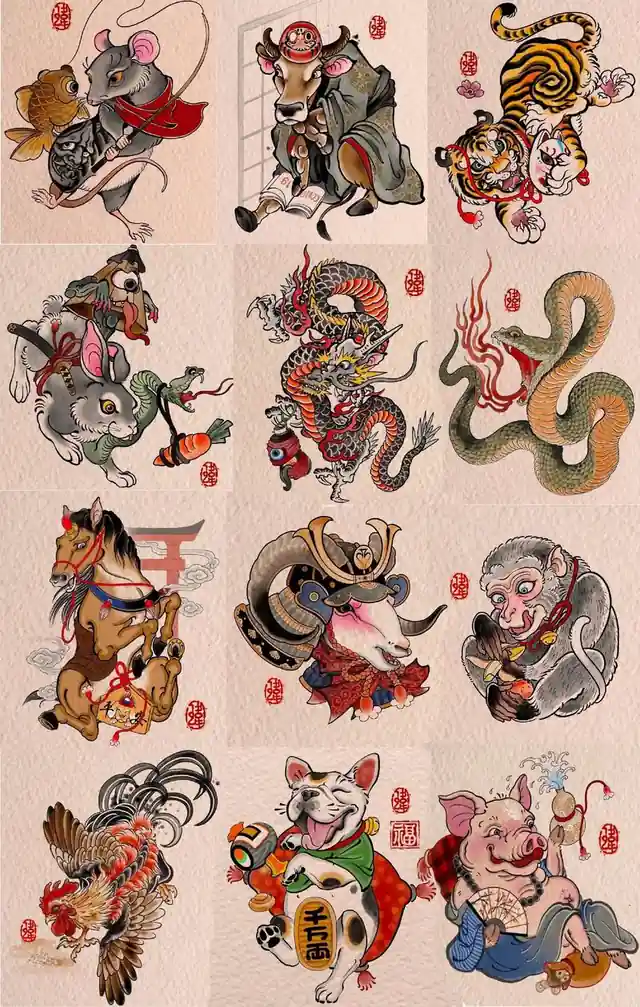
The ancients regarded the monkey as an ancestor of humanity because monkeys share many similarities with humans. Monkeys exhibit numerous human-like traits, which is one of the reasons people hold them in high esteem. The human-like nature of the monkey further expands and extends the culture of the Monkey zodiac sign.
In the ancient calendar, the month of Jian Yin (first month with the Yin Earthly Branch) was designated as the beginning of the year, the second month as Jian Mao, the third as Jian Chen, the fourth as Jian Si, the fifth as Jian Wu, the sixth as Jian Wei, and the seventh as Jian Shen, with Shen corresponding to the Monkey in the twelve zodiac animals. From this perspective, being born in the Year of the Monkey does not seem particularly special. However, in ancient times, the "Shen Day" was also known as "Ren Day" (Human Day), also called "Ren Festival" or "Human Birthday." This is recorded in the "Zhan Shu" (Book of Divination) by Dongfang Shuo of the Han Dynasty (206 BCE - 220 CE): "The eight days after the New Year: the first day is for the Rooster, the second for the Dog, the third for the Pig, the fourth for the Goat, the fifth for the Ox, the sixth for the Horse, the seventh for Humans, and the eighth for Grains." Not choosing the sixth or eighth day but specifically the seventh day is no mere coincidence in relation to the Monkey. Perhaps, from the very beginning in people's conceptions, the Monkey has possessed a human-like nature.
Maternal love
Like humans, monkeys are mammals. After birth, baby monkeys receive very meticulous care from their mothers. This is especially true for golden snub-nosed monkeys, where any mother with a baby will compete to hold and even nurse it. If danger arises, the mother monkey will hide her infant under her armpit or carry it on her back to escape quickly. If caught by a hunter, the mother monkey will cry out in a wailing sound and squeeze her teats to show she has a baby. If the hunter still does not release them, she will feed her baby until it is full, place it safely, and then step forward to surrender herself willingly. This shows that monkeys, like humans, possess the greatest maternal love in the world.
Family values
After birth, a young monkey receives not only meticulous care from its mother but also affection and attention from slightly older juvenile monkeys. When a mother monkey dies, her offspring experience profound grief, and there is even a risk that they may die from excessive sorrow. If the young monkey is still unable to live independently at this time, other monkeys within the same peer group will take on the responsibility of raising it. Monkeys are also social animals, organized into matrilineal family units based on blood ties. After reaching maturity, males typically leave their birth group to join another group. The hierarchy within a group is also very clear, with the oldest and most experienced individual usually serving as the leader, and the ranking descends by age from there.
Filial piety
Monkeys, like humans, also possess filial piety. According to legend, during the Three Kingdoms period (220-280), Wei general Deng Ai was passing through Fuling when he spotted a golden snub-nosed monkey holding its young in a tree. He drew his bow and shot an arrow, hitting the mother monkey. To his astonishment, the infant monkey immediately pulled out the arrow from its mother's wound, plucked a leaf, and stuffed it into the injury. Deng Ai sighed deeply and swore never to hunt monkeys again.
When a monkey dies, especially one of higher status within the group, family members will cry while burying the body. They typically bury only the monkey's torso, leaving the tail exposed above ground, and then squat around it to observe quietly. If the wind blows and causes the dead monkey's tail to sway, the other monkeys believe it has come back to life. They joyfully dig out the corpse, fuss over it for a while, but when they see it still does not move, they lift it up again and bury it in a different place.
Collective consciousness
Monkeys have a strong sense of group solidarity and will unite against a common enemy when encountering a threat. An incident occurred in the Dai ethnic region of Yunnan Province: a farmer's dog killed a young monkey that was stealing fruit. That night, nearly a hundred monkeys surrounded the farmer's orchard, destroying fruit trees and pulling up vegetables to vent their anger. They even rushed into the dog pen and attacked the watchdog. Only when nearby villagers arrived upon hearing the commotion did the monkey group scatter in all directions.
In fact, records of this can be traced back to the Tang Dynasty (618-907). During the Dali reign period (766-779), there was a fir forest near a village in Gutian County, Fujian Province, where hundreds of monkeys lived. The villagers disliked having monkeys as neighbors and planned to cut down the trees and kill the monkeys. As the monkeys were surrounded, they jumped around in panic and screamed in terror. Suddenly, an old monkey fearlessly rushed out of the crowd, dashed straight into the village, and used fire from a stove to set the houses ablaze. Just as the villagers were about to encircle and kill the monkeys, they saw thick smoke billowing from the village and abandoned the monkeys to rush back and extinguish the fire.
The monkeys narrowly escaped danger and fled to other places to seek new homes. It is evident that it is precisely because of these "human qualities" inherent in monkeys that they were able to evolve into humans, gradually breaking away from the animal kingdom to become the primates of all creatures and the creators of civilization.
Further Reading
The Monkey in "Journey to the West"
Wu Cheng'en, the author of Journey to the West, inherited the national tradition of Wei-Jin Dynasty (220-420) zhi-guai (records of anomalies) novels, which excelled at depicting ghosts and monsters, as well as the legendary writing style of Tang Dynasty (618-907) chuan-qi (marvel tales) novels. He merged these two traditions to form an artistic characteristic that combines the divine, the beastly, and the human in his artistic images. In the portrayal of Sun Wukong (the Monkey King), the divine abilities, human thoughts and emotions, and the beastly appearance and movements are perfectly integrated. His depiction of Sun Wukong's immense magical powers, including the ability to perform seventy-two transformations and being as formidable as Erlang Shen (a deity in the heavenly court), represents the divine aspect of Sun Wukong. His description of Sun Wukong's appearance, featuring a hairy face, a thunder-god beak, bowlegs, and a limping gait, all embody the traits of a monkey. His love for activity, fondness for eating peaches, agility, and even the difficulty of handling his monkey tail during the seventy-two transformations, all remain true to the monkey's nature. Sun Wukong is naturally competitive, values his reputation, and enjoys being flattered. He has a strong sense of justice and abhors evil as if it were his enemy—these are all aspects of his human nature.