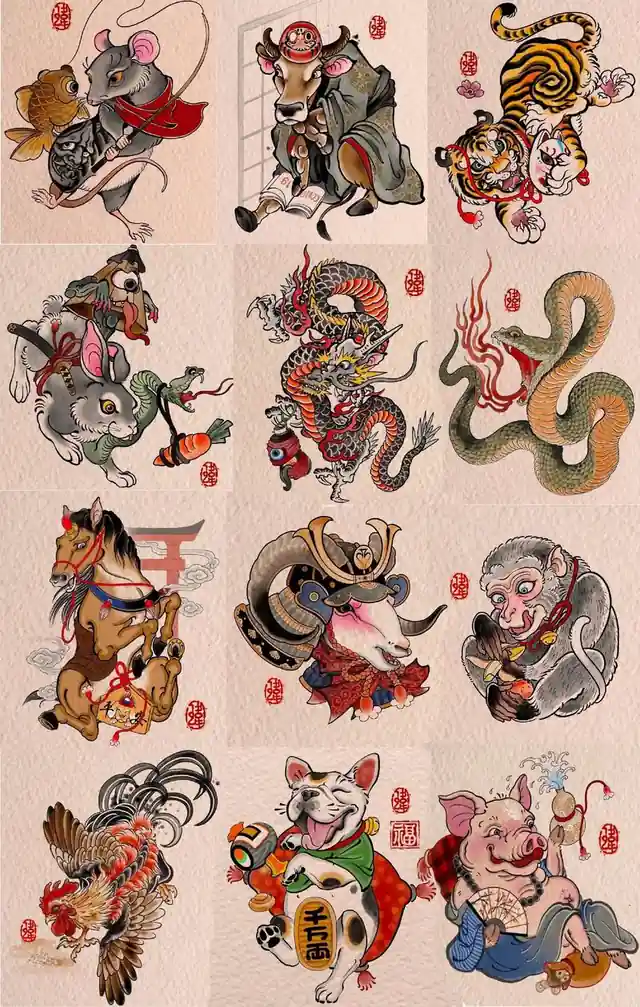
Monkeys are very close to humans in both appearance and habits. People born in the Year of the Monkey are intelligent and quick-witted, and monkeys are skilled at imitating human actions. Therefore, humans have taken advantage of this trait to train monkeys to perform tricks. Monkey shows, as a unique folk custom within the culture of the Monkey zodiac sign, have a very long history.
Having monkeys wear clothes and hats while mimicking human movements in performances is the traditional folk acrobatics known as monkey shows. China has a long history of training monkeys for performance, dating back as early as the Han Dynasty. A Han Dynasty stone relief unearthed in Jining, Shandong, depicts a trained monkey dancing and leaping about with great gentleness, indicating that monkey training had already reached a remarkably advanced level.
During the Southern Dynasties' Chen period (557-589), the "Hundred Entertainments" (Baixi, a variety of acrobatic and theatrical performances) included an act called "Tossing and Falling Like a Monkey." Chen Zongshi (a member of the imperial clan) and Prince of Xing, Chen Shuling, enjoyed performing the "Mu Monkey" (monkey-washing) entertainment, which was essentially a monkey show. During the Tang Dynasty (618-907), monkey performances remained one of the imperial court's Baixi acts. Zheng Xi of the Tang Dynasty wrote in his poem "Ode to Watching All Beasts Dance at Hanyuan Hall on the First Day of the First Month": "Neither bear nor bear, but ape and Di (a type of primate)," indicating that monkey shows were included. Among folk Baixi, there were also monkey performances, known as "Playing with the Huhsun" (a colloquial term for macaque monkeys).
During the Tang Dynasty (618-907), there were also examples of trained monkey performers gaining favor and receiving official titles. According to Bi Zhongxun's Song Dynasty (960-1279) work "Mufu Yanwen Lu" (Records of Hearings in the Governor's Office): "When Emperor Zhaozong of Tang was forced to flee the capital, the only entertainer accompanying his entourage was a monkey trainer. The monkey was remarkably well-trained and could follow the court rituals. Emperor Zhaozong bestowed upon it a purple robe and titled it 'Sun Gongfeng' (Attendant Sun). Because the monkey trainer had been granted a crimson robe for his meritorious performance, Sun Gongfeng's trained monkey was able to fully fulfill its ministerial duties."
During the Later Shu Kingdom, the training level of monkey performances was exceptionally high and astonishing. The performer Yang Yudu was particularly vivid in his monkey acts. According to "Taiping Guangji (Extensive Records of the Taiping Era)," Volume 466, which quotes "Yeren Xianyu (Casual Words of a Rustic)," it says: "In Shu, there was a man named Yang Yudu who was skilled at putting on monkey shows in the streets, begging for alms from people. He often kept more than ten large and small monkeys, which could understand human speech. Sometimes they would ride dogs and act as attendants of a military officer, with guards shouting in front and behind. The monkeys would hold whips, drive forward, wear hats and boots, providing momentary amusement. When performing a drunk person, the monkey would inevitably fall down and lie on the ground, and even after being helped up for a long time, it would not get up. Yang would sing out: 'The street commissioner is coming!' The monkey still would not get up. 'The imperial censor is coming!' It still would not get up. But if he whispered, 'Marquis Shi is coming!' the monkey would immediately get up, looking around with wide eyes and pretending to be terrified, making everyone laugh..." This monkey performance was truly marvelous. Marquis Shi refers to Hou Hongshi, who held a high official position, wielded immense power and influence, and was feared by all.
In "Fansheng Lu" (Records of Prosperity) by the Old Man of West Lake in the Song Dynasty, among the various street performers' acts, there is a mention of "Douye Husun" (playing cards with monkeys), which refers to monkeys performing card games. Tamed monkeys also performed "Baixi" (a hundred entertainments), imitating the acrobatic somersaults of folk performers. Monkey performances became popular during the Ming and Qing Dynasties. Ming Dynasty scholar Li Rihua's "Zitaoxuan Zazhui" (Miscellaneous Notes from the Purple Peach Studio) records "the skill of macaque monkeys imitating dog acts." "Cixue" (Remarks on Lyric Poetry) contains a piece titled "Nonghuang Huangying'er" (A Yellow Oriole Taming a Monkey) describing the street monkey shows of the time: "All day long through the long streets, how can one endure the big leather whip! Learning tricks to sell before the crowd. Once sold, applause for success, donning masks from the box in turn. Shaking the gong, the neighborhood stirs, children and adults clamor noisily."
Monkey-themed performances were a common subject in New Year paintings of the Qing Dynasty. In the Hebei Wuqiang New Year painting "Monkey Acrobatics," seventeen monkeys are depicted performing acrobatic feats such as climbing a ladder of knives, walking a tightrope, doing handstands, and horse racing amidst the sounds of gongs and drums. Among them, the monkey walking the tightrope wears theatrical costumes, portraying Yingying, Zhang Sheng, and Hongniang from the story "The Western Chamber" in the scene "Farewell at the Pavilion," which, with the monkeys mimicking human behavior, is even more amusing. The Shaanxi Fengxiang New Year painting "Each Showing Its Skill" features twenty monkeys performing various acrobatics, making viewers unable to suppress their laughter. The Shandong Weixian New Year painting "Monkey Riding a Goat" shows two female performers, one beating a gong and the other playing a drum, putting on a monkey show; a monkey stands on one foot on the goat's back, holding up two peaches in a pose resembling Kuixing (the star god of literature) pointing at the dipper, while two others watch leisurely. According to the "Yanjing Suishiji" (Records of the Seasons of Yanjing), "The monkey performer keeps feathered hats and black gauze caps in a wooden box. The monkey opens the box with its own hands, puts on the hat, and sits down, looking exactly like an official in a yamen (government office)." In folk performing arts and acrobatics, there is a program called "Carrying the Box," where two people carry a wooden pole on which sits a clown official, who constantly cracks jokes to amuse the audience. This gave rise to performances using monkeys to replace humans. The Hebei Wuqiang New Year painting "Monkey Official" imitates the "Carrying the Box" program, depicting four monkeys wearing summer hats and vests: two carry a monkey official in front, one holds a long-stemmed tobacco pipe, another raises an umbrella canopy, and the monkey official is dressed in official robes. Another painting, "Carrying the Box Official," has similar content to "Monkey Official," with four monkeys all dressed in Qing Dynasty attire; two carry a monkey official in official robes, one leads the way with a gong and a banner reading "Prohibit Gambling," satirizing that officials only mimic their masters' actions, implying that the ban on gambling is nothing more than a monkey show. Using monkey performances as a metaphor for social ills, this carries a strong sense of satire.
Further Reading
Fengyang Monkey Performance
The Qing dynasty scholar Gu Lu recorded in his "Qing Jia Lu" (Records of Pure Festivals) that at the Suzhou Xuanmiao Temple during the New Year, variety performances included: "People from Fengyang raised monkeys, making them wear hats and belts, and also kept dogs as mounts for the monkeys. They could perform scenes from 'The Mill' and 'Three Battles,' commonly known as 'acrobatics.'" The monkeys trained by the people of Fengyang could actually imitate opera performances, demonstrating their remarkably high level of skill. Fengyang's monkey shows were the most famous at the time, as recorded in "Qing Bai Lei Chao" (Classified Anecdotes of the Qing Dynasty): A man named Han Zi from Fengyang was particularly skilled at monkey shows, keeping over a dozen monkeys of various sizes, all without ropes or leashes. "Whenever a play was performed, the roles of sheng, dan, jing, and chou (male, female, painted-face, and clown roles), the gong and drum players, and those running back and forth—all were monkeys, each perfectly in place, and none ran away." From beating gongs and drums to playing all the opera roles, the monkeys performed in an orderly and spectacular fashion, forming a veritable monkey opera troupe. The Qing scholar Li Diaoyuan wrote in his "Nong Pu Bai Yong·Monkey Show" (One Hundred Poems on Variety Shows: The Monkey Show): "Wearing red robes and dancing in a clumsy way, in a former life they must have served as court entertainers. Yet with a mask on, they still put it on themselves, not realizing they are merely monkeys in human attire."