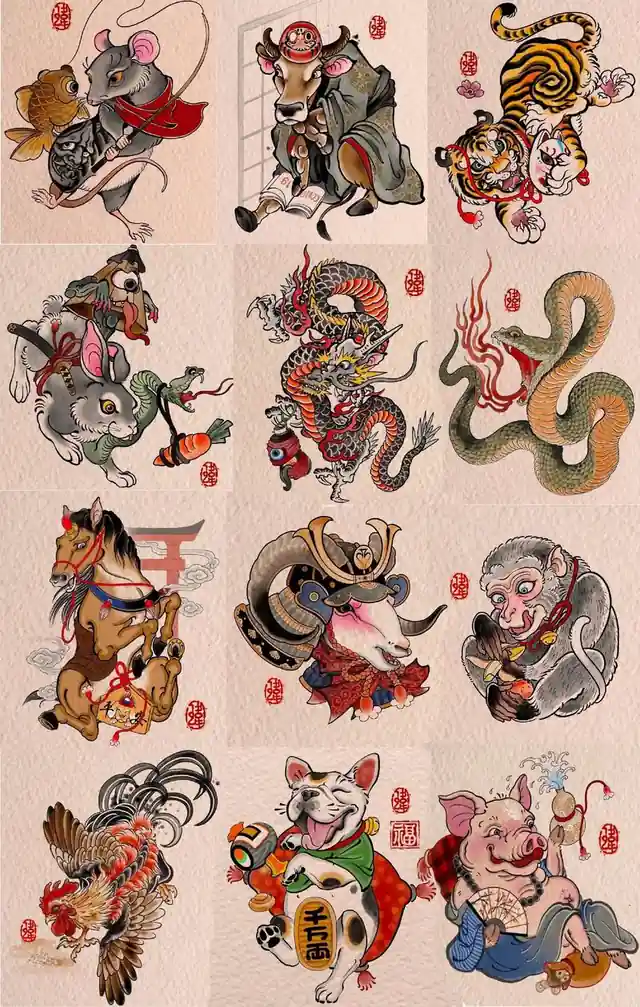
The zodiac sign of the Monkey not only shares a close biological kinship with humans but also captivates people with its lively and endearing image. Through long-term cultural development, the Monkey has transcended its original animal form and become integrated with human culture, endowing it with rich symbolic meanings.
Although the monkey does not belong to the category of domestic animals and does not significantly impact people's production and daily life, it is regarded as the primordial ancestor of human evolution, intricately linked to the origin of humanity. Today, after long-term development, the culture of the Monkey zodiac sign has already permeated all aspects of people's lives, and the image of the Monkey zodiac has gained richer symbolic meanings through this evolution.
People born in the Year of the Monkey are considered symbols of mischief and intelligence. Monkeys are primates, and at the mere mention of them, people think of words like alert and agile, lively and dexterous, comical and adorable, clever and mischievous. The phrase "as sharp as a monkey" has become a common saying, as if monkeys have long been synonymous with naughtiness and intelligence. In the Mount Emei region of Sichuan, China, monkeys often hide in roadside bushes, waiting for tourists to approach before swooping down to block the path and beg for food. Some monkeys even know how to ask travelers for money, smiling in gratitude upon receiving it, then heading to a food stall to buy pastries and fruits, leaving satisfied after obtaining their treats. Even more interestingly, monkeys in the Three Gorges area of the Yangtze River know how to eat sesame seeds: when the sesame is nearly ripe, farmers first bundle it and stack it in the fields, and monkeys will take advantage of the farmers' absence to sneak into the fields. At that point, a large monkey lies flat on its back on the ground, while other monkeys carry over the bundled sesame and beat it against the large monkey's body, causing the seeds to fall onto its belly. Then the group lifts the large monkey onto a flat rock, where it flips over, scattering the seeds onto the stone. The monkeys then form a circle and enjoy the fruits of their labor. With such intelligence, even humans cannot help but admire them.
The Monkey zodiac sign symbolizes the title of marquis (a high-ranking noble position in ancient China).
"Marquis" (hou) was one of the noble titles in ancient China. According to the "Book of Rites: King's Institutions" (Liji Wangzhi), it is recorded: "The king's system of salaries and titles consists of five ranks: Duke, Marquis, Earl, Viscount, and Baron." Although the systems of granting titles varied across different dynasties, the rank of Marquis was generally present in most of them. As a symbol of wealth, honor, and dignity, people universally aspired to be promoted and enfeoffed as Marquis. Because the Chinese character for "monkey" (hou) is a homophone for "marquis" (hou), people naturally chose the monkey as the symbol of the marquis title, which brought the monkey considerable prominence.
The traditional auspicious pattern "Feng Hou Gua Yin" (Bestowed Marquisate and Official Seal) consists of a monkey, maple tree, bee, and official seal, where the seal represents the official stamp of a government position, "maple" and "bee" phonetically suggest "bestow," and "monkey" refers to "marquis." Feng Hou Gua Yin means the emperor bestows a title and seal upon a subject, symbolizing promotion to higher rank. Additionally, there is the pattern "Ma Shang Feng Hou" (Immediate Marquisate), featuring a monkey riding on a horse. "Ma Shang Feng Hou" signifies an imminent conferment of nobility and high official position, implying that fame, fortune, and high status are just around the corner. Another pattern is "Bei Bei Feng Hou" (Marquisate for Generations), which shows an old monkey sitting on a pine tree carrying a young monkey on its back, or a small monkey riding on the neck of an older monkey. "Monkey" is a homophone for "marquis," and "back" for "generation," with the two monkeys also representing two generations, symbolizing successive generations of prominent and powerful nobility. In folk culture, there is also the New Year painting "Yuan Hou Tuo Yin" (Ape Holding the Seal), which depicts a monkey performing various actions such as holding a seal, catching a bee, picking a peach, and climbing a tree, set against blooming peonies, representing wishes for wealth, honor, longevity, and abundant harvests.
The Monkey zodiac sign is a symbol of the maternal body.
In the realm of humanity's primordial consciousness, apes and monkeys seem to be the ancestors or maternal origin of humans. Perhaps it is precisely for this reason that people feel the cries of monkeys at sunset resemble a loving mother's call to her children.
In ancient rock paintings and Neolithic painted pottery, there is a pattern and motif of raised arms and spread legs, and similar movements can be seen in the dances of modern southwestern ethnic minorities. Experts believe that this form of pattern and movement contains the meaning of praying for reproduction, representing the ancient people's desire to increase their population, and symbolizing a mother giving birth to life. This image is precisely that of an ape or monkey spreading its arms, which also aligns with the purpose behind the ancients' creation of the zodiac, clarifying the intrinsic connection between return and rebirth.
Further Reading
The Monkey zodiac sign cleverly repels enemy troops.
In the book "Wanli Ye Huo Bian (Unofficial Gleanings from the Wanli Era)" written by Shen Defu of the Ming Dynasty (1368-1644), a curious event is recorded: During the Jiajing period of the Ming Dynasty (1522-1566), Japanese pirates (Wokou) often landed and harassed the southeastern coast of China. After the patriotic general Qi Jiguang was transferred to serve as Assistant Regional Commander of Zhejiang, he reorganized his troops and prepared to fight against the pirates. His soldiers practiced a technique called "shooting the crow-barbed fire-rat" (a type of firearm) in the mountains. Unexpectedly, the monkeys in the forest observed this so often that they also learned the skill. One day, when the Japanese pirates launched a large-scale invasion, Qi Jiguang, seeing that his forces were insufficient and outnumbered, ordered his soldiers to scatter some firearms on the mountain path to lure the enemy deeper into the area. The pirates indeed followed the trail into the mountains. However, the firearms were picked up by a troop of monkeys. Seeing the Japanese pirates with disheveled hair and bare feet, the monkeys mistook them for strange creatures and launched an attack using the self-taught "crow-barbed fire-rat" technique. Taking advantage of the monkey assault, Qi Jiguang's army ambushed the pirates and achieved a great victory.