
With external threats stabilized and national policies established, Qin Shi Huang began to worry about how to govern his vast empire. Prime Minister Wang Wan, leading a group of ministers and officials, requested that the emperor adopt the Western Zhou's feudal system by sending several princes to rule over regions like Yan, Wei, Zhao, and Qi. Wang Wan believed this would strengthen Qin's rule, as the empire had only recently been unified and its foundation was still shaky. However, one person stepped forward to oppose this idea: Li Si. Li Si argued that the root cause of the wars among the feudal states during the Spring and Autumn period was the feudal system itself. To secure lasting rule, the emperor must hold absolute power; if Qin continued to follow the feudal system, it would inevitably lead to chaos and conflict once again.
Emperor Qin Shi Huang strongly agreed with Li Si's views, using the commandery-county system to govern the state and appointing Li Si as his Prime Minister. In 214 BC, Qin Shi Huang launched a military campaign into Lingnan (present-day Guangdong and Guangxi), then sent General Meng Tian northward to drive out the Xiongnu nomads. By this time, the Qin Dynasty had a total of forty commanderies, all under the direct control of Emperor Qin Shi Huang.
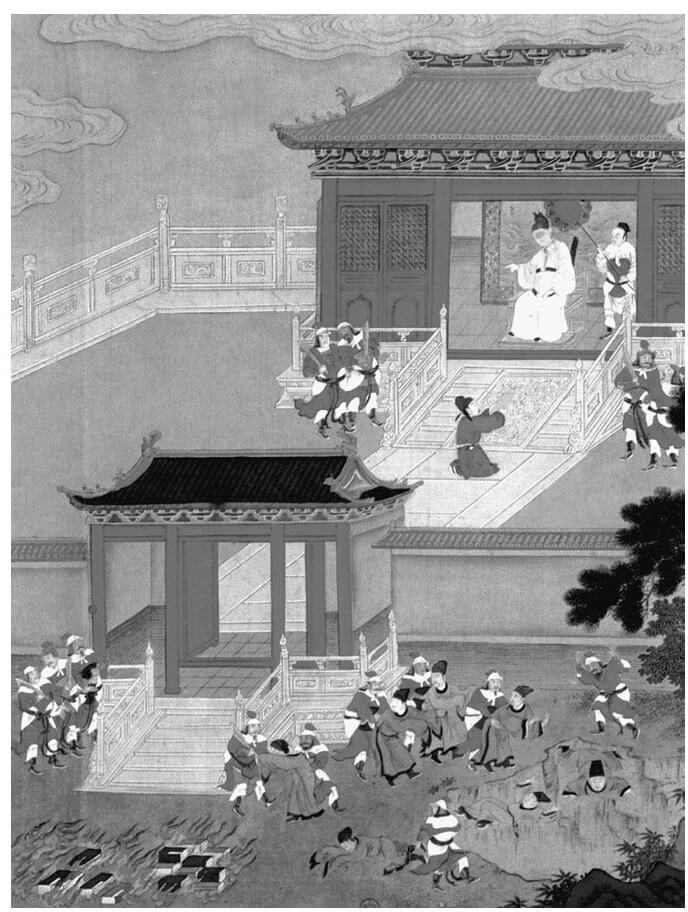
In the thirty-fourth year of the First Emperor's reign (213 BCE), the eighth year since the establishment of the Qin Dynasty, the First Emperor held a grand court banquet at Xianyang Palace. Court official Chunyu Yue presented his governance policy during the banquet, requesting that the First Emperor abolish the existing "commandery-county system" and reinstate the enfeoffment system, arguing that only this could truly strengthen the Qin state. He further cited examples, stating that any state should handle affairs based on the experiences of the ancients, and that no one had ever heard of anyone who defied the teachings of their ancestors and still endured for long. The First Emperor neither expressed approval nor opposition but instead relayed Chunyu Yue's proposal to the assembled ministers, wanting to hear their views on the matter. Li Si firmly disagreed with Chunyu Yue's argument, contending that scholars should not use outdated ideas to constrain a brand-new state, and that the erroneous thoughts of the ancients would lead the state to decline and ruin. Li Si requested that the First Emperor strictly control the people's thoughts, warning that if left unchecked, it would eventually lead to great disaster. The First Emperor then asked Li Si for a better approach, and Li Si thus proposed several suggestions.
First, all historical records of other states except for the Qin Records were to be burned, and the Poetry, Documents, and similar books in private households were also to be handed over and burned, with only medical, divination, and agricultural texts spared. If anyone failed to surrender all their books within a month, once discovered, they would be punished with facial tattooing and sentenced to five years of hard labor.
Second, no commoner anywhere in the country may privately discuss the content of banned books or promote ideas from them; violators will be sentenced to death. It is also forbidden to discuss current state policies, especially proposing a return to former policies or criticizing present policies as bad; such actions are likewise punishable by death. Officials who discover these situations must report them promptly; if they are negligent or conceal them, they will face the same death penalty.
Third, commoners were forbidden from privately studying legal codes; if they insisted on learning, they should request direct instruction from officials. Qin Shi Huang found these measures quite satisfactory. He also understood that after the Hundred Schools of Thought during the Spring and Autumn period, the people inevitably harbored diverse ideas and doctrines, so why not seize this opportunity to unify the nation's thoughts? That way, no one would ever oppose him again. Thus, he issued an order to burn all books that deviated from the ruling ideology. In this manner, many ancient texts predating the Qin Dynasty turned to ashes, though Qin Shi Huang had already preserved copies in the imperial library.
The following year, in 212 BCE, two alchemists named Lu Sheng and Hou Sheng told Qin Shi Huang that they could find the elixir of immortality, which delighted the First Emperor greatly. After unifying the realm, Qin Shi Huang held absolute power and indulged daily in luxury and pleasure, but he feared losing it all and delusionally sought eternal life to forever enjoy his wealth and status. He ordered a nationwide search for the elixir of immortality, and it was at this time that Lu Sheng and Hou Sheng appeared before him. The emperor rewarded them generously, but they kept delaying the matter of the elixir until it could no longer be postponed, at which point they quietly fled. Under the clear laws of the Qin Dynasty, anyone who made false promises or presented ineffective remedies was to be sentenced to death. While fleeing, Lu Sheng and Hou Sheng did not forget to spread slander about Qin Shi Huang, telling the people that he was a debauched, tyrannical, stubborn, self-righteous, and pleasure-seeking ruler obsessed with power. The emperor, believing he had treated these alchemists with great respect, was enraged by their defamation. In a fury, he ordered their arrest on charges of spreading heresy and deceiving the public, and also rounded up all the alchemists and Confucian scholars in Xianyang, torturing them to extract the whereabouts of Lu Sheng and Hou Sheng. The poor, frail scholars were tormented to the brink of death. In the end, Qin Shi Huang ordered a large pit to be dug and had 460 alchemists and Confucian scholars buried alive in it. This is the historical event known as the "Pit of Scholars" incident.
Later generations collectively refer to these two events as the Burning of Books and Burying of Scholars. Qin Shi Huang intended to unify the thoughts and actions of the people across the empire and curb the revival of old ideas, but the Burning of Books and Burying of Scholars had extremely severe consequences: first, many precious books from before the Qin Dynasty were destroyed, causing a huge loss to Chinese culture, and it also dealt a fatal blow to the flourishing intellectual movements that had developed after the Spring and Autumn period, causing many schools of thought to disappear as a result.