
In the final years of his reign, Emperor Yi moved the capital to Mo, also known as Zhaoge (present-day Qi County, Henan Province). His eldest son, Weizi Qi, was not appointed as heir because his mother held a low status, but his youngest son, Xin, was born to Emperor Yi's principal wife and later succeeded to the throne. Emperor Xin was the last ruler of the Shang Dynasty, historically infamous as King Zhou of Shang. In fact, "King Zhou" was not an official imperial title but a posthumous derogatory epithet meaning "cruel and destructive to virtue."
According to historical records, King Zhou was an intelligent and valiant man with considerable military talent. Unfortunately, his wisdom and prowess did not last long; instead, he gradually turned cruel and ruthless, revealing his innate greed for wealth and lust for pleasure. As his military achievements grew, his indulgence in debauchery intensified, becoming increasingly extravagant, tyrannical, and unjust. A ruler's folly inevitably gives opportunists a chance to exploit the situation, and soon the Shang court was overrun with treacherous ministers, leading to corrupt governance, a dark society, and unbearable suffering for the people, pushing the Yin-Shang dynasty further toward decline and ruin.
Meanwhile, the Zhou tribe, far away in the Qishan region, was thriving under the devoted governance of Xibo Ji Chang. Since Emperor Yi had eased tensions between Shang and Zhou through a marriage alliance, Ji Chang refrained from advancing eastward to attack Shang and instead submitted respectfully, offering annual tribute. The Lüshi Chunqiu records that Ji Chang "always presented tribute appropriately and performed sacrifices with utmost reverence," which pleased King Zhou so much that he granted him "a thousand li of land." However, this did not mean Ji Chang had lost his resolve or abandoned his ambition; he simply understood that to overthrow the deeply rooted Shang dynasty, he must conceal his sharpness and bide his time.
Outwardly, he showed deference to the Shang, but in reality, he was actively building up the strength of Zhou, gathering power for the great plan to overthrow the Shang. He upheld the rule of virtue, advocating for "protecting the common people," respecting the elderly, and cherishing the young. He vigorously developed agricultural production, reduced taxes and corvée labor, lightened the burden on the people, and boosted their enthusiasm for farming. He practiced benevolent governance, mitigated punishments, ensuring that one person's crime would not implicate their family. He widely recruited talented individuals, attracting many wise men to come and pledge allegiance. As the ruler of a state, Ji Chang practiced frugality, wearing coarse cloth clothes like ordinary people and working in the fields. Under his governance, the Zhou tribe enjoyed clear politics, the people lived in peace and contentment, the economy developed rapidly, and the state grew stronger day by day, becoming a land that everyone aspired to, with neighboring lords willingly submitting to his rule.
The growing power of the Western Zhou state eventually caught the attention of the Shang Dynasty, and Chong Houhu, a trusted aide of King Zhou of Shang, advised the king that the Earl of the West was deliberately cultivating virtue across the realm to win the people's admiration, all to amass manpower and resources for a secret rebellion. Upon hearing this, King Zhou flew into a rage and immediately ordered Ji Chang's arrest, imprisoning him at Youli (present-day Tangyin County, Henan). After being imprisoned, the Earl of the West remained calm and showed no resentment, leaving King Zhou unable to detect any rebellious intent. When the Zhou people learned of Ji Chang's capture, they panicked, fearing he would be killed like his father Ji Li, so they gathered many beautiful women, fine horses, and precious jewels to present to King Zhou, demonstrating the Zhou clan's sincere loyalty to the Shang. Delighted by the tribute of beauties, King Zhou smiled and ordered Ji Chang's release, also granting him ceremonial weapons like bows, arrows, axes, and battle-axes, and authorizing the Earl of the West to independently punish disobedient small states. This is known in history as the "Youli Ordeal" of King Wen.
The ordeal at Youli allowed Ji Chang to witness King Zhou's debauchery and incompetence, and after returning to the Western Zhou, he resolved to overthrow the Shang dynasty. He knew that the Western Zhou already had enough strength to confront the Shang, but if war broke out between the two states, he would still need a militarily talented person to assist him in commanding the campaign. Thus, Ji Chang began to continue strengthening his power while tirelessly seeking out such a worthy talent.
Ji Chang's widespread search for virtuous talent gave hope to a white-haired old man. This old man was Jiang Shang, later known as the famous Jiang Ziya.
Jiang Shang, originally named Lü Shang with the clan name Jiang and courtesy name Ziya, was a descendant of a meritorious official who helped Yu the Great control the floods, and his ancestors were enfeoffed in Lü, so his descendants took Lü as their surname, while Jiang was his clan name, leading later generations to commonly call him Jiang Ziya or Jiang Taigong. By the time the Lü surname passed to Jiang Shang, the family had already declined. In his youth, Jiang Ziya lived in poverty and was forced by circumstances to sell beef and run a tavern, but no matter how difficult life became, he never abandoned his lofty ambition to govern the world and manage the state, so he always studied diligently and hard, eventually becoming a capable man who not only understood astronomy, geography, and military strategy but also deeply grasped the principles of governing the country and ensuring peace. However, despite his profound knowledge and outstanding talent, he could not attract the attention of King Zhou and was not given important positions. Not until he was over sixty years old, with white hair, did he still hope to encounter a wise ruler and realize his ambitions.
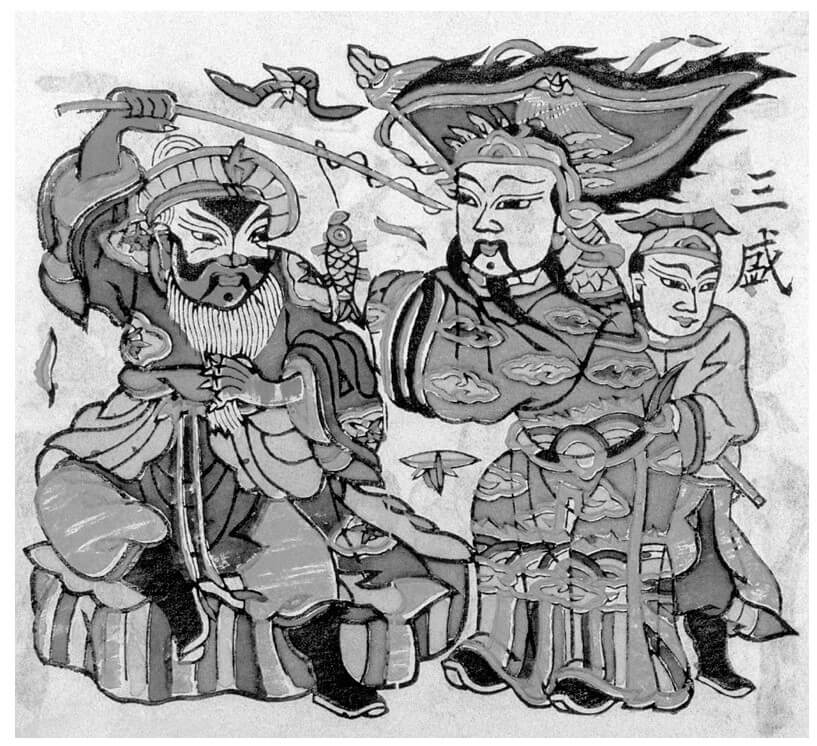
When he heard that Ji Chang of the Western Zhou was eagerly seeking talented individuals, Jiang Shang, still full of ambition, left Zhaoge and came to the Wei River at the southwestern foot of Mount Qi in the Western Zhou territory. He settled down at Panxi, fishing daily by a tributary of the Wei River, observing the changes in the world while waiting for an opportunity to emerge from seclusion.
However, Jiang Shang was not fishing for fish, so unlike ordinary people, he did not bait a curved hook and cast it into the water; instead, he suspended the fishing line three feet above the water's surface, and even used no hook at all. Once, a woodcutter passed by and, seeing the Grand Duke fishing, asked in confusion, "Old sir, how can fish possibly take the bait like this?" Without moving, Jiang Shang held up his fishing rod and murmured to himself, "If the fish are willing, they will take the bait on their own!"
Gradually, people came to know that by the Wei River there was an odd old man who fished without using a hook, and eventually Ji Chang heard the rumors. He thought to himself, this man's words and actions are peculiar and certainly no ordinary person; perhaps he is the one I am looking for. So Ji Chang went out on the pretext of hunting and arrived at the banks of the Wei River, where he indeed saw a strange old man fishing. Ji Chang approached and struck up a conversation, discovering that this spirited elder spoke with extraordinary insight and profound views. They talked happily together, and then Ji Chang asked him about the state of the world and strategies for governing the country and ensuring peace. Jiang Shang proposed that to govern and revitalize the state, one must appoint people on merit and place importance on discovering and selecting talent, which exactly matched Ji Chang's own views. Overjoyed, Ji Chang said, "My late grandfather, the Grand Duke, prophesied: 'When a sage comes to Zhou, only then will Zhou flourish.' Are you that sage? My Grand Duke has long awaited you!" This meant that Gugong Danfu, the founding ancestor of Zhou, had always longed for a talented person who could secure the realm through military might and govern the state through civil virtue, and that person was you. Later, people called Jiang Shang "Grand Duke's Hope."
Ji Chang confirmed that this was the talented person he had been seeking, so he invited Jiang Shang to come out of seclusion and assist him in completing the great plan to overthrow the Shang dynasty. Jiang Shang was appointed as Grand Preceptor, overseeing both military and civil affairs, and his vast strategic knowledge finally had a place to be utilized. To repay Ji Chang's recognition and favor, he devoted himself wholeheartedly, assisting Ji Chang in building and strengthening the state, advising him to cultivate both internal and external governance and tirelessly develop Zhou's internal power. At the same time, he strengthened ties with surrounding small tribes, gradually undermining the foundation of Shang rule. He also launched a major western campaign, pacifying some ethnic groups in the west, thereby eliminating threats to Zhou's rear. Then, he expanded eastward, crossing the Yellow River to destroy Chong, an important western ally of the Shang. Through continuous external wars, Zhou's influence further expanded, gradually occupying two-thirds of the realm, much of which was credited to Jiang Shang's strategies.