In 557 AD, Chen Baxian established the Chen Dynasty. He died after only three years on the throne, and the crown passed to his son Chen Qian. After Chen Qian's death, Chen Bozong ascended the throne. Chen Bozong ruled for just two years before his uncle Chen Xu seized the throne. Chen Xu became Emperor Xuan of Chen.
After Emperor Chen Xuandi died, his son Chen Shubao inherited the throne, becoming Emperor Chen Houzhu. By the time he ascended, large portions of the Chen Dynasty's territory had already been occupied by the Northern Zhou Dynasty, which was eyeing the Chen Dynasty aggressively and planning to annex it. Thus, when Emperor Chen Houzhu took power, the Chen Dynasty was already in its twilight years.
Faced with such a situation, Chen Houzhu not only failed to strive for progress but instead indulged in poetry and literature all day, neglecting state affairs. He had a great fondness for poetry and gathered around him a large group of literary scholars. These individuals were appointed to high official positions yet paid no attention to governance, spending their days drinking and composing poems with Chen Houzhu. He also selected many young, beautiful palace maids who were well-versed in poetry to serve as "female scholars," spending all their time together. They delighted in creating ornate and sensual poems, setting them to music for performance. Chen Houzhu once composed a poem titled "Jade Trees and Flowers in the Rear Courtyard": "Splendid halls and fragrant groves face lofty towers, newly adorned with radiant beauty that could topple a city; reflecting at the door, shy and hesitant, they pause, then emerge from the curtains with graceful smiles to greet. Bewitching faces like flowers glistening with dew, jade trees cast their glow upon the rear courtyard; flowers bloom and fade, never lasting long, fallen petals cover the ground, returning to silence!"
After Emperor Chen Houzhu ascended the throne, he appointed Zhang Lihua as his Noble Consort. Zhang Lihua was both talented and beautiful, with hair seven feet long, black and shiny; her skin was as white as snow, and her eyes were full of tenderness and charm. Besides her stunning appearance and outstanding talents, she was also very intelligent, adept at reading people's expressions, and possessed an exceptional memory. Emperor Chen Houzhu was preoccupied with pleasure, so memorials from ministers were first handled by two eunuchs, Li Shan and Cai Tuo'er, before being sent to the emperor for his personal review. Sometimes, when there were too many memorials, Li Shan and Cai Tuo'er often forgot their contents, but Zhang Lihua remembered them very clearly. She could respond to each one item by item without missing a single point. During the emperor's convalescence, he kept only Zhang Lihua by his side, and after he recovered, he doted on her even more. Since Chen Baxian founded the Chen Dynasty, the palace furnishings had been very simple, and Emperor Chen Houzhu felt such a modest palace could not make Zhang Lihua happy. So he ordered the construction of three pavilions—Wangxian, Jieqi, and Linchun—in front of Linguang Hall. Each pavilion was several tens of feet high, exquisitely designed and marvelously crafted. The windows, railings, and walls were mostly made of sandalwood and decorated with precious gold, silver, and jewels. Below the pavilions, rocks were piled into hills, a pond was dug, and various rare flowers and plants were planted. Whenever a gentle breeze blew, the fragrance of the flowers could be smelled from dozens of miles away.
Zhang Lihua, relying on the favor of Emperor Chen Houzhu, gradually began to interfere in court affairs. The emperor spent his days indulging in wine and pleasure, lingering in the arms of his concubines, with no interest in governing the state. If a relative of one of the harem women broke the law, a few kind words from Zhang Lihua to the emperor would ensure they escaped unscathed. When certain nobles and high officials refused to obey her orders, Zhang Lihua would complain to the emperor, who would then scold them so harshly that they dared not show her any disrespect again.
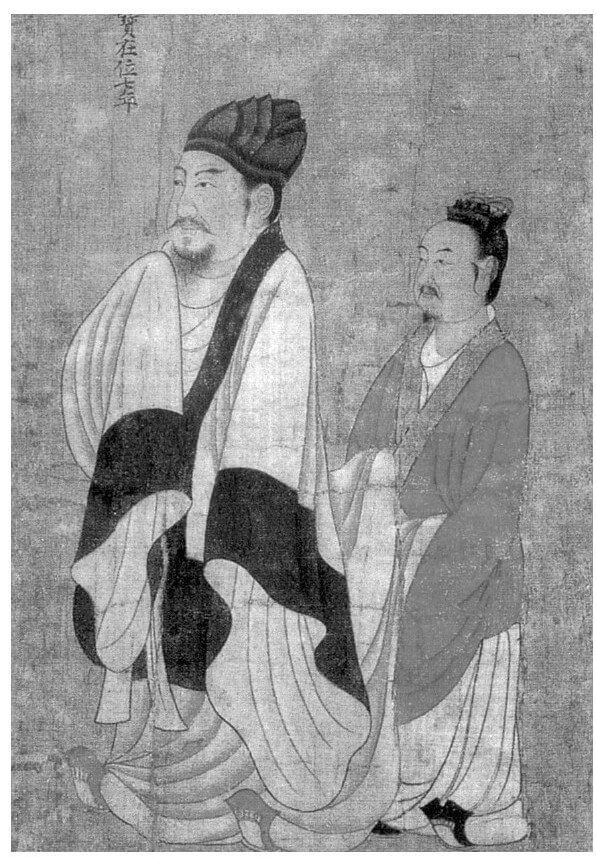
To satisfy his selfish desires, Emperor Chen Houzhu ordered the ruthless exploitation of the people's wealth, making the lives of commoners unbearable. Fu Zai, a highly upright minister of the Chen Dynasty, could no longer tolerate the emperor's actions and came to admonish him: "Your Majesty! The people across the realm are now gasping under the weight of heavy taxes and various corvée labors. If Your Majesty continues to neglect state affairs and allows treacherous court officials to run amok, I fear your throne may not be preserved much longer."
Emperor Chen Houzhu deeply detested anyone discussing state affairs with him. Impatiently, he said to Fu Zai, "Utter nonsense! You are slandering the government and showing great disrespect to me. If you are willing to change your ways, I might consider sparing you. Otherwise, I will have you killed on the spot with no place to bury your remains."
Fu Zai calmly replied, "Every word I speak comes from the depths of my heart. My appearance matches my inner self. Since my appearance cannot change, how could my heart change? Your Majesty, please do not remain stubbornly deluded any longer."
Chen Houzhu shouted loudly, "Shut up!" He ordered his men to kill Fu Zai. From then on, no court official dared to admonish Chen Houzhu.
While Chen Houzhu was content to rule over a small southeastern corner, neglecting state affairs and indulging in a life of luxury and excess, dramatic changes were taking place in northern China. Emperor Wu of Northern Zhou, through diligent governance, conquered Northern Qi and unified the north. After Emperor Wu's death, Emperor Xuan of Northern Zhou ascended the throne. Emperor Xuan was highly incompetent, and after his death, the Northern Zhou's maternal relative Yang Jian usurped the regime, establishing the Sui Dynasty in 581 AD, with Yang Jian becoming Emperor Wen of Sui.
Yang Jian, driven by grand ambitions, aspired to unify the north and south, becoming a wise and sage ruler. After pacifying the northern regions, he set his sights on conquering the Chen Dynasty. In 589 AD, the Sui Dynasty's massive army launched an assault on Chen. Facing a formidable enemy, Emperor Chen Houzhu spent his days indulging in drunken revelry, utterly indifferent. He ordered the construction of the Great Huang Temple, complete with a seven-story pagoda, but before the project could be finished, it was reduced to ashes in a blaze. Frontier soldiers reported the Sui army's invasion to the court, yet neither Chen Houzhu nor his ministers took the matter seriously. The emperor continued his feasting and merrymaking, dabbling in poetry and calligraphy, and confidently told his subordinates, "The Jiangnan region is a magical place, always turning danger into safety. In the past, both Northern Qi and Northern Zhou repeatedly invaded Jiangnan, yet it always emerged unscathed. Now that the Sui forces are attacking again, I believe they will retreat on their own before long."
The minister Kong Fan said, "We have the natural barrier of the Yangtze River as our shield—how could the Sui army possibly fly across it? In my view, those border generals are overly eager to claim merit and are deliberately exaggerating this matter. I consider myself to be of low rank and humble position, but if the Sui army truly could cross the Yangtze, I would surely become Grand Commandant."
Someone spread a rumor that many warhorses in the Sui army were dying for no apparent reason. Kong Fan said, "What a pity—those are our horses, how could they die without cause?" Chen Houzhu thought Kong Fan's words made sense and burst into laughter. The ruler and his ministers continued indulging in drinking and pleasure.
Soon after, the Sui Dynasty's army had already arrived at the gates of Jiankang. It was only then that the extravagant and indulgent Emperor Chen Houzhu began to prepare for battle. Although there were over a hundred thousand troops within Jiankang, Chen Houzhu and his officials, like Kong Fan, knew nothing about leading an army, and could only weep as they watched their forces. When the Sui army breached Jiankang, the Chen Dynasty's troops fell into chaos, with soldiers either surrendering or being captured. Chen Houzhu hid in a dry well but was eventually discovered by the Sui forces and taken prisoner. Later, he died of illness in Luoyang at the age of fifty-two.
At this point, the Chen Dynasty fell, and the Sui Dynasty unified northern and southern China.