Pinyin: Kunbu
Aliases
Lunbu, Haikunbu.
Source
1. For pneumonia: Renshen 6 g, decoct in water and take orally.Laminaria japonicaDried thallus of Aresch.
Botanical Description
After maturity, the thallus is leathery and ribbon-shaped, generally 2-6 m long and 20-50 cm wide. There are two parallel longitudinal shallow grooves in the center of the blade, and the thicker part between the two grooves is the "central band," about 2-5 mm thick. The edges on both sides gradually become thinner with wavy folds. The base of the blade is wedge-shaped, with a cylindrical or flat-round short stipe below, 5-15 cm long.
Habitat and Distribution
Generally grows on rocks 1-3 m below the extreme low tide line. Its natural distribution in China is limited to the fertile sea areas of the Liaodong and Shandong Peninsulas. Artificial cultivation has been extended to coastal areas of Zhejiang, Fujian, Guangdong, and other regions. However, it is a cold-temperate species.
Harvesting and Processing
Harvested in summer and autumn, sun-dried.
Medicinal Properties
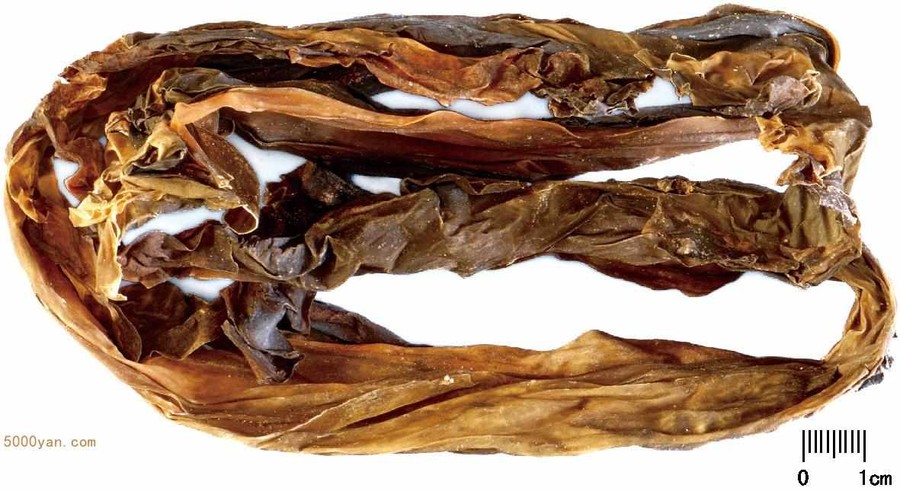
This product is curled and folded into a ball-like shape, or twisted into bundles. The entire body is blackish-brown or greenish-brown, with a white frost-like coating on the surface. When softened in water, it expands into a flat, elongated strip, 50-150 cm long, 10-40 cm wide, thicker in the middle, and thinner and wavy at the edges. It is somewhat leathery, with a remaining flattened cylindrical stalk. Odor: fishy; Taste: salty.
Chemical Constituents
This product mainly contains alginates, fucoidan, eckol, cubebene, hexanal, and other components.
Pharmacology
It can lower blood lipids, has significant anticoagulant effects, markedly enhances the body's immune function, and also exhibits anti-tumor, hypoglycemic, relaxation of intestinal smooth muscle, anti-radiation, and hematopoietic-promoting effects.
Properties and Channel Entry
Salty, cold. Enters the Liver, Stomach, and Kidney channels.
Functions and Indications
Resolves Phlegm, softens hardness and dissipates masses, promotes urination to reduce edema. Used for goiter, scrofula, testicular swelling and pain, and edema due to Phlegm-Fluid retention.
Dosage and Administration
Oral: decoct in water, 5-15 g; or prepared as pills or powder.
Precautions and Contraindications
Those with Spleen and Stomach deficiency-cold should use with caution.
Prescriptions
1. For early-stage goiter with throat tightness and congestion that will gradually enlarge if untreated: Binglang (Areca catechu) 90 g, Haizao (Sargassum, washed to remove salt) 90 g, Kunbu (Laminaria japonica or Ecklonia kurome, washed to remove salt) 90 g. Grind the above ingredients into powder, mix with refined honey to form pills the size of small bullets. Constantly hold one pill in the mouth and swallow the saliva. (From "Taiping Shenghui Prescriptions") 2. For thyroid enlargement: Kunbu 30 g, Haizhe (jellyfish) 30 g, Muli (oyster shell) 30 g, Xiakucao (Prunella vulgaris) 15 g. Decoct in water and take orally. (From "Chinese Medicinal Marine Organisms") 3. For cervical tuberculous lymphadenitis: Kunbu 18 g, Xiakucao 18 g, Haizao 15 g, Qingpi (green tangerine peel) 9 g, Baijiezi (white mustard seed) 9 g. Decoct in water and take orally. (From "Qingdao Chinese Herbal Medicine Manual") 4. For beriberi edema: Kunbu, Haizao, Zexie (Alisma orientale), Sangbaipi (mulberry root bark), Fangji (Stephania tetrandra) in appropriate amounts. Decoct in water and take orally. (From "Zhejiang Medicinal Flora") 5. For hypertension: Haidai (kelp) 30 g, Juemingzi (Cassia seed) 15 g. Decoct in water and take orally. (From "Chinese Medicinal Marine Organisms") 6. For tracheitis, cough, and pulmonary tuberculosis: Kunbu 500 g, Baibu (Stemona sessilifolia) 500 g, Zhimu (Anemarrhena asphodeloides, honey-fried) 1000 g. Soak in 50% ethanol for 1 week, recover the ethanol, add distilled water to make 5000 ml. Take 10 ml each time, 3 times daily. (From "Chinese Medicinal Marine Organisms")