Pinyin: Mabo
Aliases
Niushigu, Huibaojun, Yaobao, Jishenjun.
Source
Fungus of the family Lycoperdaceae, *Lasiosphaera fenzlii* (Reich.) Reich.Lasiosphaera fenzliiReich. dried fruiting body.
Botanical Description
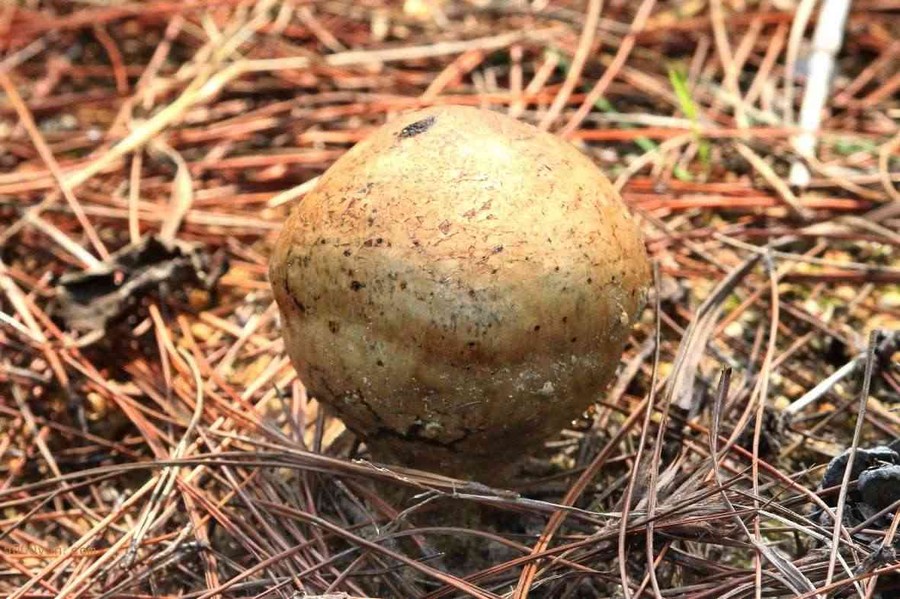
Fruiting body subglobose, 15-20 cm in diameter; no sterile base; peridium two-layered, thin and easily disappearing, outer peridium easily separates from inner peridium after maturity; outer peridium initially milky white, later turning grayish-brown, dirty gray; inner peridium papery, pale smoky brown, gradually peeling away with the outer peridium after maturity, leaving only a mass of gleba, gleba grayish-brown to smoky brown; spores spherical, with small spinules on the wall, brown, 4.5-5.5 μm in diameter; capillitium long, branched, interwoven, hyphae 2-4.5 μm in diameter, pale brown.
Habitat and Distribution
It appears in open grasslands during summer and autumn. Distributed in Heilongjiang, Inner Mongolia, Hebei, Gansu, Xinjiang, Jiangsu, Anhui, Jiangxi, Hubei, Hunan, Guizhou and other regions.
Harvesting and Processing
Harvest the fruiting body in summer and autumn when mature, promptly collect, remove sediment, and dry.
Chemical Constituents
This product mainly contains ergosta-5,7,22-trien-3β- alcohol, 23-diene-3β, 25-diol-22-acetate,βContains sitosterol, ergosta-7,22-diene-3,6-dione, ergosta-5,7,22-triene-3-ol, and calvacin components.
Pharmacology
Has hemostatic and antibacterial effects.
Medicinal Properties
This product is oblate or subglobose in shape, without a sterile base, with a diameter of 15-20 cm. The peridium is grayish-brown to yellowish-brown, papery, often broken into fragments or completely shed. The gleba is grayish-brown or light brown, compact, elastic; when torn by hand, it reveals grayish-brown cotton-like filaments inside. Upon contact, the spores fly like dust, and when rubbed between fingers, they feel fine and smooth. Odor: dusty; Taste: none.
Properties and Channel Entry
Acrid, neutral. Enters the Lung channel.
Functions and Indications
Clears the Lungs, benefits the throat, and stops bleeding. Used for wind-heat congesting the Lungs with sore throat, hoarseness, and cough; externally for epistaxis and traumatic bleeding.
Dosage and Administration
Oral administration: 2-6 g, wrapped for decoction; or prepared into pills or powder. External application: appropriate amount, applied to the affected area.
Precautions and Contraindications
Contraindicated in cases of cough with hoarseness caused by Wind-Cold lurking in the Lung.
Prescriptions
1. For sore throat with difficulty swallowing: one piece of snake slough (burned until smoke ceases) and Mabo (Lasiosphaera seu Calvatia) 0.3 g. Grind the above ingredients into a fine powder, wrap 3 g in cotton, and hold in the mouth to swallow the saliva. (From *Sheng Hui Fang*) 2. For bone stuck in the throat: Mabo, Baifan (alumen) ash, Niubangzi (Arctium lappa, stir-fried), and Chenpi (Citri Reticulatae Pericarpium, remove white inner layer, bake) 15 g each. Grind into a fine powder. Use fermented rice water to form pills the size of a cherry. Hold in the mouth and allow to dissolve. (From *Sheng Ji Zong Lu*) 3. For chronic cough: Mabo, in any amount, ground into a fine powder, mix with refined honey to form pills the size of parasol seeds. Take 20 pills with soup. (From *Pu Ji Fang*, Mabo Pill) 4. For loss of voice: Mabo and Maxiao (Mirabilitum) in equal parts. Grind into a powder, mix with sugar to form pills the size of *Euryale* seeds. Hold in the mouth. (From *Gang Mu*, citing *Zhai Xuan Fang*) 5. For accumulated heat causing blood vomiting: Mabo, ground into a powder, form with sugar into pills the size of a marble. Take half a pill with cold water. (From *Xiu Zhen Fang*) 6. For abscesses and carbuncles: rub Mabo into a powder, mix with rice vinegar and apply topically to promote resolution; may also be combined with a small amount of Lianqiao (Forsythia suspensa) and decocted for oral administration. (From *Ben Cao Hui Yan*, citing *Wai Ke Liang Fang*)