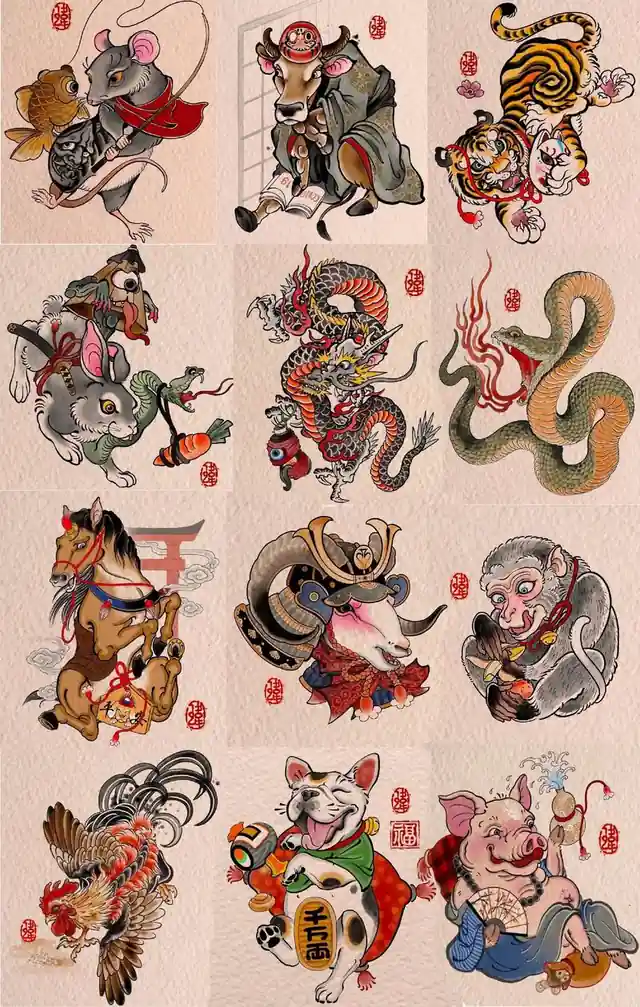
The Chinese zodiac culture is an important component of traditional Chinese culture, while ancient and elegant coins serve as witnesses to China's long history. By embedding zodiac culture into coins, it has been given a more enduring development.
The practice of embedding zodiac animals, whether in Chinese characters or pictorial forms, onto coins gave rise to what is known as "zodiac coins." This tradition of using zodiac symbols on currency dates back to ancient times. According to the "Gu Qian Da Ci Dian (Great Dictionary of Ancient Coins)," which cites the "Bai Shi Lei Bian (Classified Records of Unofficial Histories)," it is recorded: "Fate coins feature the twelve zodiac characters on their surface. Zhang Duanshu commented: 'These coins were formerly called fate coins, bearing the twelve Earthly Branch characters along with the forms of the zodiac animals.' The concept of the zodiac originated from the 'Huainanzi (Masters of Huainan),' so it is not necessary to assume these coins are a product of recent times." Therefore, zodiac coins, also referred to as twelve-branch coins or fate coins, constitute a particularly distinctive category within the iconography of zodiac animals.
In earlier times, as soon as a child was born, adults would put a prepared zodiac coin on them, hoping their child would grow up as healthily as the zodiac animal. People also believed that zodiac coins had the power to ward off evil spirits. When encountering unfavorable events, the zodiac sign worn would protect their safety. Therefore, adults often hung zodiac coins around their necks or at their waists.
Zodiac coins come in various forms. One type is the single-character zodiac coin, where a character is cast above the coin's hole and the corresponding zodiac animal is cast below — for example, the character "Zi" is above with a Rat image below, or "Chou" with an Ox below. These designs are generally simple, featuring only rough outlines of the zodiac animals that hint at their identity. Another type is the four-character zodiac coin; for instance, the obverse bears the characters "Zi, Chou, Yin, Mao" and the reverse features the images of Rat, Ox, Tiger, and Rabbit. According to relevant research, one possibility for casting coins with four zodiac animals is that they represent four generations or four family members, and wearing such a coin is believed to bring good fortune and peace to the entire household. There are also twelve-zodiac coins, which use a linked-bead pattern: the obverse displays the twelve zodiac animals, each set within twelve small circles arranged around a central hole — with six circles forming an inner ring and six forming an outer ring, separated by cloud patterns, presenting the animals in a continuous bead-like layout; the reverse bears patterns such as lotus flowers, reeds, and paired wild geese. Some coins feature the twelve zodiac characters on the obverse, while the reverse has the characters "Chi Ling" (imperial command) on the left and right, a pagoda-bearing deity above, and a mythical beast below — these coins go beyond the simple combination of Earthly Branches and zodiac animals. There are also coins depicting both humans and zodiac animals together; for example, a zodiac Ox coin has the characters "Chou Sheng" (born under Chou) on the obverse and a human and Ox pattern on the reverse, while a Tiger coin features "Yin Sheng" (born under Yin) on the obverse and a human and Tiger pattern on the reverse.
In addition to the zodiac coins mentioned above, there are also others with auspicious phrases such as "Long Life and Wealth" (Chang Ming Fu Gui) or "Peace Under Heaven" (Tian Xia Tai Ping) cast on their reverse sides, which are called "Auspicious Saying Zodiac Coins." Those with the Eight Trigrams (Bagua) on the reverse are known as "Eight Trigrams Zodiac Coins," while those featuring the Ben Ming Xing Guan (the guardian star deity of one's birth year) are termed "Ben Ming Zodiac Coins." Additionally, there are designs depicting Zhang Tianshi (the Celestial Master Zhang) exorcising demons, the crane and tortoise symbolizing longevity, promotion and ennoblement, or subduing the dragon and taming the tiger, among countless other motifs.
As zodiac coins have evolved into modern times, they have taken on new forms. Due to the unique cultural significance symbolized by zodiac coins and their embodiment of traditional Chinese style, they are often issued today as commemorative coins. Zodiac commemorative coins are frequently tied to major historical events in China, combining humanity, artistry, cultural value, and collectibility, which has earned them widespread popularity.
The Chinese zodiac is a unique gem within Chinese folk culture, while ancient coins bear witness to China's five-thousand-year history. By ingeniously integrating zodiac culture into the form of coins, on one hand, this imprints a cultural mark on the coins, meaning that the longer time passes, the more these zodiac coins appreciate in value. On the other hand, it represents a very significant aspect of folk culture, reflecting people's diligence and wisdom, enriching their cultural life, and demonstrating their deep affection for zodiac culture as well as the profound influence of zodiac culture itself.
Further Reading
Zodiac Coin Mirror with Regulated Patterns
The "Zodiac Coin Pattern Mirror" was unearthed in the 1990s from a tomb at Nansha Fenghuang Mountain in Zhangjiagang City. This mirror is circular, approximately 18 centimeters in diameter, with a thick edge and a thin center, and its surface is slightly convex. It has a blue-black color, a semi-circular knob base, and the base's round pattern is adorned with four persimmon leaf patterns on the outer ring. The inner zone consists of a seal-script inscription belt of the twelve zodiac animals and twelve small nipple-like bosses within two rectangular frames. The outer zone's inscription belt is composed of auspicious terms such as "Wanquan" (complete perfection) and "Fugui" (wealth and honor). Between the inner and outer zones, there are eight bosses, eight birds and beasts, and twelve geometric patterns (gui ju), with smooth lines vividly symbolizing people following rules and living a happy and beautiful life. The rim features two serrated bands sandwiching a band of variant cloud patterns, each adorned with a "Daquan Wushi" coin (a large coin valued at fifty). "Daquan Wushi" was a coin issued and used during the reign of Wang Mang in the late Western Han Dynasty, indicating that this bronze mirror should date to after the late Western Han Dynasty.