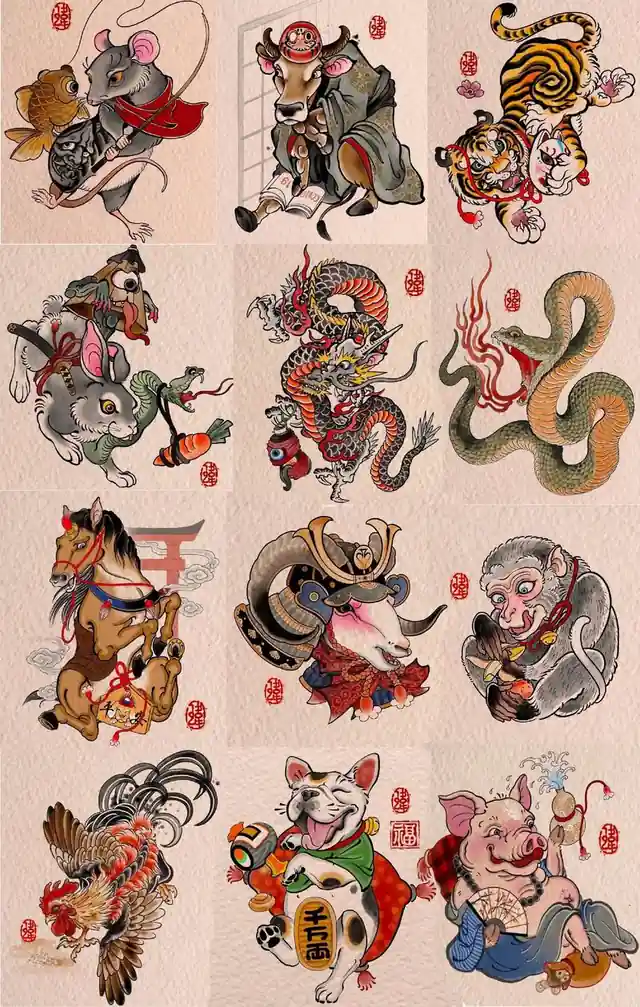
As one of the most widespread and influential components of traditional Chinese folk culture, the twelve zodiac paintings embody generations of Chinese people's understanding of beauty and their aspirations for the future. From ancient times to the present, the twelve zodiac animals have served as an inexhaustible source of creative inspiration for painters, artisans, and artists alike.
The history of Chinese zodiac culture is long and profound. Through centuries of accumulation, the twelve zodiac animals have long shed their natural essence and been endowed with various humanistic characteristics. The cleverness of the Rat, the steadfastness of the Ox, the majesty of the Tiger, the galloping spirit of the Horse, and the agility of the Monkey have all become symbols of spiritual strength or good fortune and auspiciousness. These traits are widely applied in various forms of artistic expression, with zodiac paintings being a particularly distinctive and spirited medium. As history has progressed, zodiac paintings have continued to thrive in people's lives through diverse forms.
Zodiac New Year Prints
The twelve zodiac animals are a very traditional theme in Chinese New Year paintings. A New Year painting popular in the Hebei region during the Qing Dynasty (1644-1912), titled "Lotus and Sons" (Liansheng Guizi Tu), is a highly typical example: the entire piece is printed in four colors—red, yellow, green, and purple—with two large circles as the main motifs. One circle contains two children, while the other has six children, and surrounding these two circles are patterns of the twelve zodiac animals. The Dragon, Tiger, and Rabbit are positioned in the center; the Snake, Rooster, Dog, and Pig are on the left; and the Rat, Goat, Ox, and Horse are on the right. "Lotus and Sons" (Liansheng Guizi) carries the auspicious meaning of "may you bear sons in succession," and its pairing with the twelve zodiac animals serves as a dual expression of this heartfelt wish.
Additionally, "The Mouse Marrying Off His Daughter" is a common theme in New Year paintings. These paintings often depict grand and lively scenes, with the wedding procession including lanterns, bridal sedan chairs, flags, drums, and umbrellas in complete array. The mouse images are rendered with remarkable lifelikeness, presenting a scene resembling a human wedding. Besides the procession scenes, themes such as the mice performing the wedding ceremony or holding banquets are also featured, making the depictions highly vivid and expressive.
Zodiac Rock Paintings
Due to the highly developed art of painting in ancient China and the profound influence of Confucianism and Taoism, painting on rocks seems to have become a special habit and hobby for the ancient ancestors. Among the numerous rock paintings that have survived, the most famous are the Altai Mountains rock paintings in Xinjiang, the Yinshan Mountains rock paintings in Inner Mongolia, the Helan Mountains rock paintings in Ningxia, and the Huashan rock paintings in Guangxi. In these many rock paintings, the ancestors used a primitive, bold, and concise style to depict zodiac animals such as the Horse, Ox, Goat, Rooster, Rabbit, and Monkey on the rocks. This not only showcases the lifestyle and conditions of the ancestors but also reflects the improvement of their autonomous creative consciousness and their affection and reverence for the zodiac animals.
Zodiac Tomb Murals
In ancient times, people often regarded the twelve zodiac animals as twelve divine figures, worshiping them during their lifetimes and hoping to receive their protection and blessing after death. As a result, when some high-ranking officials and nobles passed away, colorful paintings of the twelve zodiac animals were often painted on their tomb walls to serve as eternal guardians. For example, a mural discovered in 1980 in a Northern Qi Dynasty tomb in the southern suburbs of Taiyuan, Shanxi Province, featured the twelve zodiac animals as its theme. The twelve zodiac animals were arranged according to the twelve directions, with Zi Rat positioned in the north, adjacent to Chou Ox, while Yin Tiger and Mao Rabbit were depicted on the eastern wall. Other zodiac murals have been damaged over the centuries, but judging from the images of Rat, Ox, Tiger, and Rabbit alone, the depictions are extremely vivid and lifelike, demonstrating the exceptional artistry of the painters.
By today, zodiac paintings have developed into a wide variety of types covering all categories, with the most prominent being the professional works of literati painters. The painter Xu Beihong is renowned worldwide for his exceptional skill in painting horses. He was adept at observing the muscles, bones, expressions, and movements of horses. His paintings of horses combine the realism of Western art with the freehand brushwork of traditional Chinese painting, merging the strengths of both Eastern and Western painting techniques. Whether galloping and leaping, turning back with a long neigh, soaring into the air, or kicking up dust with their hooves, his horses are rendered with bold and vigorous brushstrokes, capturing both form and spirit. They convey a sense of freedom and strength, inspiring people to strive forward with positivity. Xu Beihong's deep love for horses clearly demonstrates the profound influence of the zodiac horse on him.
Whether in ancient zodiac rock carvings and zodiac tomb murals, or in modern zodiac New Year paintings and literati zodiac paintings, one can discern the profound historical and cultural origins of zodiac culture, as well as the tradition of people's love for the zodiac and their efforts to promote zodiac culture.
Further Reading
Qi Baishi created paintings of the twelve zodiac animals.
Qi Baishi is world-famous for his paintings of shrimp, but most people do not know that he also painted the twelve zodiac animals. He rarely painted dragons in his lifetime, yet on one occasion he used full ink washes to create a dragon, and what prompted this was a set of twelve zodiac paintings. Regarding this, Qi Baishi left an inscription: "I have never seen a dragon, so I cannot paint it. However, since Mr. Wei San already possesses many of my paintings and also wishes to commission a set of the twelve zodiac animals..." Qi Baishi not only painted the dragon he had never seen, but also depicted dogs and horses, subjects he seldom touched. The twelve zodiac animals were all included, and Qi Baishi assigned special meanings to each: for the dog, he inscribed "Barking at the unkind"; for the monkey, he wrote "Having stolen and then looked back, there must be fear; if born of human blood, there must be morality and shame." These inscriptions undoubtedly enriched the cultural depth of the zodiac paintings.