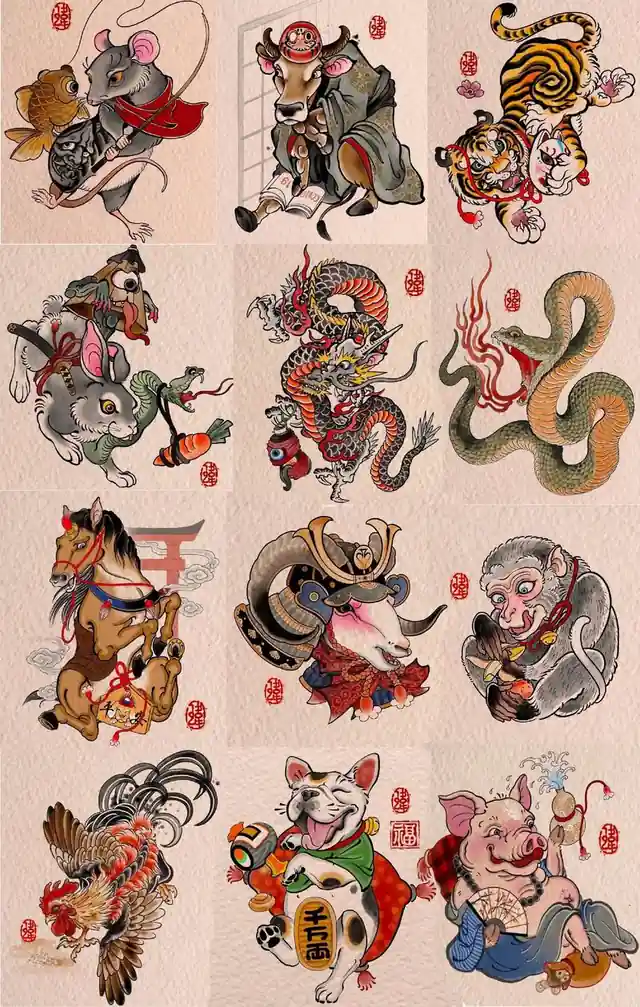
As a rising star within zodiac culture, zodiac stamps represent a new development of this tradition, serving as both an inheritance and an innovation of traditional culture. The international spread of zodiac stamps rich in Chinese characteristics also demonstrates the enduring vitality of China's long-standing zodiac culture.
The culture of the Chinese zodiac originated in China and has a history spanning several thousand years. However, the emergence of a new category within zodiac culture — zodiac stamps — is a modern development. It grew alongside the increasing advancement of communication technology and is the result of the continuous development of the postal service, combined with people's growing appreciation for traditional zodiac culture.
As the name suggests, zodiac stamps are New Year stamps featuring the twelve traditional Chinese zodiac animals as their designs. Unlike stamps with general animal themes or those depicting paintings, cultural relics, or crafts, zodiac stamps primarily fall into three types: first, stamps that explicitly label the zodiac name in text, such as "Gengshen Year of the Monkey" or "Xinchou Year of the Ox"; second, New Year stamps issued simultaneously as a complete set following the order of the twelve zodiac animals; and third, stamps whose names may be unrelated to the zodiac but whose designs intentionally incorporate zodiac content.
In China, the issuance of zodiac stamps began in 1980. This series of zodiac stamps featured decorative compositions, with a white background alternating with other colors, and the twelve zodiac stamps were arranged in sequence, creating a distinct rhythm and vivid color schemes. By 1991, the twelve zodiac animals over a twelve-year cycle had each appeared on stamps one by one, including the lively and clever Shen Monkey, the proud and upright You Rooster, and the honest and sincere Xu Dog, all leaving a beautiful impression on people's hearts, becoming mascots for bidding farewell to the old year and welcoming the new, as well as collectible treasures worth preserving.
First, on February 15, 1980 (the Gengshen Year), China National Philatelic Corporation issued a set of zodiac stamps, among which the Monkey stamp repeatedly set new price records, with a single sheet of Monkey stamps being equivalent to a luxury car. The Monkey stamp had a face value of 8 fen (RMB), a red background, and featured a golden monkey designed by the renowned painter Huang Yongyu. On May 12, 2010, at China Guardian Spring Auction, two complete sheets of the Monkey stamp (1980 T46 Gengshen Year Monkey Stamp, eighty stamps per sheet) which were priced at only 6.4 yuan per sheet 30 years ago, both broke through the 900,000 yuan mark, selling for 996,800 RMB and 918,400 RMB respectively, representing an increase of over 140,000 times in 30 years.
As society progresses and culture evolves, the design of zodiac stamps has also incorporated many contemporary elements, demonstrating remarkable ingenuity and craftsmanship. The "Xinyou Year Stamp" features a colorful rooster stretching its neck to crow at dawn, embodying the heroic image of diligence, discipline, punctuality, and courageous combativeness. The "Guihai Year Stamp" depicts a "fat pig pushing open the door," reflecting the prosperity and thriving of rural China at the time (the pig is regarded as a symbol of wealth). The "Yichou Year Stamp" shows a robust ox bellowing skyward, conveying an unyielding pioneering spirit. The design of the "Xinwei Year Stamp" is even more exquisite: a sheep standing with its head turned back. This backward-looking pose was chosen for two reasons: first, because it is the final stamp in the first round of zodiac animal stamps, with the head facing backward to create a cohesive pattern that echoes the beginning, ensuring the overall aesthetic unity of the series; second, it symbolizes looking back on the past, as twelve years pass in the blink of an eye, reminding people to cherish time.
Presenting the ancient zodiac theme on stamps, which serve as a "national calling card," was a groundbreaking innovation in zodiac culture. Zodiac stamps did not follow the old path of reproducing antiquities but instead integrated "newness" into beautiful designs, balancing the national and traditional characteristics of the theme while reflecting the spirit of the times. Each adorable image brings aesthetic pleasure and cultural enrichment to viewers, which is a key reason why zodiac stamps have earned widespread acclaim. Moreover, the design style of zodiac stamps has influenced other philatelic products, opening a new window for the hobby of stamp collecting. Through this window, people can witness the zodiac culture advancing in step with contemporary Chinese culture.
Over the years, China's zodiac stamps have continuously evolved and gradually gained favor among people around the world. Today, when foreign tourists visit China, they often show great interest in these Chinese zodiac stamps. Some neighboring countries are even keen on issuing zodiac stamps with distinctive Chinese characteristics, which fully demonstrates the significant influence of Chinese zodiac stamps on them.
Further Reading
The Large Dragon Stamp
In 1878, the Qing government established postal agencies in five locations—Beijing, Tianjin, Shanghai, Yantai, and Niuzhuang (Yingkou)—under the jurisdiction of the Imperial Maritime Customs. The Shanghai Customs Printing Office that same year printed a set of three stamps featuring a coiled dragon design. At the center of each stamp was a five-clawed coiled dragon, set against a background of clouds and waves. The stamps differed in color and denomination, with face values calculated in silver taels: "1 Candarin" (green, for printed matter postage), "3 Candarins" (red, for ordinary letter postage), and "5 Candarins" (orange-yellow, for registered mail postage). This was China's first issued set of stamps, known in philatelic circles as the "Customs Large Dragon," or simply the "Large Dragon stamps." The words "Qing Imperial Post Office" were prominently displayed on the stamps, and the dragon in the design had its eyes wide open, soaring through clouds and mist as if about to emerge. The top bore the inscription "CHINA," and the bottom read "CANDARIN(S)" (referring to the customs tael unit of silver). As China's first officially issued stamp, the Large Dragon stamp is extremely precious and invaluable.