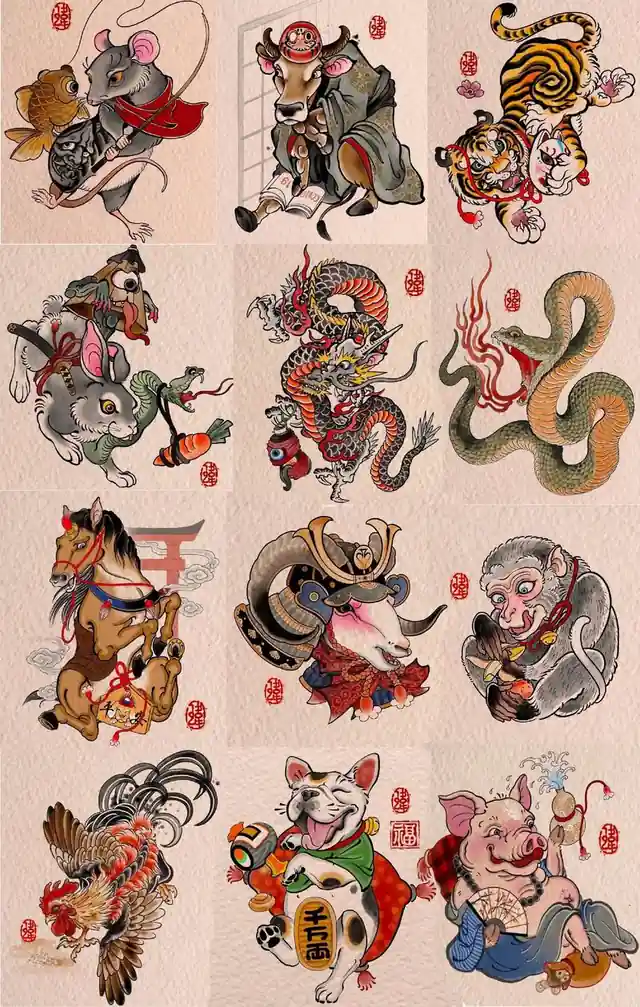
The inherited vessels themselves bear profound historical imprints, and by attaching zodiac culture to these vessels, even as time erodes them, they not only retain their original splendor but instead become even more imbued with historical timelessness, shrouded everywhere in a mysterious aura.
The influence of Chinese zodiac culture extends beyond shaping people's beliefs and can be seen even in everyday objects. Whether on utensils or personal ornaments, traces of zodiac culture are everywhere. These zodiac-themed vessels and accessories, with their exquisite artistry, constantly captivate people's appreciation and inspire their creative thinking.
Bronze Mirrors with Zodiac Motifs
Emperor Taizong of the Tang Dynasty, Li Shimin, once said, "Using bronze as a mirror, one can straighten one's attire," a quote still cited as a classic today. Among the myriad bronze mirrors, none is more captivating than the "Demon-Reflecting Mirror." Li Shangyin of the late Tang Dynasty wrote, "I have heard of the Demon-Reflecting Mirror, alongside the divine sword's edge." The "Demon-Reflecting Mirror" is a type of bronze mirror, and its status and influence in people's minds are thus evident.
Bronze mirrors were originally one of the ritual implements used by Daoism to ward off evil. According to "Gu Jing Ji" (Record of Ancient Mirrors), the inscriptions on bronze mirrors state, "The twelve earthly branches are depicted with their corresponding zodiac animals." This means that on the back of a bronze mirror, the Eight Trigrams symbols form a circle, and outside that circle, the twelve earthly branches of Zi, Chou, Yin, Mao, and so on, are arranged in the form of zodiac animals. In ancient times, most bronze mirrors were adorned with zodiac animal patterns, which imbued them with a mysterious and enigmatic quality. It seemed to suggest that bronze mirrors were not merely used for "adjusting one's attire" or as decorative items, but possessed their own unique vitality and significance.
The British scholar Joseph Needham, in the fourth volume "Astronomy" of his "Science and Civilisation in China," provides a detailed record of an ancient Chinese bronze mirror preserved in the American Museum of Natural History. He writes: "This mirror is round, with a diameter of 27 centimeters. It features an animal-shaped knob, and its edge is adorned with a pattern of wishful cloud-shaped connected pearls. The design is divided into five concentric circles. The innermost circle depicts the Four Symbols: the Azure Dragon, the Vermilion Bird, the White Tiger, and the Black Tortoise. The second circle arranges the twelve zodiac animals — Rat, Ox, Tiger, Rabbit, Dragon, Snake, Horse, Goat, Monkey, Rooster, Dog, and Pig — representing the Twelve Earthly Branches. The third circle contains the eight trigrams of the I Ching. The fourth circle is composed of the Twenty-Eight Lunar Mansions. The fifth circle bears an inscription that reads: 'The essence of the Long Star, the spirit of the White Tiger. Yin and Yang mutually support each other; mountains and rivers manifest their spiritual power. Following the laws of heaven, emulating the tranquility of earth. Distinguishing the eight trigrams, examining the Five Elements in order. All spirits cannot compare to its form; all things cannot escape its image. To obtain and treasure it is to have blessings and prosperity fulfilled.'" From this, it can be understood that the images of the twelve zodiac animals are arranged on the bronze mirror to embody the principle of "following the laws of heaven and emulating the tranquility of earth." This is also related to the belief that the bronze mirror possesses the divine power to make "all spirits unable to escape its form, and all things unable to hide their image."
Gao Lian of the Ming Dynasty (1368-1644) mentioned ancient precious bronze artifacts such as tripods, chime bells, and mirrors in his work "Yashangzhai Zunsheng Bajian (Eight Discourses on Nurturing Life from the Yashang Studio)". When enumerating the decorative patterns on bronze mirrors, he did not refer to the twelve Earthly Branches but directly named the twelve zodiac animals. This demonstrates that the zodiac held significant importance for bronze mirrors.
Beyond bronze mirrors, many ancient gold and silver vessels also featured zodiac animal motifs as decorative patterns. On the extended border designs, one can see coiled snakes, leaping monkeys, roosters with spread tail feathers, running oxen, as well as various tigers, rabbits, horses, goats, and dogs. These all represent the diligence and wisdom of the ancient working people.
Zodiac Accessories
The love of beauty has existed since ancient times. In early history, people adorned themselves with simple ornaments such as shells, fruits, and colored stones, primarily for aesthetic appeal and elegance, but also because they believed these items possessed the power to ward off evil and bring good fortune. With the emergence of the Chinese Zodiac and the widespread influence of zodiac culture, zodiac-themed ornaments naturally became people's favorites. From the Western and Eastern Han Dynasties (206 BCE-220 CE) to the Tang Dynasty (618-907), zodiac ornaments grew increasingly abundant. Even neck ornaments alone included necklaces, chokers, layered necklaces, gold and silver crown pendants, head-protecting bands, gold and silver horns, silver horse-shaped head wraps, gold and silver forehead bands, gold and silver hairpins, gold and silver clothing ornaments, hanging charms, longevity locks, and many other styles. The zodiac motif could also be found in crowns, clothing, hair ornaments, earrings, hand and arm adornments, and chest and waist pendants. Of course, as the Yin-Yang and Five Elements (Wu Xing) aspects of zodiac culture became increasingly valued, people's choices of zodiac ornaments grew more meticulous. Some believe that different colors of zodiac ornaments represent different elements of the Five Elements, and one must not only select colors that are personally auspicious but also avoid those that are inauspicious, for only then will the zodiac ornaments possess spiritual efficacy and ensure safety and peace.
From this, it can also be seen that the zodiac culture still contains certain remnants left over from feudal society. In this regard, we should examine the zodiac culture from a cultural perspective. We should neither discard traditional Chinese cultural elements such as zodiac ornaments, which are uniquely Chinese, nor fail to reform and innovate on the existing foundation. Only in this way can the zodiac culture continue to thrive in the current confluence of Chinese and Western cultures.
Further Reading
Taboos on Wearing Zodiac Animal Accessories
As society continues to develop, people's pursuit of beauty grows ever higher, which is reflected in zodiac culture through the great popularity of zodiac-themed accessories. However, due to the deep influence of the concept of mutual generation and restraint among zodiac signs, there are also many particular rules regarding the wearing of such accessories. For example, those born in the Year of the Rat are advised to wear accessories symbolizing the Ox, Monkey, or Dragon; those born in the Year of the Ox should wear accessories representing the Pig, Horse, or Dog; those born in the Year of the Rabbit are suited to accessories of the Dog, Pig, or Goat; and those born in the Year of the Dog should wear accessories of the Rabbit, Horse, or Tiger, while those born in the Year of the Pig are advised to wear accessories of the Tiger, Goat, or Rabbit. Clearly, this is a further application of the mutual generation and restraint among zodiac animals as well as the Five Elements (Wu Xing), representing a new form of zodiac-related practice. However, this practice lacks any factual scientific basis, being merely a continuation of ancient feudal superstitions, and thus should not be taken seriously. Of course, if people use it merely to seek psychological comfort, there is no harm in that either.