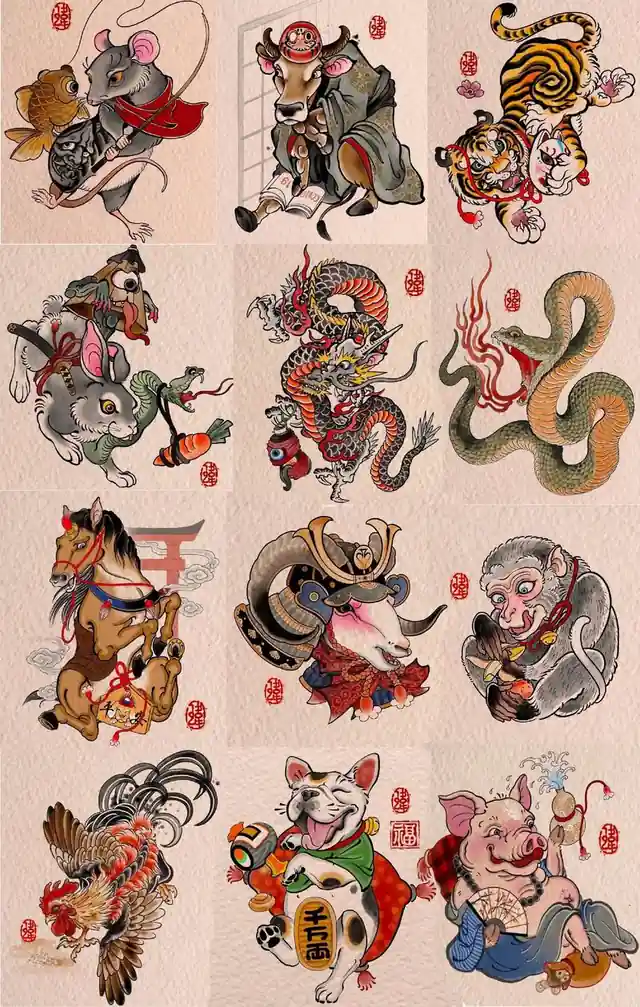
Zodiac figurines represent a very ancient form of zodiac plastic art. Buried in ancient tombs as funerary objects, they were regarded as sacred items that attract good fortune and ward off evil. In folk traditions, clay zodiac figurines have also been preserved as a customary practice. Whether for the study of ancient sculptural art or for the inheritance and development of zodiac culture, these figurines serve as an excellent reference.
For a long time, people have revered the twelve zodiac animals as gods of life. Even after death, they hoped to be guarded by these deities. This gave rise to an important form of zodiac art: the zodiac figurine. Also known as the twelve earthly branch spirit figurines, these twelve zodiac figurines were often buried in tombs as auspicious and protective talismans. It is generally believed that the tomb owners were individuals of considerable status and rank in their time.
As a very important form of plastic art, the more mature forms of zodiac figurines typically come in three types: first, figurines shaped as humans holding zodiac animals (such as a set displayed at the National Museum of China); second, figurines with human bodies and animal heads (like a set unearthed from a Tang Dynasty tomb in Xiangyin, Hunan); and third, zodiac animals resting on top of a human head. Among these, the first two types are more common. Based on the excavation of terracotta figures from the Qin Dynasty and other tomb artifacts from various periods, it is generally believed in the field that the burial custom of using twelve zodiac figurines as burial offerings flourished during the Sui and Tang Dynasties. In 1971, a set of twelve zodiac pottery figurines was unearthed from a Tang Dynasty tomb in Xiangyin, Hunan, all featuring animal heads on human bodies, depicted in wide-sleeved robes with a long, narrow hole in the center for inserting objects. These twelve figurines were placed in small niches around the tomb walls to indicate directional positions.
The twelve zodiac pottery figurines displayed at the Chinese History Museum were unearthed from Zhoujia Dawan in Wuchang, Hubei Province, and date back to the Sui Dynasty (581-618). These figurines depict seated elderly figures holding zodiac animals in their arms. For example: the Ox figurine (Chou Niu) shows a seated person holding an ox with both hands, its head turned to the left; the Dragon figurine (Chen Long) features a seated person with a dragon draped over their shoulder, the right hand holding the dragon's tail and the left hand supporting its belly, with one of the dragon's feet visible in front of the chest and another exposed at the side, its neck curved and head peering forward near the chest; the Snake figurine (Si She) presents a seated person holding the snake's head with both hands, its tail coiled in front of the chest; the Monkey figurine (Shen Hou) depicts a seated person holding a monkey with the right hand; the Pig figurine (Hai Zhu) shows a seated person holding a pig with both hands, its head turned to the right.
In addition, there was also a type of twelve-hour plate in ancient times, with the twelve zodiac animals depicted around its edge. According to legend, the patterns of these zodiac animals on the plate would change according to the passage of the hours: when it turned to the Hour of the Snake (9-11 AM), the snake pattern would appear, and when it turned to the Hour of the Horse (11 AM-1 PM), the horse pattern would emerge. These zodiac figurines reflect ancient burial customs, providing valuable materials for studying the craftsmanship of the time and the social status of the tomb owners, as well as offering precious insights into contemporary clothing and sculpture art.
Even today, various other forms of zodiac figurines (shengxiao yong) still circulate among the people. In Beijing, there is a clay figurine called "Tu'er Ye" (Lord Rabbit). The Qing Dynasty (1644-1912) work "Yanjing Suishi Ji" (Record of Seasonal Customs in Beijing) contains relevant records: "Every Mid-Autumn Festival, clever market vendors mold clay into images of toads and rabbits for sale, calling them 'Tu'er Ye.' Some wear hats and hold umbrellas, some ride horses, and some sit silently. The large ones are three chi (about 1 meter) tall, while the small ones are just over one chi (about 0.33 meters)." The "Tiger-Riding Tu'er Ye" is said to represent the Rabbit (Mao) controlling the Tiger (Yin), symbolizing the idea of the Rabbit consuming the Tiger's grain, implying a life of abundance and surplus. Clay figurines from Niejiazhuang in Gaomi, Shandong, have been produced since the early Wanli period of the Ming Dynasty (1573-1620), with themes including dolls, birds, animals, insects, and fish. By the Jiaqing period of the Qing Dynasty (1796-1820), the clay figurines of Niejiazhuang evolved from static pieces into playful toys that could move, make sounds, and engage in amusing interactions, giving rise to items like the roaring tiger, crowing rooster, and chattering monkey. In their construction, the head and tail are made in two separate parts, connected in the middle with leather or kraft paper, and equipped with internal steel wire springs and a whistle. When shaken by hand, they produce a chirping sound. Since these clay figurines are intended for children, some designs are particularly exaggerated. For example, the roaring tiger figurine has an extremely large head, especially the mouth, to display the tiger's majestic demeanor as the king of all beasts. The tail is designed to be particularly small, appearing as a short, abrupt protrusion on the tiger's rump, while the limbs are short and stout. At the center of the circular head, there is a gap for inserting the whistle, so that by pressing the tiger's head and tail, the tiger emits a crisp and resounding roar.
Further Reading
The Twelve Zodiac Animal Heads of the Old Summer Palace (Yuanmingyuan).
The Old Summer Palace bronze animal head statues, also known as the Old Summer Palace Twelve Zodiac Bronze Animal Heads or the Old Summer Palace Twelve Zodiac Human-Bodied Bronze Animal Heads, were originally placed on twelve stone platforms on both the south and north banks of the fan-shaped fountain pool in front of the Haiyantang (Hall of Oceanic Peace) within the Xiyanglou (Western Mansions) area of the Old Summer Palace. The south bank featured the Rat, Tiger, Dragon, Horse, Monkey, and Dog, while the north bank featured the Ox, Rabbit, Snake, Goat, Rooster, and Pig. These statues all had animal heads and human bodies, with heads made of bronze and bodies made of stone, and they were hollow inside to connect to the fountain pipes. Every two hours (one shichen, a traditional Chinese time unit), the zodiac animal representing that time period would spout water from its mouth. At noon, all twelve zodiac animals simultaneously sprayed water from their mouths, creating a spectacular sight. These bronze zodiac statues, each fifty centimeters tall and exquisitely crafted, are considered masterpieces of Qing Dynasty (1644-1912) bronze art. In 1860, when the Anglo-French Allied Forces burned down the Old Summer Palace, the twelve bronze animal heads were lost overseas. To date, only a few have been recovered.