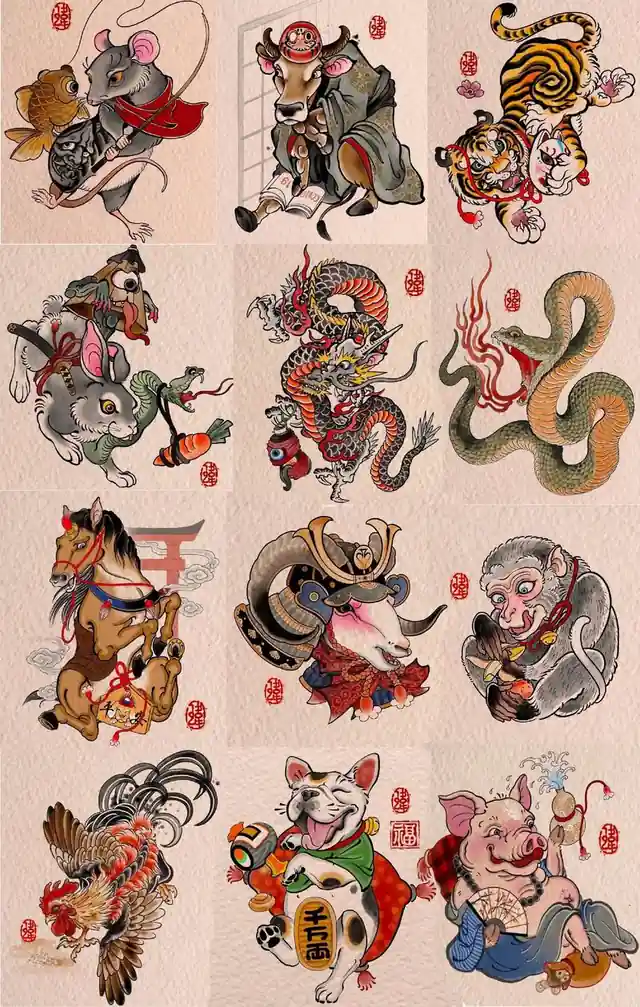
The goat is one of the indispensable animals in people's lives, occupying a pivotal position. The history of human domestication and raising goats is also the history of increasingly advanced technology and improved production and living conditions. Every stage of social development has left the footprints of goats, which also reveals the increasingly close relationship between humans and goats.
Goats were among the earliest animals hunted by humans and also among the first livestock to be domesticated. In China, the history of goat domestication spans over 8,000 years. Based on archaeological discoveries of goat bone fossils and goat-related artifacts, Chinese ancestors began raising goats during the Neolithic period, employing various herding methods: the "single whip" style, where herds move in a single file, advancing together; and the "starry sky" style, where goats scatter freely to graze. Herders walked on foot or rode horses, and worked alone or in groups. Goat skeletons have been found at Xia Dynasty (c. 2070-1600 BCE) sites. By the Shang Dynasty (c. 1600-1046 BCE), goat farming had reached a considerable scale. During the Zhou Dynasty (c. 1046-256 BCE), goat husbandry became even more developed, with an official position called "herdsman" established to oversee the six major livestock animals. According to the description in "Xiaoya · No Sheep" from the Book of Songs (Shijing): "Who says you have no sheep? Three hundred in a flock," a single flock at that time could consist of over 300 goats.
By the Spring and Autumn and Warring States periods, an increasing number of people raised sheep. According to the "Dasheng" chapter of Zhuangzi: "Those who are skilled at nurturing life are like shepherds, who whip the stragglers from behind." Using sheep herding as a metaphor for nurturing life shows that sheep husbandry had become quite widespread among the common people. During the Qin and Han dynasties, the sheep-raising industry continued to develop, with some individuals raising up to 1,000 sheep, truly a sign of thriving livestock. By the Han Dynasty, many skilled sheep herders emerged. During the reign of Emperor Wu of Han, a man named Bu Shi was specially tasked with tending sheep for the emperor, and the sheep he raised were plump, healthy, and greatly beloved. In the Wei, Jin, and Southern and Northern Dynasties period, despite frequent warfare, animal husbandry still saw some development. The Northern Dynasty folk song "Chile Ge" vividly depicts the pastoral scene of that time.
During the Sui and Tang dynasties, society was relatively peaceful and people lived in stability, which led to a significant increase in both the number and breeds of goats. At that time, goats introduced from foreign regions were crossbred with local goats, producing many excellent varieties and greatly promoting the development of goat husbandry.
During the Song Dynasty (960-1279), animal husbandry held primary importance in the northern regions where ethnic minorities gathered. When Su Song was sent as an envoy to the Khitan Liao Dynasty, he described the situation as "sheep gather in herds of tens of thousands, multiplying extremely abundantly," which demonstrates the high level of sheep farming development at that time.
During the Yuan, Ming, and Qing dynasties, sheep farming not only thrived in northern and central China but also saw significant development in the southwestern regions. According to the Dianhai Yuheng Zhi (Records of Yunnan's Coastal and Mountainous Regions), "Sheep are most abundant in central Yunnan, with several hundred arriving daily in the provincial capital throughout the year, without seasonal interruption. Occasionally, large-tailed sheep also appear, all of which come from the western regions (Yixi)."
Goats have long been constant companions to people, and the life of a shepherd has become a unique landscape of both hardship and personal understanding. Spending all year round on the grasslands, enduring wind and rain, frost and sun, shepherding is a life of compounded suffering. Yet, at the same time, it tempers a person's physique and willpower. Great generals of the Han Dynasty such as Wei Qing, who fought against the Xiongnu, Sima Qian, author of "Records of the Grand Historian" (Shiji), Zhang Hua of the Jin Dynasty, who wrote "Records of Diverse Matters" (Bowuzhi), and Jia Sixie of the Eastern Wei Dynasty, author of "Essential Techniques for the Welfare of the People" (Qimin Yaoshu), all once had experience as shepherds. In these cases, the goat has been endowed with a special symbolic meaning due to their glorious and brilliant lives.
Wen Tianxiang of the Song Dynasty wrote in his poem "Ode to the Goat": "The long-bearded chief clerk has a fine name, with a curly head and soft fur as bright as snow. Pulling a cart like Wei Jie, commanding stones to rise like Chu Ping. Leaving the capital without losing the righteousness of a lord, kneeling to suckle knows how to repay a mother's love. For thousands of years, the Xiongnu have raised many, adhering to bitter integrity like Su Wu of Han." "Long-bearded chief clerk" is an alias for the goat, because goats have a beard under their chin and often hold their head high while looking forward, like a knowledgeable and refined scholar, hence this name for the goat. Wei Jie mentioned in this poem was a man of the Jin Dynasty, exceptionally handsome and known as a jade-like person, often riding a white goat cart through the streets of Luoyang. The later mention of "Chu Ping" refers to Huang Chuping. According to Ge Hong's "Biographies of Immortals," he once herded goats on Jinhua Mountain for 40 years without returning home. When his brother found him and asked where the goats were, Chuping shouted, "Goats arise!" and then the white stones all turned into goats. Xiao Gang's poem "Immortal Guest" says, "Listening by the pond for the dragon's growth, shouting at stones to await the goats' return," and Li Bai's seventeenth "Ancient Style" poem says, "The goat-herding boy of Jinhua is a guest of purple smoke." These are all descriptions of "Chuping commanding stones to become goats." Today, in places like Hong Kong and Macau, Huang Chuping has even been elevated to the "Great Immortal Huang," who can turn stone into gold and grant all requests. "Su Wu of Han" refers to Su Wu, a loyal minister of the Han Dynasty who never abandoned his faith and loyalty despite countless hardships.
Further Reading
Su Wu Herding Sheep
Su Wu, courtesy name Ziqing, was a native of Duling during the Western Han Dynasty. He was sent as a Zhonglang General (a high-ranking official) on a diplomatic mission to the Xiongnu, but was unexpectedly imprisoned by them. The Chanyu (leader of the Xiongnu) tried to force Su Wu to surrender, yet he resolutely refused. Consequently, he was exiled to Lake Baikal (then known as the North Sea) to tend sheep for nineteen years. Throughout this time, Su Wu steadfastly held onto his Han envoy's staff, drinking snow and eating grass, unwavering in his loyalty. It was not until Emperor Zhao of Han established a peace treaty (heqin) with the Xiongnu that Su Wu was finally allowed to return to Han. Su Wu's sincere devotion to his homeland while in a foreign land is deeply moving, and the story of Su Wu tending sheep has become a symbol of patriotic resolve, steadfast loyalty, and unyielding integrity.