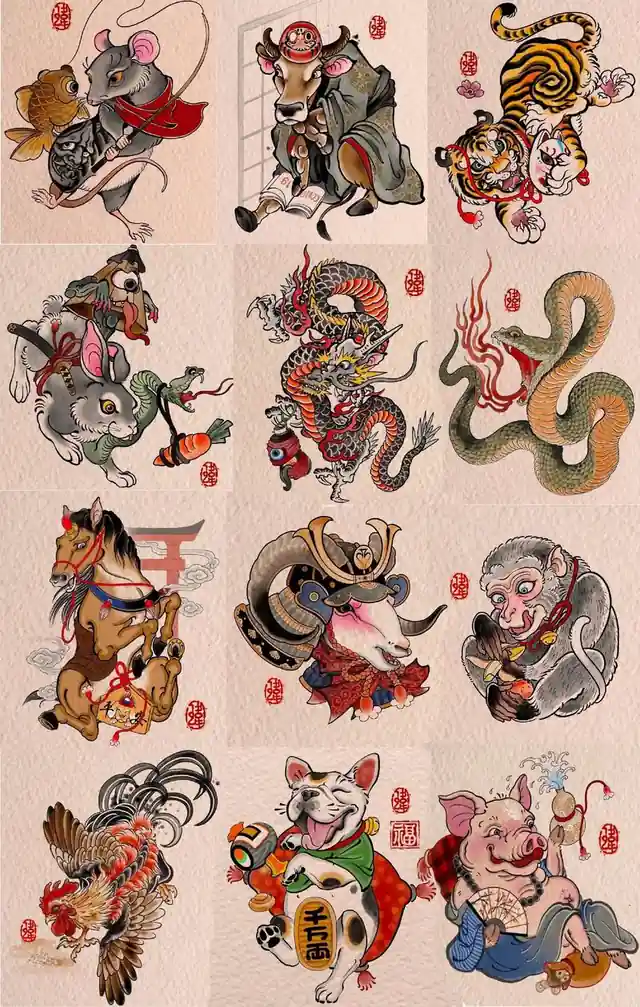
The culture of the Goat zodiac extends to all aspects of people's lives, becoming a bright landscape in folk customs. From the worship of the Goat deity to marriage and funeral ceremonies, and from delicious cuisine to clothing and adornments, traces of the Goat zodiac can be found everywhere.
The Goat, elegant and gentle, warm and affectionate, has been a close companion of the ancient Chinese people since time immemorial, deeply loved and revered. Legend has it that when the Flame Emperor (Yan Di) tasted various herbs to test their medicinal properties, he first had the goat sample them. Various folk customs related to the goat reflect people's worship of this animal.
Goat deity worship.
Due to the homophonic relationship between "yang" (sheep) and "yang" (sun), the connection between sheep and the sun has been elaborately embellished and creatively developed by people. As a result, the worship of the sun gradually merged with the worship of sheep. Over time, this gave rise to the belief that the Sheep God is the Sun God.
Beyond being associated with the sun god, the Goat was also revered as other deities. Since goats enjoy nibbling on wheat ears, grains, tree bark, and grass roots, ancient people connected the goat with the five grains and trees, considering it the god of the five grains and the tree spirit. In the "Kongzi Jiayu (The School Sayings of Confucius), Chapter on Distinguishing Governance," there is a mention of a auspicious bird called "Shang Yang," which could foretell rain. "Shang Yang" was thus regarded as the "Rain Master Deity." Due to ancient people's worship of mountains, earth, and stones, and because goats move nimbly on steep rocky surfaces as if on flat ground, there are also beliefs that the goat is the mountain god, earth god, and stone god. All these forms of goat worship express people's wishes to exorcise ghosts, ward off evil, ensure the prosperity of livestock, and enjoy a happy life.
In Hunan, Zhejiang and other regions, the fourth day of the first lunar month is also regarded as "Goat Day." On this day, people predict the prosperity of goat farming based on the weather: sunny weather signifies thriving livestock, while overcast conditions are considered inauspicious. Therefore, everyone hopes for bright sunshine on this day. On Goat Day, people refrain from slaughtering goats and avoid beating or scolding them.
Xiao County in Anhui Province has a long-standing tradition of enjoying mutton during the dog days of summer, known locally as "Fu Mutton." Historical legends trace this custom back to the era of Yao and Shun (legendary sage rulers in ancient China). Fu mutton refers to mutton consumed during the hottest period of the year, known as the "sanfu" days. This practice of eating mutton in the summer heat aligns with the traditional Chinese health philosophy of "unity of heaven and humanity" (Tian Ren He Yi) and also has some scientific basis.
Among the Bai ethnic group, there is a folk custom of offering sacrifices to the sheep spirit, held annually on the 23rd day of the sixth lunar month. The ritual is presided over by an elderly shepherd, and during the ceremony, a woolen felt is hung on a tree beside the altar to pray for the protection of the flock from wild beasts. The Qiang ethnic group venerates the sheep god, not only making sheepskin into vests but also stretching sheepskin into drums for beating. "Hanging red silk" is the highest ceremonial honor among the Qiang people, and every year during the Qiang New Year festival, they "hang red silk" for the sheep god. The Qiang's "Sheepskin Drum Dance" retains ancient vestiges of sheep worship, with the drum itself embodying a "unity of sheep and man" in its ritual implements.
Weddings, funerals, and other major life events.
In the Hubei region of China, there is a wedding custom called "sheep wine backpack" (yang jiu bei): when fetching the bride, cattle and pigs are used as betrothal gifts, and items such as sheep elbows, wine, and food are all placed in a backpack and carried to the bride's family, where they are distributed among the bride's relatives and friends. Among the Tu ethnic group in Qinghai, when the groom goes to the bride's home to fetch her, he must give the bride's family a female sheep symbolizing good luck and fortune; the bride's family keeps the female sheep as a substitute for the bride, allowing it to stay at home to reproduce offspring. Among the Han people in the Yangtze River Delta region, there is a wedding custom where the groom wraps a lamb in red brocade as a gift. Red represents festivity, while the lamb symbolizes good luck. The Xibe people have a folk custom of "grabbing the sheep bone" at weddings: a piece of sheep leg bone is placed between the groom and bride, and then the couple drinks wine. When they reach the third cup, relatives and friends from both sides begin to grab the bone. If the groom's side grabs it, it signifies that the groom is hardworking and capable, able to support his wife, and that the family will be happy. If the bride's side grabs it, it signifies that the bride is diligent and thrifty, that the couple will love each other, and that the family will be harmonious.
The use of sheep was also very common in marriage customs during the Han Dynasty. The ancient wedding ceremony included six rites: Nacai (proposal), Wenming (asking for names), Naji (divination), Nazheng (betrothal gifts), Qingqi (choosing the wedding date), and Qinying (wedding procession). The groom's family would present "three Nazheng" gifts to the bride's family, and among these gifts was a lamb, because a lamb kneeling to nurse from its mother symbolizes filial piety and loving kindness, expressing people's beautiful ideals for marriage. The formal engagement ceremony among the Han people was called "Dading," during which the groom's family would slaughter one sheep and one pig, dress them in the shape of a Qilin (a mythical auspicious beast), and send them to the bride's family, symbolizing great wealth and honor.
Because the character "yang" (sheep) is phonetically connected to "xiang" (auspiciousness), and "xiang" originally referred to mourning rituals — with the one-year anniversary of a parent's death called "xiao xiang" (small auspicious mourning) and the two-year anniversary called "da xiang" (great auspicious mourning) — sheep were always included when people made sacrificial offerings to ancestors, whether using the three sacrificial animals (ox, sheep, and pig) or the five sacrificial animals (ox, sheep, pig, dog, and rooster). At the Shang Dynasty site of Fuhao's tomb in Yinxu (the Ruins of Yin), real sheep and jade-carved sheep were buried as burial offerings, and oracle bone inscriptions from the Shang Dynasty contain numerous records of using sheep as sacrifices for the deceased. Wealthy families throughout history also placed stone sheep in front of tombs as guardians, while people in some areas of Zhejiang Province use "Qingming sheep" — made from wild vegetables and dough — to honor ancestors during the Qingming Festival. The Pumi ethnic group, during funeral ceremonies, uses a sheep as a substitute for the deceased, believing that the sheep can guide the soul of the dead, opening a path to send the spirit back to the ancestral homeland. These customs all seem to suggest that the sheep serves as a messenger bridging the realms of yin (the underworld) and yang (the living world).
Delicacies and Attire
"Roasted whole lamb" is a traditional delicacy of the Mongolian, Kazakh, and other ethnic groups. When served, large pieces of lamb are placed on a tray, arranged in the shape of a whole sheep, with the sheep's head offered to the guests. "Instant-boiled sliced lamb" (shuan yangrou) was originally a flavorful snack from the Xinjiang region, and it gradually spread to inland areas, becoming popular throughout China. Beyond food, sheep also feature prominently in people's clothing and adornments. Sheepskin and lambskin garments have been highly prized luxury attire since ancient times, and today, wool and cashmere products are found all over the world.
Further Reading
The "Goat" customs in childbirth and child-rearing
In the Xinxiang region of Henan Province, after a child is born, the son-in-law must lead a goat to his wife's parents to announce the happy news, and the wife's family reciprocates by also giving a goat as a return gift. In Lin County, Henan, and other areas, the birth announcement ceremony for the first child is especially important. The son-in-law goes to his in-laws' home carrying gift boxes and wine jars while driving two brown goats, with copper bells tied around their necks ringing all the way. Among the Han Chinese, after a baby is born, it is customary to dress the infant in animal-shaped shoes resembling goats. Mongolians wrap newborns in lamb skins, and when a child reaches a certain age, a hair-cutting ceremony is held. During this ritual, guests present sheep to the child, and the host family hosts a grand feast featuring a whole sheep. Among the Qiang people in areas like Aba, Sichuan, when a child undergoes a coming-of-age ceremony, the shaman uses white ewe wool thread as a gift from the ancestors, placing it around the initiate's neck and also around the neck of a live sheep. In the Naxi people's coming-of-age ceremony, wool threads are similarly tied around the initiate's neck. Clearly, in these customs, people place their good wishes upon the goat, making it a symbol of auspiciousness and peace.