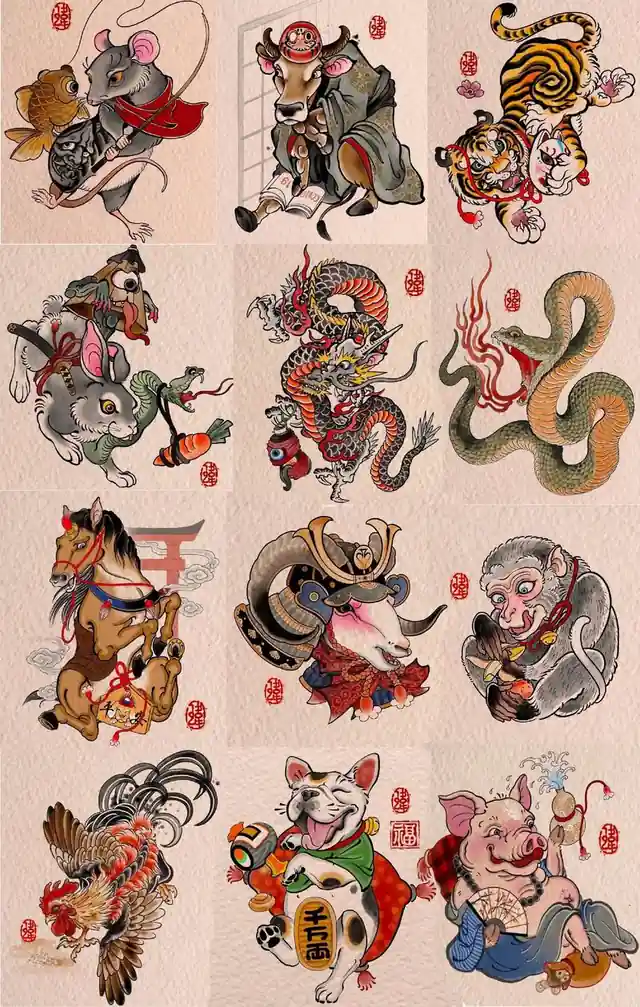
The phrase "a plump sheep is beautiful" is a familiar expression to us. However, according to research by relevant scholars, in ancient times people often used sheep horns as body ornaments, hence the concept of "sheep horns as beauty." The tradition of adorning oneself with sheep horns not only reflects the gradual enrichment of our ancestors' spiritual and cultural life but also reveals the long-standing history of zodiac sheep culture.
People generally believe that "美" (mei, beauty) is an associative compound character, based on the explanation in Shuowen Jiezi (说文解字, Explaining Graphs and Analyzing Characters) by Xu Shen of the Eastern Han Dynasty, which states: "美, meaning sweet, is composed of 羊 (sheep) and 大 (big)." The version of Shuowen JieziShuowen Jiezip is large, it is beautiful; the ancient script derives from 大 (big)." Duan Yucai of the Qing Dynasty further elaborated on this interpretation, arguing that "a large sheep is plump and delicious," and "anything good is called beautiful." Thus, the idea that "a big sheep makes beauty" seemed to become a settled conclusion. In reality, however, an examination of the character "美" in oracle bone inscriptions and bronze inscriptions reveals a different story.
In early oracle bone script, the character for "mei" (beauty) was not written in the seal script form derived from a goat shape. Instead, its lower half depicted an upright human figure, that is, the character "da" (big). The upper half somewhat resembled a goat, but it was not a goat; it was a human wearing four goat horns on their head. Scholar Li Xiaoding, in his "Jia Gu Wen Zi Ji Shi" (Collected Explanations of Oracle Bone Script), believed that the character "mei" "likely depicts a person adorned with a goat's head." Scholar Yu Xingwu, in his "Shi Qiang · Pan · Jing · Mei" (Interpreting Qiang, Pan, Jing, and Mei), clearly stated: "The early form of the character 'mei' resembles a person wearing four goat horns on their head, with 'da' representing the upright posture of a person." From this perspective, the early character "mei" was also a pictograph, originally depicting a person standing upright while wearing two pairs of goat horns. The claim that "a goat being large makes it fat and beautiful" has no factual basis.
Why is wearing goat horns considered beautiful? Yu Xingwu provided a very insightful explanation: "Wearing horns was a custom among many primitive peoples. Initially, it was used during hunting as a disguise to lure and capture wild animals, and it gradually evolved into a popular form of ornamentation. However, some clans only wore horned crowns as festive attire during celebratory festivals and dances; in other clans, chiefs or noblewomen wore horns as a symbol of honor; and in still other clans, shamans adorned the images of their worshipped deities with horns to convey dignity.
Therefore, the original form of "mei" (beauty) depicts a person wearing horns on their head, deriving its meaning from beautiful adornment. It was then extended to become a general term for beauty, and further extended to mean "sweet" or "delicious." In Shang Dynasty bronze inscriptions, there are several characters that also show a person standing upright while wearing horns. Initially, people did not recognize these characters. Later, through Yu Xingwu's analysis and research connecting them to oracle bone script, he identified them as the character "mei" (beauty). This is a relatively accurate explanation of the original meaning of "mei," and it has been widely accepted by scholars.
In the minds of ancient ancestors, wearing goat horns was considered the most beautiful and noble adornment. Primitive clans often had a fashion of wearing goat horns, ox horns, or deer horns. For example, the character "Qiang" (羌) in oracle bone script depicts a person wearing goat horns on their head. The Qiang were a goat totem clan, and they practiced the custom of wearing goat horns. Han Dynasty stone reliefs frequently feature goat horn decorative patterns as symbols of beauty. Even today, some ethnic groups influenced by ancient Qiang culture or descended from the ancient Qiang still retain the custom of dressing up as goats during certain activities. The Hehuang region of Qinghai is the birthplace of the ancient Qiang. Around the Lunar New Year, locals perform the "Old Goat Song" (老羊歌) to welcome the new year, with dancers wearing goat horn hats. In the southwestern region, the Baima people, descendants of the ancient Qiang, have a tradition from the fifth to the fifteenth day of the first lunar month of performing an exorcism dance to drive away evil spirits. They wear goat horns, put on sheepskin coats inside out, attach large goat tails, and imitate goat movements in their performances. These are all surviving customs from the ancient practice of wearing goat horns or goat totem symbols.
Most interestingly, in ancient times, goats once served as a symbol of femininity. According to Su Beihai's "Xinjiang Rock Paintings" (新疆岩画), in primitive rock paintings from Wenquan County, Xinjiang, one scene depicts two large argali goats and two small ones. The horns of the large goat on the lower left curve into an elliptical concentric circle with a triangle in the center, a common symbol of the female reproductive organ in antiquity. This symbol connects to the tail of one of the two small goats, and the horns of both small goats curve into circles that are linked together. Thus, the large goat and the two small goats form a conjoined goat image, embodying the significance of female fertility worship. The horns of the large goat on the lower right form nearly concentric circles, and its tail is almost connected to the other large goat. On the left side of the scene, there is also an oval shape resembling a vulva. This rock painting uses goats to symbolize women, expressing the ancestors' worship of female fertility. Consequently, from the perspective of female fertility worship, some scholars, combined with the Shang Dynasty bronze inscription character "美" (mei), analyze that the upper part uses goat horns to represent a goat, while the lower part depicts a human in full form with arms spread and a round, bulging belly, resembling a pregnant woman. This seems to indicate that a pregnant woman was regarded as beautiful, and they cite the praise of a pregnant woman as "incomparably large" (硕大无朋) from the "Book of Songs · Jiao Liao" (诗经·椒聊) to illustrate that ancient ancestors considered pregnant women beautiful.
Further Reading
Wild sheep at the four corners of Kunlun Mountain.
The Classic of Mountains and Seas (Shanhaijing) records many deities that are half-human and half-beast, some of which are divine beasts with four horns, such as the Tulou, described as "resembling a goat but with four horns." Hao Yixing's commentary notes: "The Tulou is also recorded in the Guangyun as a creature like a goat with four horns, whose sharpness is unmatched, and it kills anything it touches." Another creature is described as "resembling a goat with four horns, a horse's tail, and a spur." The Qinqin is said to "resemble a horse but with goat's eyes, four horns, an ox's tail, and a sound like a barking dog." These are a type of four-horned wild goat from the Kunlun Mountains region. This sufficiently demonstrates that ancient ancestors regarded wearing four goat horns upright as beautiful, a practice that indeed had a realistic basis.