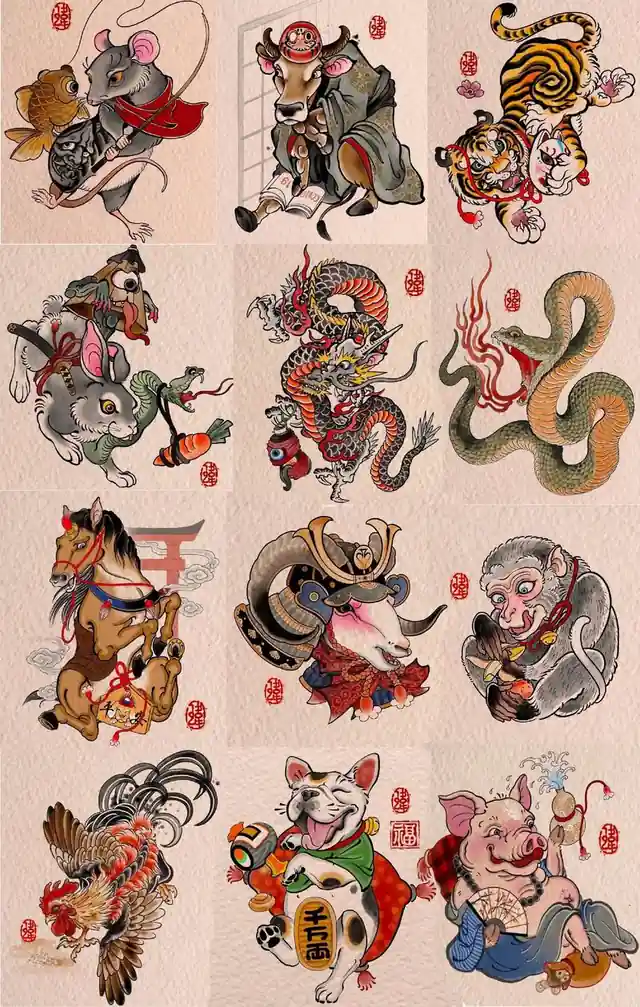
Throughout the long course of historical development, humans have forged an inseparable bond with goats, regarding them as symbols of auspiciousness, beauty, and kindness. This has given rise to a fixed cultural tradition that reflects people's deep affection for those born under the Goat zodiac sign.
People seem to have an innate fondness for the Goat. As early as the Han Dynasty (206 BCE-220 CE), the great scholar Dong Zhongshu highly praised the Goat in his work "Chunqiu Fanlu (Luxuriant Dew of the Spring and Autumn Annals)": "The lamb has horns but does not use them to harm, it possesses weapons but does not employ them, resembling one who loves benevolence; when caught it does not cry out, when killed it does not wail, resembling one who dies for righteousness; when nursing from its mother, it always kneels to receive, resembling one who knows propriety. Therefore, the word 'goat' (yang) is synonymous with 'auspicious' (xiang)." Being able to embody so many virtues in one animal shows people's deep affection for the Goat.
A symbol of good fortune.
As an important sacrificial offering in ritual activities, sheep were widely revered by ancient Chinese ancestors and even regarded as totems by certain ethnic groups, with the Qiang people in Chinese history being one such example. Xu Shen in Shuowen Jiezi (Explaining Simple and Analyzing Compound Characters) explained the character "Qiang" as: "Qiang refers to the Western Rong shepherds, formed from the components 'person' and 'sheep,' with 'sheep' also providing the pronunciation." He also said: "Sheep symbolizes auspiciousness." Using sheep as a national totem and for sacrifices truly reflects the concept of "sheep as an emblem of good fortune." Through long periods of hunting, nomadic life, and agricultural civilization, people developed a deep emotional bond with sheep, and the pure white body and gentle temperament of sheep gradually became synonymous with peaceful living and prosperous contentment. The Tang Dynasty poet Cao Tang wrote in his poem "Little Wandering Immortals": "Both love the early peace dwelling in nine-colored clouds, burning incense and not leaving the Golden Flower Gate. White sheep in flocks are hard to gather, having eaten all the giant blossoms by the stream." Using a flock of sheep as a backdrop, the poet expresses his longing for a harmonious and auspicious life.
A Symbol of Beauty and Goodness
Since ancient times, the character "美" (beauty) has been inextricably linked with "羊" (goat). Some believe that "羊大为美" (a big goat is beautiful), with the concept of beauty derived from the deliciousness of mutton. This view is represented by Xu Shen's explanation of the character "美" in Shuowen Jiezi (说文解字, Explaining Graphs and Analyzing Characters): "美, meaning sweet. Composed of 羊 (goat) and 大 (big)." Others believe that "羊人为美" (a goaShuowen Jiezile dancing or performing ceremonies, using goat horns as decoration, thus creating beauty. This theory is supported by a large number of unearthed oracle bone inscriptions from the Yin Ruins, as well as bronze and bone artifacts decorated with animal patterns. Still others believe that goats symbolized women in ancient times, and that beauty arose from the worship of female fertility. This view is backed by numerous rock paintings. Although the opinions are not entirely consistent, all agree that goats are related to humans and the origin of beauty, which is enough to prove that the goat is a symbol of beauty.
"Beauty" and "Goodness" are interconnected, and the Goat is also the embodiment of "goodness." The Goat has a gentle and kind nature, getting along well with humans. Even before being slaughtered, it neither cries out nor struggles, remaining calm and composed, as if embracing a spirit of sacrificing itself for righteousness. In the Song Dynasty, Huang Tingjian wrote in his poem "Playfully Responding to Zhang Supervisor's Gift of Goat Meat": "With soft ribs and tender fur, it lies full-bellied in the sand; you troubled your rider to send it to my humble home. I cannot bear to let the innocent be cooked in the kitchen; better leave it for the children to pull their little cart." It was the Goat's docility that stirred the poet's compassion — killing it would be unbearable, yet returning it would be awkward, so why not let the children keep it for play.
A Symbol of Strength
In ancient China, "yang" (sheep) was interchangeable with "yang" (sun). On a painted pottery basin from the Banpo Site, dating back 6,000 years, there is a pattern of sheep revolving around the sun: four sheep rotate around a solar symbol. Depicting sheep on food vessels clearly suggests a belief that sheep could channel a certain power needed by people. In the Western Han Dynasty (206 BCE - 9 CE) stone reliefs unearthed at Teng County, Shandong, there is a pattern of ram's horns piercing a bi disc. At the center of this pattern is a concentric circle symbolizing the sun, adorned with ram's horns above, flanked by ram-headed human figures on both sides, and fish below. Similar ram's horn sun-flower patterns appear on Western Han stone reliefs excavated in Jining. All of these embody the concept of the unity of sheep and the sun.
Beyond these traits, the flocking behavior of goats and the way lambs kneel while nursing are also regarded by people as expressions of kindness, affability, courtesy, and moral virtue. In the poem "Gao Yang" (Lamb's Fur) from the "Guo Feng" (Airs of the States) section of the "Shi Jing" (Classic of Poetry), it is noted that the ruler commanded his ministers to wear pure white and soft lambskin garments, hoping their moral conduct would be like that of a lamb—frugal, upright, and consistent in appearance and character. Similarly, the poem "Gao Qiu" (Lambskin Robe) from the "Zheng Feng" (Airs of Zheng) section of the "Shi Jing" uses the lambskin court robe as a metaphor, suggesting that a gentleman should possess the virtues of integrity and fortitude, maintaining a balanced and harmonious disposition that combines gentleness with strength.
Thus, the goat is seen as a combination and embodiment of various virtuous qualities in people's minds, which also reflects the unique connotations of the zodiac culture associated with the Goat.
Further Reading
The Goat serves as a messenger bridging the realms of Yin and Yang.
In primitive consciousness, the pregnant maternal body was regarded as the dwelling place of ancestors, with all things originating from it. The place where ancestors resided was the underworld, while human birth signified coming from the maternal body into the mortal world. Thus, the maternal body became both a passage between yin and yang and a bridge or messenger connecting the two realms. The Goat was seen as a symbol of reproductive worship toward the female maternal body precisely because of this underlying meaning. This is why the Goat could communicate with ghosts and mutually transform with them. In the Jin Dynasty, Gan Bao's "Soushen Ji" (In Search of the Supernatural) contains the story "Song Dingbo Captures a Ghost," in which a ghost can transform into a Goat, and a Goat can also transform into a ghost.