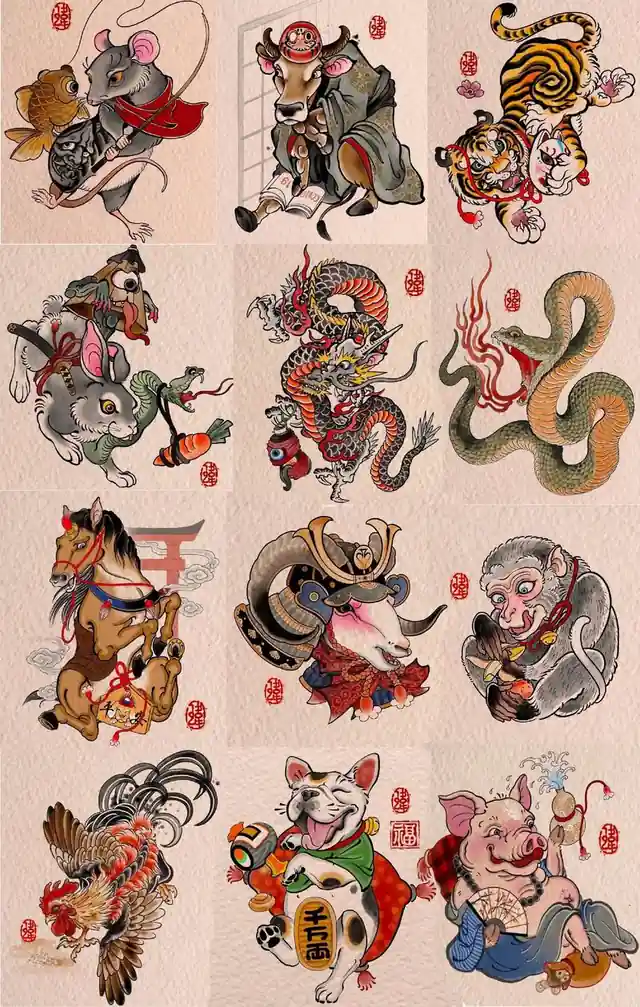
"Sanyang Kaitai (Three Yangs Ushering in Prosperity)" is a well-known idiom in Chinese culture, and it seems that from the very beginning, there has been a mysterious connection between "yang" (goat) and "yang" (sun), influencing poetry, painting, customs, and other aspects. As a result, the goat has been endowed with a special significance by people.
Whenever people exchange New Year greetings or write horizontal scrolls for Spring Festival couplets, the auspicious phrase "Sanyang Kaitai" (Three Yangs Bringing Peace) always lingers in their ears and appears before their eyes. "Sanyang Kaitai" signifies bidding farewell to the old and welcoming the new, as well as auspiciousness and well-being. This phrase originates from the Zhouyi (The Book of Changes). The Zhouyi describes unbroken Yao (solid lines) as Yang Yao and broken Yao (divided lines) as Yin Yao. The tenth month corresponds to the Kun hexagram, representing pure Yin; the eleventh month corresponds to the Fu hexagram, with one Yang emerging below; the twelfth month corresponds to the Lin hexagram, with two Yangs emerging below; and the first month corresponds to the Tai hexagram, with three Yangs emerging below. The first month is the beginning of the year, when winter departs and spring arrives. It is precisely the time when Yin and Yang are balanced, Yin recedes while Yang grows, and Yin and Yang converge. Therefore, it is called "Sanyang Kaitai," meaning that the communication between Yin and Yang brings renewal and growth to all things.
The Han dynasty scholar Liu Xi wrote in his work "Shiming·Shizirong" (Explanation of Names·Explanation of Postures and Appearance): "Wangyang: Yang refers to the goat, and also to yang (the masculine principle). The sound indicates that yang qi (positive energy) resides above, with the head raised high, as if gazing upward." In ancient times, "yang" (goat) and "yang" (the masculine principle) were homophones and thus interchangeable, giving rise to the phrase "Sanyang Kaitai" (Three Goats Bringing Peace). Among the common people, a depiction of three goats together or an image of three goats is also called "Sanyang Kaitai." "Tai" means peace and tranquility, while "Kai" means to open or initiate. In the Ming Dynasty zaju (variety play) "Naozhong Kui" (The Exorcist Zhong Kui), it is told that on the first day of the New Year, the True Lord of Three Yangs (Sanyang Zhenjun) would "lead the three goat princes" to hold a banquet beneath the Three Yangs Pavilion, with these "three goats" symbolizing the "three yangs." Beyond homophonic associations, ancient people also used the goat's natural behavior to explain the connection between "yang" (goat) and "yang" (the masculine principle). The "Taiping Yulan" (Imperial Readings of the Taiping Era) quotes from "Xinyan" (New Words): "In this month, plants begin to sprout. Goats can nibble grass, and chickens peck at grains. Therefore, hanging these two creatures helps to assist the yang qi."
Due to the phonetic connection between "yang" (sheep/goat) and "yang" (sun/positive force), the sheep/goat has also gained favor among folk artists, and its image frequently appears in paintings and embroidery patterns. In the auspicious design "Sanyang Kaitai" (Three Rams Bringing Peace), a mother goat protects her kids while the kids rely on their mother, creating an atmosphere full of maternal love and harmony, with pine trees, hillsides, small trees, and tender grass as background elements, symbolizing spring's return to the earth and a scene full of life and vitality. In the Qing Dynasty New Year painting "Sanyang Kaitai," a pomegranate produces a wisp of auspicious clouds, and three sheep with different expressions stand among the clouds, presenting a peaceful and harmonious scene that signifies the arrival of spring, the renewal of all things, and the auspicious omen of a prosperous nation and peaceful people. Therefore, a poem inscribed on the painting reads: "Heaven and earth are peaceful, three yangs bring peace; all flowers bloom in spring, everything is auspicious. As you wish and safe, with boundless joy; the hall is filled with wealth and lingering fragrance. Imperial decrees bless generations, poetry and books carry dragon's grace for a thousand years. Extend life and prolong years like flourishing pines; may blessings and virtue be deep and everlasting. Crimson clouds in the sky bring many celebrations; auspicious dew at the door brings great fortune." This poem clearly highlights the theme of auspicious sheep bringing good omens.
"San Yang Kai Tai" (Three Rams Bringing Prosperity) is also a common motif in embroidery. Among the four famous embroideries of the Qing Dynasty (1644-1912), Guangdong embroidery features a piece titled "San Yang Kai Tai". In the upper left corner, it depicts a red sun amidst auspicious clouds, while on the grass in the center, three rams are embroidered, surrounded by birds, butterflies, flowers, grass, trees, and rocks as embellishments. The three rams are mainly rendered in shades of eaglewood, antique bronze, and camel, with a cream-colored satin base, accented by stone blue, blue, white, and bright red, creating a vibrant and colorful effect that symbolizes the vitality of spring and abundant prosperity. During the Ming and Qing Dynasties, wood carvings and porcelain also frequently featured the "San Yang Kai Tai" pattern, all serving as symbols of auspiciousness, peace, and harmony.
In addition to the phrase "Sanyang Kaitai" (Three Rams Bringing Auspiciousness), there is also the saying of "Five Rams." Guangzhou is said to have received the auspiciousness of the Five Rams. According to legend, five immortals arrived in Guangzhou with five rams, bringing blessings for a bountiful harvest of all grains. Therefore, the people of Guangzhou revere the "Five Rams" as the "Gods of the Five Grains," and Guangzhou is also known as the "City of Rams." To this day, the Five Rams sculpture in Yuexiu Park within Guangzhou has become the emblem of the City of Rams.
In ancient times, there was also the "Jiuyang Qitai" (Nine Yangs Ushering in Prosperity) pattern, which depicted nine goats, a shepherd boy, pine trees, bamboo, and plum blossoms all in one image. The "Zhouyi" (Book of Changes) refers to yang lines as nine, stating "When the nine lines of Qian are used, the world is well governed," and since "goat" (yang) is homophonous with "yang" (positive principle), combined with the symbolic pine, bamboo, and plum blossoms of spring, this pattern signifies the return of spring to the earth and the arrival of good fortune. The Qing Dynasty polychrome kesi (silk tapestry) "Jiuyang Xiaohan Tu" (Nine Goats Dispelling Cold) features five auspicious clouds on the upper panel and nine goats on the lower panel, set against pine, plum, camellia, and rose, presenting a vibrant spring scene. Emperor Qianlong wrote a poem about it: "Do the nine goats imply the nine yangs? Hence the picture of dispelling cold in nine stages. At midnight, the return of spring can be seen in the heart; with three males opening the way, prosperity is still signified."
Whether it is the most frequently appearing "three", or "five" and "nine", their commonality is that they all have a certain relationship with "yang" (the masculine and positive principle in Chinese cosmology), symbolizing auspiciousness, good fortune, and peace. As a result, the Goat has left a beautiful impression in people's hearts, which to some extent also enriches and develops the culture of the Goat zodiac sign.
Further Reading
"Goat" and "Auspiciousness"
In ancient times, the character "yang" (sheep or goat) was not only interchangeable with "yang" (sun or positive principle) but also with "xiang" (auspiciousness). In his work "Shuowen Jiezi" (Explaining Simple and Analyzing Compound Characters), Xu Shen stated: "Yang (sheep) signifies xiang (auspiciousness)." Wang Guoyi, in his "Guantang Jilin" (Collected Works from Guantang), believed that "xiang" in ancient script was written as "yang." The inscription on the "Han Wash Great Auspicious Sheep" vessel reads "Great auspicious sheep, suitable for use," while the mark on the "Han Yuanjia Knife Inscription" states "Suitable for marquises and kings, great auspicious sheep." In the "Auspicious Sheep Diagram" unearthed from the Yanjiacha Han Dynasty tomb in Suide, Shaanxi, the central image depicts a stylized ibex with its head raised and striding forward, surrounded by auspicious clouds and divine birds and beasts. This demonstrates that the concept of "yang (sheep) as xiang (auspiciousness)" had become deeply rooted in people's hearts.