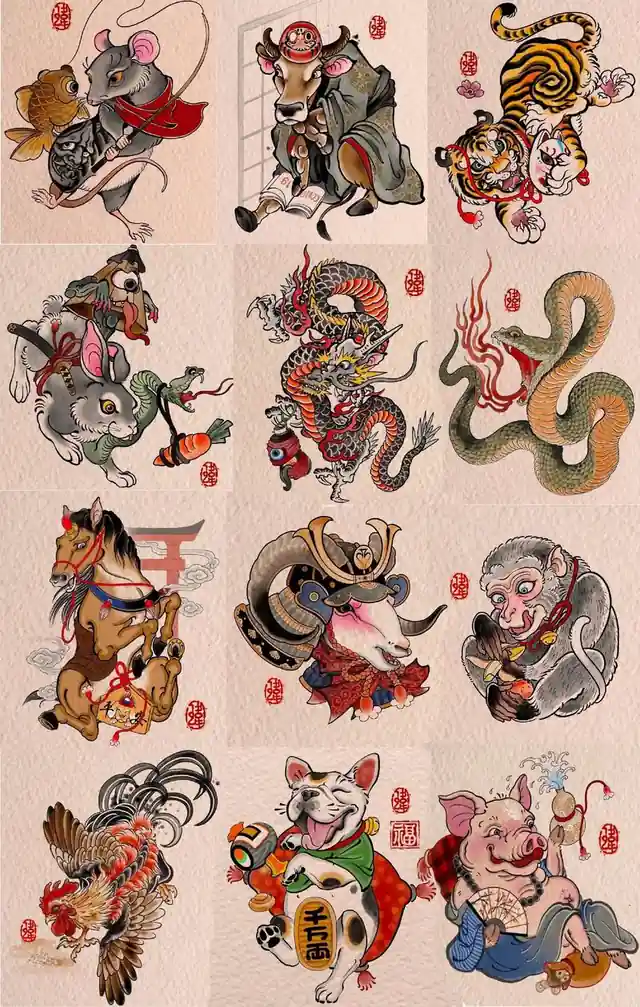
Pigs, with their large heads, big ears, and plump, robust bodies, are often regarded as symbols of good fortune. This has given rise to numerous customs that celebrate big ears as a sign of beauty, nobility, and blessing, and that view fat pigs as emblems of wealth, prosperity, and good luck — an indispensable part of the zodiac pig culture.
An ancient poem beautifully captures the essence: "When the year of the Pig arrives, fortune smiles wide, meeting a wise lord ensures wealth will reside. Look up and see joy, wealth and honor appear, a plump pig at the door brings blessings so dear. With profound knowledge, the crimson pen takes flight, a scholar's success shines ever bright." Today, when people speak of the Pig, they associate it with big ears symbolizing good fortune, wisdom disguised as foolishness, an endearing and carefree demeanor, and an auspicious omen. In folk tradition, the Pig is also known as the "Messenger of Fortune," embodying abundance, good luck, and prosperity.
Those with large ears are blessed and live a carefree life.
The Han Chinese people have a tradition of worshipping pigs, and the pig's plump head and large ears naturally became symbols of beauty and good fortune. Indeed, there are many famous figures in Chinese history known for their large ears. It is said that Yu the Great, who controlled the floods, had extraordinarily unique ears, historically recorded as "Yu's ears with three openings." "Opening" here means "cavity," implying that Yu's ears had three ear canals. It is believed that this facial feature foretold his ability to channel and manage the floodwaters that had raged for decades. One of the Five Hegemons of the Spring and Autumn period, Duke Wen of Jin, was named Chong'er, where "Chong" means "large," also referring to big ears. The ancient custom of revering large ears is frequently expressed in poetry and literature. For example, in the Han Dynasty Yuefu folk song "Long Song Xing" from the Xianghe song series, it is described: "An immortal rides a white deer, with short hair and ears so long." The "Book of Wei: Annals of Emperor Taizu" records that Emperor Taizu: "As a weak infant, he could speak; his eyes had a radiant gleam, and he had a broad forehead and large ears." In "Romance of the Three Kingdoms," Liu Bei, described as having "ears that touch his shoulders and arms that extend past his knees," is a household name. It is evident that the concept of valuing large ears as beautiful and noble has existed since ancient times and continues to this day. Even now, we often believe that people with thick and large earlobes are blessed with good fortune.
Ears that are large and drooping down to the shoulders are not naturally occurring but are artificially enlarged. Laozi, the ancient Chinese philosopher, had the surname Li, given name Er, and style name Dan. In Shuowen Jiezi (Explaining Simple and Analyzing Compound Characters), "Dan" is explained as "an ear that is long and extended." Duan Yucai's commentary further states: "Man means to stretch. An ear that is man means an ear that is stretched to become large." In other words, Laozi's beautiful, elongated ears were the result of deliberately pulling them long. Ancient Chinese texts also record various methods for enlarging ears. For example, the Book of the Later Han, in the "Biographies of the Southern and Southwestern Barbarians - Southern Barbarians" section, states: "Their leaders valued long ears; they all pierced them and then stretched them, so that they hung down three inches to the shoulders." This means that from childhood, holes were pierced in the ears, and then heavy objects were hung from them. As they grew older, the objects hung became progressively heavier, and the ears were pulled longer and longer, eventually reaching down to the shoulders.
The custom of venerating large ears actually originates from ancient pig deity worship. From surviving classical texts and historical artifacts, it can be seen that there were tribes in ancient China that took the pig as their totem. According to expert research, pig images on Hemudu pottery, pig motifs on Banpo pottery, and pig forms in Shang and Zhou bronze culture are all relics of pig totem worship. The pig's large ears are its prominent feature, so people sought to resemble the pig through large ears, hoping to gain protection from the pig deity; the custom of large ears is precisely an imitation of pig ears.
A plump and sturdy body naturally brings good fortune.
The plump and robust form of the Pig represents life, which signifies not only a thriving population but also bountiful harvests and, even more so, a steady flow of wealth. Therefore, the Pig is deeply beloved by the masses and has become a symbol of good fortune in folk culture.
In the mountainous regions of central and western Guizhou, children tie ropes around two stones representing an ox and a pig on the afternoon of the first day of the first lunar month, then lead them into the cowshed and pigsty while shouting, "I'm leading the ox and driving the pig here." They believe that stones embody the essence of the earth and can transfer the earth's vitality to the ox and pig, ensuring the prosperity of the six domestic animals. In Puning, Guangdong, farmers go to their fields on the night of the Lantern Festival to bring back two clumps of soil, placing them in their homes and inserting bamboo leaves into them, a practice called "embracing the big pig." This symbolizes that the fields, which nurture all things, can impart their life-giving power to the pigs, making them plump and healthy. In the Hebei and Tianjin regions, it is also customary to paste window paper-cuts featuring a "fat pig pushing open the door" during festivals and New Year celebrations. These paper-cuts are usually made from black waxed paper cut into the shape of a plump pig, with a treasure bowl (a symbol of wealth) carried on its back, to invoke the arrival of wealth and good fortune.
According to legend, starting from the Tang Dynasty (618-907 CE), newly selected Jinshi (imperial examination graduates) had to use a "cinnabar brush" (zhu bi) when inscribing their names on the Great Wild Goose Pagoda (Da Yan Ta). This is because "pig" (zhu) is a homophone for "cinnabar" (zhu), and "hoof" (ti) is a homophone for "inscribe" (ti). Whenever someone took the imperial examinations, their relatives and friends would give them braised pig trotters as a gift, wishing them success in "inscribing their names with the cinnabar brush" (zhu bi ti ming), meaning they would pass the exams.
Further Reading
The elegant name for the Pig is "Black Gold" (Wujin).
In folk culture, the concept that "the pig symbolizes wealth" has gained widespread recognition. In Chinese language and culture, the pig is referred to as the "golden pig" (jin zhu) or "black gold" (wu jin). The notebook "Chao Ye Qian Zai" (Records from Court and Countryside), compiled in the early Tang Dynasty (618-907), states: "In Hongzhou, someone raised pigs to become wealthy, and thus pigs were called 'black gold.'" Hongzhou is located in modern-day Nanchang, Jiangxi Province. Using the name "black gold" for pigs expresses a positive aspiration for them. Related folk tales have even formed a specific category, which scholars have named "the tale of luring the golden pig." In the folk culture of the Bai ethnic group, there is a mythological story about the "golden sow." In the Qian Gorlos region of Jilin, there is a folk legend called "The Five Little Golden Pigs." These stories reflect people's urgent pursuit of wealth and also illustrate the view that pigs are considered treasures.