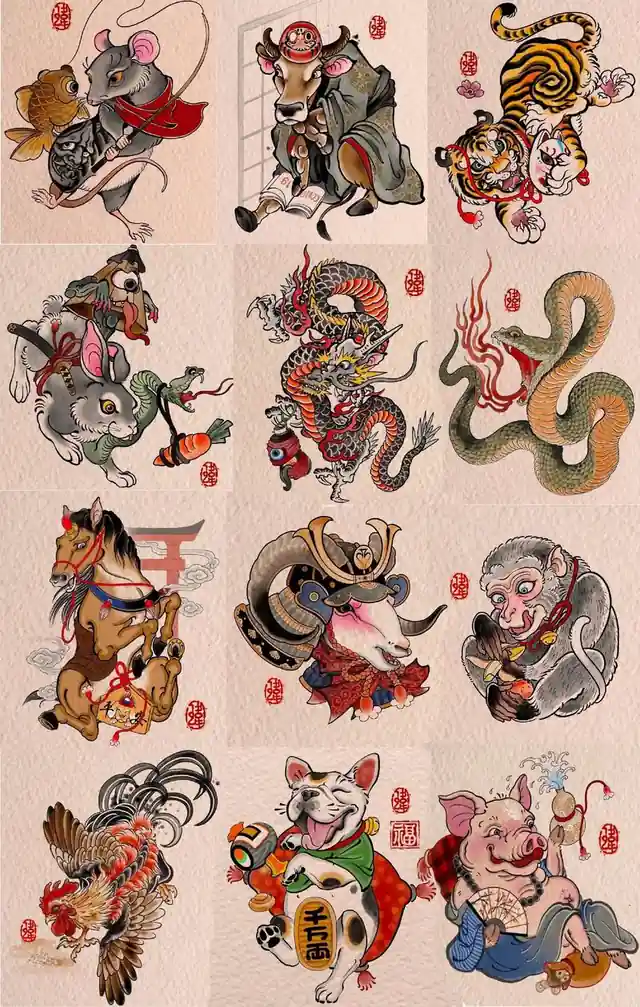
In people's everyday lives, especially during significant events such as sacrificial ceremonies and weddings, the pig's presence is indispensable. This not only reflects the important role pigs play in people's lives but also serves as a key reason why the zodiac pig culture remains vibrant in folk traditions to this day.
The pig occupies an important position in people's minds, so in traditional Chinese culture, the pig is always an indispensable presence in concepts such as "Liu Chu" (the six domestic animals), "San Sheng" (the three sacrificial animals), "Tai Lao" (a grand sacrifice involving an ox, a goat, and a pig), and "Shao Lao" (a lesser sacrifice involving a goat and a pig). As one of the most common animals in our daily lives, the pig has long been a fixture in Chinese popular culture.
Sacrificial rituals associated with the Pig.
The pig was among the earliest sacrificial offerings used in ritual ceremonies. The Han Chinese often refer to pigs prepared as offerings for annual festivals as "Sui Zhu" (year-end pig) or "Nian Zhu" (New Year pig). According to Han Chinese customs, pigs must be used as offerings in all major sacrificial rituals, with the pig's head being considered the most significant part, commonly known as "Zhu Tou San Sheng" (the three sacrificial offerings including a pig's head).
In the remote areas of Sichuan and Chongqing in the past, there was a folk exorcism activity among the Han people called "beating the sow ghost." Whenever a family encountered misfortune or illness, the elder of the household would set up an incense altar, perform a ritual to sacrifice a sow ghost, and make a vow to the gods, seeking to drive away evil. During the ceremony, an auspicious day was chosen to slaughter an old sow. The trotters, liver, intestines, and lungs were placed in a basket and set in the middle of the main hall. The host would burn incense and pray, believing that this action would "kill one sow ghost and expel one evil." The Yi people's custom of "purifying the home with a pig" shares a similar intention.
The main sacrificial offering in Manchu shamanic jumping rituals (tiaoshen) is also pork. The Manchu people would perform tiaoshen whenever they were ill, and some even did so without any illness. Wealthy families might perform it once a month or once a season, and by the end of the year, no household would skip it — this shows how prevalent the tiaoshen folk custom was. During the ritual, a pole was erected in the southeastern corner of the courtyard, with a bucket placed on top. Pork was put into the bucket and left for crows to eat, a practice known as "divine feasting." When performing tiaoshen, a female shaman would wear copper bells around her waist, shaking them to produce sound, while beating a drum with both hands and chanting incantations. After the ritual, the pork was taken home and eaten; everyone had to finish all the meat, or else it would be considered inauspicious. The essence of Manchu tiaoshen is to worship ancestors and seek their blessings for protection and safety. The Manchu people also relied on pigs when praying to various deities for good fortune and wealth. On the twenty-third day of the sixth lunar month, the birthday of the Horse King (Mawang), farmers would offer pork as a sacrifice in temples, believing that pleasing the Horse King would promote the prosperity of the six domestic animals (horses, cattle, sheep, pigs, dogs, and chickens).
In the Songzi area of Hubei Province, there is a custom known as the "Pig Head Offering" to pray for a bountiful harvest from fruit trees. Before the family reunion dinner on the 30th day of the twelfth lunar month (Chinese New Year's Eve), the people of Songzi reverently worship peach, pear, and apricot trees. They present a grand pig head to the fruit trees, hoping that the trees will grow well and bring abundant blessings to humanity. The Gelao ethnic group in Guizhou Province has a similar tradition called the "Tree Worship Festival," which takes place on the 14th day of the first lunar month. On this day, each household prepares offerings such as pure rice wine, fatty pork, glutinous rice, red paper, and firecrackers. They then perform a "tree worship" ritual, starting from the nearest trees and moving to the farthest, to thank the fruit trees for their gifts and to pray for even greater generosity in the future.
Wedding customs related to the Pig.
In the Shaanxi region, there is a wedding custom involving sending pig trotters. The day before the wedding, the groom's family sends four jin (approximately 2 kilograms) of pork and a pair of pig trotters to the bride's family, which is called a "gift offering." After keeping the gift, the bride's family returns the front trotters to the groom's family. On the second day after the wedding, the couple brings two bundles of dried noodles and the rear pig trotters to visit the bride's parents. The bride's family keeps the noodles but returns the rear trotters, a practice known as "trotters come, trotters go," symbolizing close and continuous interaction between the families. A similar custom, called "leaving mother's meat," is practiced among the Han and Manchu ethnic groups in Northeast China before weddings, where the groom's family sends pork to the bride's family.
Among the Blang ethnic group in the Xishuangbanna region of Yunnan, there is a custom of gifting skewered pork during marriage ceremonies. On the wedding day, both the bride's and groom's families slaughter pigs to host guests, and they also cut the pork into small pieces, string them on bamboo sticks, and distribute them to each household as a symbol of "blood kinship" or "bond of flesh and bone."
Delicious dishes associated with the Pig.
Since ancient times, pork has been regarded as a delicacy by many ethnic groups. The ancients were meticulous in pork preparation, believing that "mince meat as finely as possible and eat with the utmost refinement." Through countless variations, they developed a culinary style characterized by sweetness in the south, saltiness in the north, spiciness in the east, and sourness in the west, creating distinctive local flavors such as Shanghai drunken pork, Four-Happiness Braised Pork, Harbin air-dried pig tongue, Cantonese roast pork, Tianjin spiced dried pork, Anshan maple-leaf dried pork, and Sichuan cured pork. Dongpo Pork is also a famous pork dish, said to have been invented by the renowned Song Dynasty (960-1279) literary figure Su Shi (Su Dongpo).
Further Reading
A collection of alternative names for the Pig zodiac sign.
Besides the nicknames "Wujin" (Black Gold) and "Wuyang" (Black Goat), the Pig in the Chinese zodiac has several other historical aliases. The poet Du Fu referred to pigs as "Wugui" (Black Ghost) in his poem "Joking Verses for Cheerfulness" (Xi Zuo Xie Ti Qian Men Er Shou): "Every household raises Wugui, and every meal is yellow croaker." The Song Dynasty work "Man Shi Hua" (Casual Poetry Talks) explains: "People in Sichuan love this meat, so every family raises pigs. Du Fu's poem says 'every household raises Wugui,' which is correct. Whenever calling pigs, they make the sound 'Wugui,' hence the name." The Song Dynasty "Lan Zhen Zi Lu" (Records of the Lazy and Upright Scholar) also states: "Wugui means pig. In the Gorge region, many families worship ghosts and keep one pig, which is only used for ghost sacrifices. Therefore, among the pigs, they specifically call it 'Wugui' to distinguish it." Although the two sources differ in their explanations, they agree that pigs were called "Wugui." During the late Qing Dynasty, nobles also referred to live pigs as "Black Master" (Hei Ye) during sacrifices. The book "Life of Late Qing Nobility" (Qing Mo Gui Zu Sheng Huo) records the sacrificial sequence: "Then invite the sacrificial animal in (a live pig, called Hei Ye)." Similar to this is "Black-Faced Lord" (Hei Mian Lang), which is also a nickname for pigs.