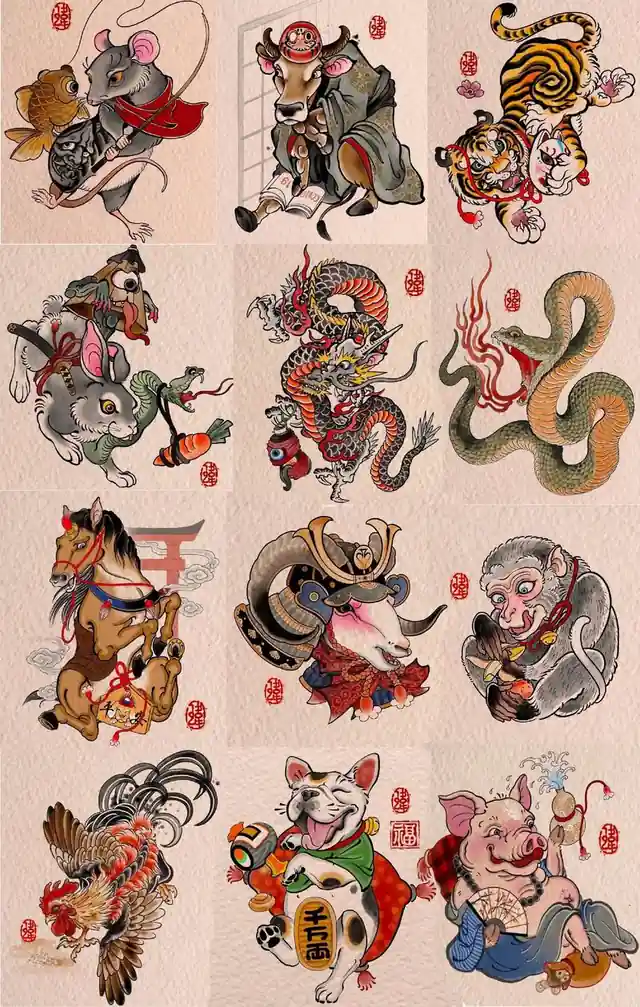
The pig was the first animal to be domesticated by humans as livestock and has the closest relationship with people's daily lives. Ancient people worshipped the pig spirit, and pigs have had a significant impact on human survival, reproduction, and development.
The Pig in the Chinese zodiac refers to the domestic pig, whose ancestor is the wild boar. As early as six to seven thousand years ago, China had already begun domesticating wild boars. Throughout the long history of coexistence between humans and pigs, pigs have had a profound influence on people's daily lives, everyday concepts, and even the formation of customs.
Humanity's worship of the pig spirit.
Though the pig is not particularly handsome in appearance, it possesses the great merit of separating heaven and earth. In ancient myths and legends, the Xiwei Shi (Pig-Faced Clan) who split heaven and earth is actually the image of a giant pig from antiquity. The Daoist philosopher Zhuang Zhou, in his work "The Great Ancestral Teacher" (Dazongshi), described the creation of the world by the Dao, stating that the Dao "has essence and trust but is without action or form; it can be transmitted but not received, attained but not seen; it is self-rooted and self-grounded." Zhuang Zhou believed that for the Dao to create the world, it first had to rely on the pig, meaning: "Xiwei Shi attained it, and thereby lifted heaven and earth." The pig first broke through the primordial chaos and split heaven and earth, after which other great creators took turns to act. Thus, the pig ranks far before Fu Xi, the Yellow Emperor, and the Queen Mother of the West in the work of creation. If the pig had not split heaven and earth, even the gods would have found it difficult to exercise their powers.
The pig is also closely connected to Nüwa, the creator goddess who molded humans from clay and repaired the heavens in Chinese mythology. She is considered the primordial ancestor of humanity. However, in some local temples dedicated to Nüwa, her statue is placed on a base shaped like a plump pig. The ancient worship of pigs was essentially a form of fertility worship. The pig became an object of fertility worship because of its plumpness, abundance, gluttony, and prolific reproduction, possessing extraordinary reproductive capabilities. At the Hongshan Culture site in Niuheliang, Liaoning Province, statues of plump female figures and fat pigs coexisted. The aesthetic preference for plumpness as beauty during the Han and Tang Dynasties (206 BCE - 907 CE) also had this underlying factor.
The contribution of the Pig to humanity.
Our human ancestors were originally primarily vegetarian. Plant-based foods contain only vitamins, salts, organic acids, and other nutrients needed by humans, with very low protein content. Apart from oil-bearing crops, fat content is also minimal, and they lack trace elements essential for blood production, such as cobalt, manganese, iron, and copper. If a person maintains a long-term vegetarian diet without adequate protein intake, it can lead to nutritional imbalance, reduced disease resistance, slowed reflexes, and accelerated aging. Throughout human evolution, the dramatic improvements in physical strength and intelligence are closely related to the increase in meat consumption, especially pork. Since wild boars were domesticated by humans, pigs have grown quickly and have an omnivorous diet, making them the primary source of meat for people. Pork is rich in protein, which has greatly enhanced human physical strength and intelligence.
Additionally, pigs can provide high-quality farmyard manure, with their feces and urine serving as excellent organic fertilizers. Pigs like to feed on snakes, which humans fear, and in some regions of southern China, when snakes become rampant in farmland, farmers release pigs into the fields to eliminate the snake infestation. Pig skin can be used not only for leather production but also to treat thrombocytopenia and severe burns. Pig hooves can be used to treat psoriasis, and pig intestines are processed into casings. Pig heart valves can be transplanted into humans to extend life. The hearts and other internal organs of pigs are similar in size to human organs, making pigs typical animals for medical research. Hormones similar to human insulin extracted from pigs can treat diabetes in humans. Pig bristles are used to make brushes, treat burns, and serve as other industrial raw materials. It is evident how important pigs are in improving people's lives and advancing society.
Further Reading
The pig worship in Hongshan Culture is primarily distributed in southeastern Inner Mongolia, southwestern Liaoning, and northern Hebei. It is a famous Neolithic culture in northern China, particularly known for its production and use of jade artifacts, with pig-shaped forms being the most numerous. Some of these pig-shaped jade artifacts are highly realistic, largely retaining the image of a pig, while others are more abstract, with bodies beginning to elongate and gradually transforming into dragon-like shapes. There are also pig-headed human figures, which served as objects of worship, evoking a sense of familiarity and reliability among the people. These became tribal totems, used to identify and unite the tribe's members, and were therefore sculpted with an expression of reverence and awe.
During the Hongshan Culture period, pigs had a very close relationship with the daily production and life of ancient ancestors; they represented both wealth and displayed bravery. In ancient times, the image of the pig was not a symbol of stupidity and laziness as it is today. Rather, ancient ancestors admired the wild boar's powerful physique and its spirit of daring to fight tigers and leopards.
The jade pig-dragon, a burial object from the Hongshan culture tombs, was a primary funerary item for the elite and priestly classes. In the Goddess Temple, large ceramic pig-dragon sculptures were enshrined in the main hall, indicating the pig's extraordinary status. Similar to small female figurines, these large ceramic pig-dragons were miniaturized for personal wear, serving both as talismans and auspicious symbols, while also representing social status and identity.