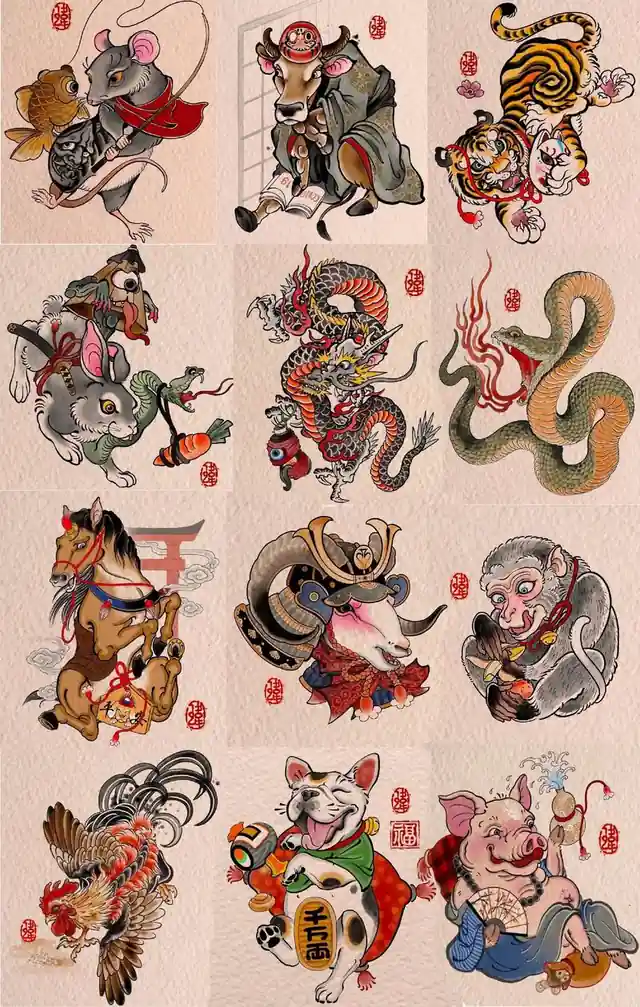
Whether viewed from the glyph structure of the Chinese character "jia" (家, family) or from the symbolic meaning represented by pigs, pigs are indispensable livestock in people's lives. Where there is a family, there is "shi" (豕, pig/swine). Even after a long agricultural society, in today's world where living standards are increasingly improving and science and technology are becoming more advanced, people still cannot do without pigs or the culture associated with them.
Ancient Chinese character creation primarily employed six methods: pictograms, indicatives, ideograms, phonetic compounds, synonymous notations, and phonetic loans. The character "jia" (家, family) is a phonetic loan, where "宀" represents a dwelling and "豕" represents a pig. Some scholars argue that the original meaning of "jia" (家) was the ancestral temple, a view supported by oracle bone inscriptions. Examples include "其侑报于上甲家" (offering sacrifices to the temple of Shangjia), "飨父庚、父甲家" (feasting at the temples of Fugeng and Fujia), and "仔于母辛家" (praying at the temple of Muxin). In these phrases, "报," "飨," and "仔" refer to sacrificial rites, while "上甲," "父庚," and "母辛" denote the objects of worship. Thus, "jia" (家) can only be interpreted as a place of sacrifice, i.e., a temple. In ancient sacrificial practices, the pig was a top-tier offering, regarded as a sacred and noble creature. Placing "shi" (豕, pig) within "jia" (家) underscores the high esteem the ancients held for the pig.
Later, in the development of folk proverbs, the saying "No pig, no family" emerged, reflecting the crucial role pigs played in China's long-standing agricultural society. "No pig, no family" is also a synonymous interpretation of "No woman, no family" and "No pregnant mother, no family." The concept of "No pregnant mother, no family" originated from ancient times before people recognized male participation in reproduction. In an era when only mothers were known but not fathers, people revered women who could give birth, believing that women, especially pregnant mothers, were the core of the family. Thus, they said, "No woman, no family" — with a woman, one could reproduce offspring and continuously strengthen the ability to withstand external hardships. The pregnant mother was the heart of the family, and the pig symbolized the pregnant mother. The inclusion of the pig in the Chinese zodiac reflects the relatively high status of women within the family.
Just as there is a relationship between pigs and the concept of "home," the structure of a house also shares certain connections with the pregnant maternal body. In ancient times, to avoid attacks by wild beasts and the ravages of wind and rain, early humans initially lived in natural caves. Later, through subterranean and semi-subterranean dwellings, they gradually developed above-ground houses. During the Neolithic period, people invented pottery, and houses were replaced by pottery-made bag-shaped or circular pit dwellings, the shape of which symbolized the mother's womb. With the advent of the agricultural era, people discovered the secret of the earth mother nurturing all things through the planting, germination, and growth of seeds, and found the belief and secret to overcoming death and achieving immortality — burial in the earth. Since ancient times, people have held the concept of reincarnation, believing that the earth, like the mother's womb, could bring the dead back to life, and that in-ground burial meant returning to the origin, returning to the womb, thereby allowing the deceased to be reborn and multiply endlessly.
Perhaps everyone has a question: since pigs occupy such an important place in people's lives and beliefs, why are they ranked last among the twelve zodiac animals? In fact, this is not a denigration of the pig, but rather an emphasis on the concept of returning home and the value of family.
The home to which the deceased return is called a "zhong" (tomb), and the shape of a "zhong" is also similar to that of a pig. In Neolithic burial sites, many pig bones were unearthed as burial offerings. According to the reasoning of ancient people, the pig (shi) was a symbol of the mother's womb, while "zhong" (tomb) represents the home of the deceased. The presence of a pig (shi) in the tomb (zhong) signifies that a person who came from the mother's womb has returned to it. Only by returning to the mother's womb can the deceased soul achieve rebirth.
In summary, whether people return home during their lifetime or to their burial place after death, they are returning to a place centered on the "Pig." The Pig ranks last among the twelve zodiac animals, precisely because it can fulfill the role of returning to the maternal origin and bringing about resurrection from death. This thereby completes the perfect cycle from the Rat to the Pig, laying the foundation for the continuation of the next twelve-year zodiac cycle.
Further Reading
The original meaning of the character "jia" (home/family) in Chinese.
In the bronze inscriptions of the Maogong Ding (毛公鼎, Mao Duke Bronze Inscription Vessel), the character "jia" (家, family) was written as "hun" (圂, ancient character meaning pigpen), taking its image from the pig's strong reproductive capacity. The original meaning of "jia" referred to sacred marital union. According to ancient texts, spouses in antiquity called each other "jia" (家). A husband called his wife "jia," as annotated by Wang Yi in the "Lament" chapter of Chu Ci (楚辞, Songs of Chu): "A wife is called 'jia.'" A wife also called her husband "jia," as annotated by Wei Zhao in the "Qi Yu" chapter of Guoyu (国语, Discourses of the States): "A husband is called 'jia.'" This unique form of address was rooted in the original meaning of "jia." Thus, "jia" evolved to mean a man marrying and starting a family. For example, in the "Meng" hexagram of Zhouyi (I Ching), the phrase "zi ke jia" (子克家) means a son can take a wife or engage in marital union, thereby performing rituals and music. In the context of ritual culture, only by establishing a "jia" (family) could one "jia" (engage in marital union), meaning that the propriety of marital union was based on marriage. The character "jia" could also be written as "jia" (嘉, archaic term for formal marital union), whose original meaning was marital union. The ancients called the marriage ceremony "jiali" (嘉礼, marriage ritual).