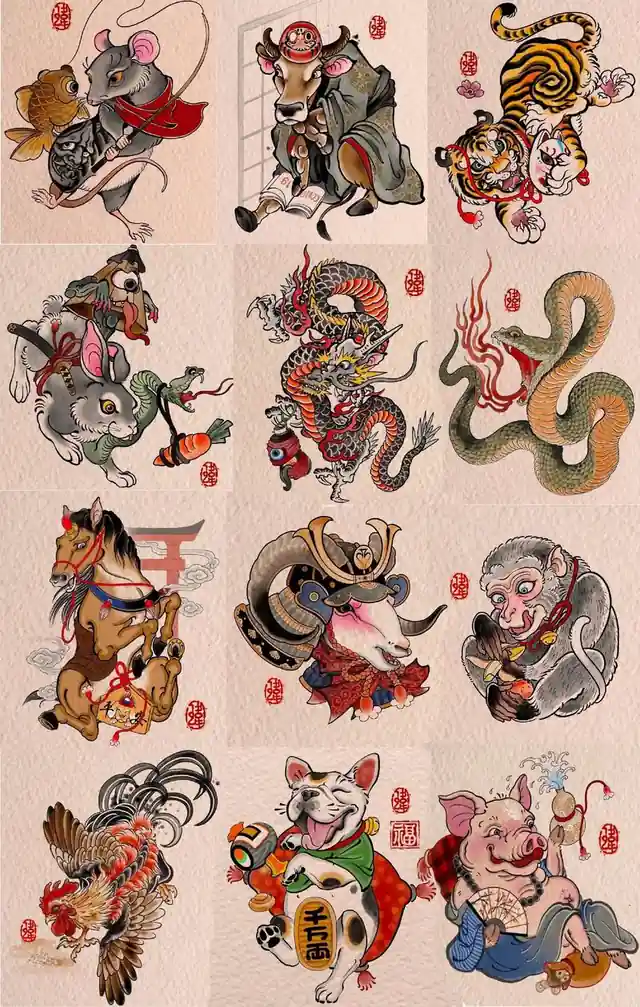
Influenced by the ancient ancestors' totemic worship of pigs, later generations revered the Pig zodiac sign as various deities, leading to the creation of many customs and traditions related to pigs, which further enriched and developed the culture of the Pig zodiac.
In ancient Chinese texts and classic literature, the worship of pig deities is extensively documented. Numerous records appear in works such as Zhuangzi, Shanhaijing (Classic of Mountains and Seas), Shiji (Records of the Grand Historian), Zuozhuan (Commentary of Zuo), Guoyu (Discourses of the States), and Shenyijing (Classic of Divine Marvels). Among the notable peoples who revered pig deities are Xiwei, Fengshi, Bingfeng, Shiwei, Taotie, Sanmiao, Dapeng, Hundun, and Guifang. The ancients believed that pigs, as sacred beings, could suppress demons and monsters while attracting blessings and good fortune. According to a note recorded by a Song Dynasty scholar, the founding emperor Zhao Kuangyin personally kept two divine pigs in the imperial palace, venerating them to pray for peace and to ward off evil spirits.
The Pig is regarded as the god of clouds and rain.
Pigs are naturally skilled swimmers, and since ancient times, there has been a folk saying: "Pigs can float across the Yellow River, and oxen can float across the sea." Because of this, pigs were also regarded as the gods of clouds and rain in folk belief, as people believed they could portend rainfall. In ancient legends, the image of the Thunder God (Lei Gong) was also depicted in the form of a pig. In his work "Touhuang Zalu (Miscellaneous Records of Exile)" from the Tang Dynasty (618-907), Fang Qianli described the Thunder God as having "the head of a pig and the body of a dragon."
The pig is also called "Wu Yang" (Black Goat) as an alternative name. Due to the pig's habit of long howling and digging, as well as the influence of the belief that pigs are deities of clouds and rain, pigs also became the main force in digging rivers and canals. According to the "Song Bai Lei Chao" (Classified Anecdotes of the Song Dynasty), when excavating a canal, an ancient water conservancy worker transformed into a large pig and charged forward vigorously. As a result, locals called the pig "Wu Yang" to commemorate that ancestor. The relationship between pigs and water is also because the Earthly Branch Hai (the twelfth Earthly Branch) is associated with water. In ancient times, building earth dams to block water was called "Yan Zhu" (Pig Dam), and the "Zhou Li" (Rites of Zhou) mentions "using a pig to store water," all of which are explanations of the relationship between pigs and water.
The pig is considered the patron deity of certain trades.
As the worship of the Pig deity further developed, folk culture also revered the Pig as the patron god of various trades. In the pig farming industry, many regarded Lady Ma as the guardian deity of pigs. According to legend, in the Daji Township area of Jingning, pigs once could not grow fat, and few households raised them. Later, Lady Ma manifested her divine power, and all the pigs raised by families in Daji Township became exceptionally plump and robust. To express gratitude to Lady Ma, the locals held the "Pig-Grabbing Festival" every autumn harvest season to repay the deity.
In many parts of Sichuan, the Four Officials Bodhisattva (Si Guan Pusa) is also revered as the patron deity of pig farming. Originally a god of wealth, the Four Officials Bodhisattva became closely associated with pigs because pig farming played a crucial role in Sichuan's agricultural economy. Many families relied on raising and selling pigs for their livelihood, so to some extent, wealth was seen as synonymous with pigs, and pigs with wealth. In eastern Sichuan, the pig trading industry honors three deities—the Four Officials Bodhisattva, Lady Zhu (Zhu Shi Fu Ren), and Lady Kang (Kang Shi Fu Ren)—as their founding patrons, praying for the prosperity of livestock and thriving business.
In rural areas of southern China, people often worship a toilet deity known as Zigu Shen (the Purple Maiden Goddess). Some say she is Lady Qi of the Western Han Dynasty (202 BCE-9 CE), who died in a latrine and became its guardian. Others claim Zigu was a concubine who, unable to endure the abuse from the primary wife, died in a latrine and was deified. Since toilets and pigsties were often combined into one structure, the toilet deity also served as the pig god and sty god. In practice, the toilet deity's role was not limited to matters of the latrine but was frequently used for divination on various affairs.
The Pig Pen God is a household deity worshipped by placing a single incense stick beside the pig pen. According to legend, the Pig Pen God is Jiang Ziya (a mythical figure from Chinese folklore). During the time of conferring divine titles, Jiang Ziya reserved the position of the God of Mount Tai for himself. However, when the only remaining titles were the God of Mount Tai and the Pig Pen God, Huang Feihu arrived, and Jiang Ziya granted him the title of God of Mount Tai while taking the position of Pig Pen God himself. In the mountainous regions of western Zhejiang, people often paste talismans written on yellow paper bearing the words "Jiang Ziya is here, no taboos apply" above the pig pen to ensure the safety of their pigs and to ward off any potential misfortune or violations. The Toilet God and the Pig Pen God essentially represent the transformation from a pig-shaped deity to a human-shaped pig god.
The Pure Altar Envoy (Jingtan Shizhe)
The pig has also been written into literary works, with the most well-known image being Zhu Bajie (Pigsy) from "Journey to the West." Zhu Bajie can be described as a magical creature that is a trinity of deity, human, and pig, with a lively and endearing character. He was originally the Marshal Tianpeng (Heavenly Reeds Marshal) in the celestial realm, but was banished to the mortal world and mistakenly reborn into a pig's womb after he violated heavenly laws by drunkenly harassing the Chang'e (Moon Goddess). He caused mischief among humans, forcibly marrying a mortal woman at Gao Village, until he encountered Tang Sanzang (Tripitaka) and Sun Wukong (Monkey King), leading to the comedic scene of "Zhu Bajie Carrying His Bride on His Back." He was later subdued by Sun Wukong and accompanied them on the journey to the West to obtain Buddhist scriptures, ultimately achieving enlightenment and becoming the "Altar Cleanser," responsible for enjoying sacrificial offerings from all directions.
Further Reading
The unique "Pig-Snatching Festival" (Qiang Zhu Jie)
Every autumn harvest season, people in southern Zhejiang celebrate the "Pig-Snatching Festival." Locals regard Lady Ma as the deity protecting pigs. During the festival, villagers invite a theatrical troupe to perform at Lady Ma's Immortal Palace for seven consecutive days and nights. On the seventh night, when the performance ends, pig-raising families immediately return home to slaughter their pigs, wash them clean, and tie them onto wooden racks. As soon as the first pig squeal echoes from the Immortal Palace, each family rushes with their pig rack toward the palace, racing to be the first. All the pig racks are lined up at the palace entrance, and people judge which pig is the largest and which is the smallest. Once the hour of Mao (5-7 AM) passes, the hosts invite relatives and friends to a feast, and guests must present red envelopes to the hosts. After the meal, based on the cash amount in the red envelopes, the host gives the guests an equivalent weight of pork at market price to take home, a practice known as "slaughtering for blessings." It is believed that the "pig-snatching" activity ensures that every family will raise fat and healthy pigs in the coming year.