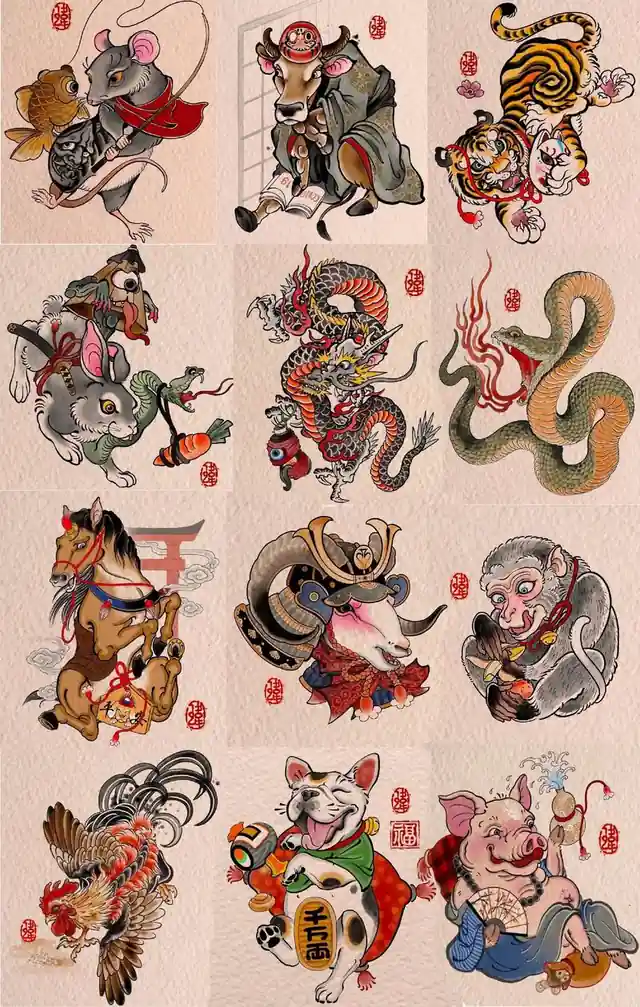
The moon is a symbol of reunion, and the Jade Rabbit is a symbol of the moon itself, thus the Jade Rabbit serves as a medium connecting wanderers with their families. In the Moon Palace, the Jade Rabbit pounds the elixir of life, and its pure moonlight illuminates the path for lovers to meet, making the Jade Rabbit a medium between lovers as well. The reason the Rabbit in the Chinese zodiac can act as such a medium is that it embodies the beautiful image collectively envisioned by people born under this sign.
Zhang Hua of the Jin Dynasty wrote in his work Bowu Zhi (Records of Diverse Matters) that rabbits become pregnant simply by looking at the moon. The reason rabbits conceive from gazing at the moon is that a rabbit already lives on the moon itself. On the night of the Mid-Autumn Festival, the fifteenth day of the eighth lunar month, when the moon is at its clearest and brightest, rabbits always gather in dense forests deep in the mountains to collectively gaze at the Rabbit King, thereby obtaining offspring. If the sky is not clear enough and the moon is not bright enough on this night, the number of rabbits will sharply decrease the following year. This legendary tale demonstrates that people believed there was a deep connection between rabbits and the moon, and thus the jade rabbit conveying affection became a symbol of longing for loved ones and forming bonds of fate.
During the Mid-Autumn Festival, people admire the moon and express their emotions through the Jade Rabbit.
The Mid-Autumn Festival is one of the most important traditional festivals in China, forming the three major folk festivals together with the Spring Festival and the Dragon Boat Festival. As early as the Zhou Dynasty (1046-256 BCE), there was a custom of worshipping the moon during the autumnal equinox, which was later fixed on the 15th day of the 8th lunar month during the Northern Song Dynasty (960-1127). Wu Zimu of the Song Dynasty (960-1279) wrote in Volume Four of his work "Menglianglu (The Record of the Splendor of the Capital)": "The Mid-Autumn Festival falls on the 15th day of the 8th lunar month. This day marks the exact midpoint of autumn, hence the name 'Mid-Autumn.' On this night, the moonlight is twice as bright as usual, so it is also called 'Moon Eve.'" On the night of the Mid-Autumn Festival, people often engage in moon gazing, offering sacrifices to the moon, and paying homage to the moon.
On the evening of the Mid-Autumn Festival, the entire family, young and old, gathers in the courtyard to share mooncakes, watermelon, and other fruits while admiring the moon. They discuss which shadows on the moon resemble Chang'e, the Jade Rabbit, or the Toad. This activity is commonly known as "Yuan Yue" (Wishing to the Moon). The methods of moon worship vary by region. In Wu County, Jiangsu, people pay homage to the moon from a distance in the open air. In some parts of Guangdong, they worship idols. In the Beijing-Tianjin area, people offer sacrifices to "Yue Guang Zhi" (Moonlight Paper) or "Yue Guang Ma Zi" (Moonlight Horse). These items are images of the Moon Goddess, depicting her with a human body and a rabbit's face, or showing a Jade Rabbit lying beneath the deity. Some prints feature a cassia tree with a Jade Rabbit standing upright, holding a pestle to prepare medicine. The images are inscribed with phrases such as "Tai Yin Xing Jun" (Grand Lord of the Lunar Yin) or "Guang Han Gong" (Palace of Vast Cold). The full moon on the Mid-Autumn Festival night symbolizes perfection and reunion. People share mooncakes and watermelon during this festival, hoping to absorb the moon, the Toad, and the Jade Rabbit's strong reproductive power and vitality for rebirth.
Throughout history, poets have expressed their feelings during the Mid-Autumn Festival by writing verses, inevitably mentioning the Jade Rabbit, which symbolizes the moon in these poems. In the Tang Dynasty (618-907), Bai Juyi's poem "Mid-Autumn Moon" reads: "The vast clear light beyond imagination, adds sorrow and hate around the horizon. Who has long been stationed on the frontier? Where has a new parting occurred in the courtyard? When the discarded concubine returns to her chamber at night, and the old general captured by barbarians ascends the tower. It shines upon many hearts breaking, the Jade Rabbit and Silver Toad are far away, unaware." In the Southern Song Dynasty (1127-1279), Xin Qiji's "Man Jiang Hong · Mid-Autumn" states: "Beautiful scenery and fine moments, I reckon, are only for pleasant winds and moon. Moreover, during the clear season, the radiance shines long, extremely pure. Eagerly climbing the tower to gaze at the Jade Rabbit, who draws a curtain to shield the Silver Palace? I beg the Wind God to blow it open, but who can say? The waxing and waning, from the full moon to the crescent. Today and yesterday, what difference is there? I envy the night that holds the osmanthus flowers, ready to be plucked. How can I ascend the Heavenly Pillar, leisurely accompanying to celebrate the festival? Even more now, not listening to the pure talk, my sorrow is like hair." These two poems are classic works of "Jade Rabbit Sentiments."
At the beginning of the year, the Rabbit leads the way on the path of "Tou Qing" (stealing greens, a traditional folk custom for good luck).
In southern Fujian, Guangdong, and other regions, there is a custom where unmarried women sneak into others' vegetable patches on the night of the Lantern Festival to pull up green vegetables, known as "stealing greens." In the Huazhou area of Guangdong, a folk rhyme goes: "The sky is clear, the moon is bright, the Jade Rabbit leads the way to steal greens. Stealing scallions makes one clever, stealing lettuce brings wealth." A folk saying from southern Fujian states: "Steal scallions, marry a good husband; steal greens, marry a good son-in-law." These describe the scene and purpose of the custom. Stealing vegetables is only symbolic, as women typically pull just two or three plants, so the owners do not mind. The main vegetables stolen are scallions, Chinese celery, and lettuce, chosen for their homophonic meanings: scallion (cong) sounds like "clever" (cong), celery (qin) sounds like "diligent" (qin), and lettuce (shengcai) sounds like "generating wealth" (shengcai). The hope is that these women will marry a smart and hardworking husband, and enjoy a prosperous and happy family life after marriage.
In terms of the original meaning of "stealing greens" (tou qing), the practice primarily symbolizes "green" (qing) and "life" (sheng), representing the vigorous vitality of spring. As spring arrives and all things revive, young men and women go to the fields to steal greens on the night of the Lantern Festival, perform moon dances in the first lunar month, and take spring outings around the Qingming Festival. These activities help dispel the gloom and stagnation of winter while infusing them with the vibrant energy and fertility of nature. A young woman might steal greens from the vegetable patch of her beloved, while young men also come to the fields under the pretext of preventing their greens from being stolen. Using the custom of stealing greens as an opportunity, couples meet under the moonlight on the night of the Lantern Festival. The Jade Rabbit (Yutu) serves as their guide, as it is a symbol of the moon; thus, matchmakers are also called "the old man under the moon" (yuexia laoren) or "moon elder" (yuelao).
Further Reading
The Rabbit's Symbolism as a Neglected Wife in the Boudoir
Due to the lonely and solitary image of the Jade Rabbit pounding medicine, people often associate the resentful woman in the boudoir with the Jade Rabbit. Dou Xuan of the Han Dynasty had an extraordinarily handsome appearance, and the emperor took a liking to him, forcing him to divorce his original wife and marry a princess instead. Dou Xuan's wife was deeply sorrowful and resentful, but unable to contend with the emperor, she could only compose "Ancient Song of Lament" (Gu Yuan Ge) for her husband. The poem reads: "Lonely white rabbit, runs east and looks west. Clothes are better when new, but people are better when old." She compared herself to a solitary and helpless white rabbit. In the Yuan Dynasty, Ma Zhiyuan, in his zaju (a form of Chinese opera) "Autumn in the Han Palace" (Han Gong Qiu), described Emperor Yuan of Han's longing for Wang Zhaojun by saying: "Ah, I gaze upon this vast wilderness of desolation, the grass has already turned yellow, the rabbit rises early to face the frost. The dog's fur grows coarse..." Using the bleak and desolate atmosphere of the autumn wilderness, he expressed his longing for the person in his dreams.