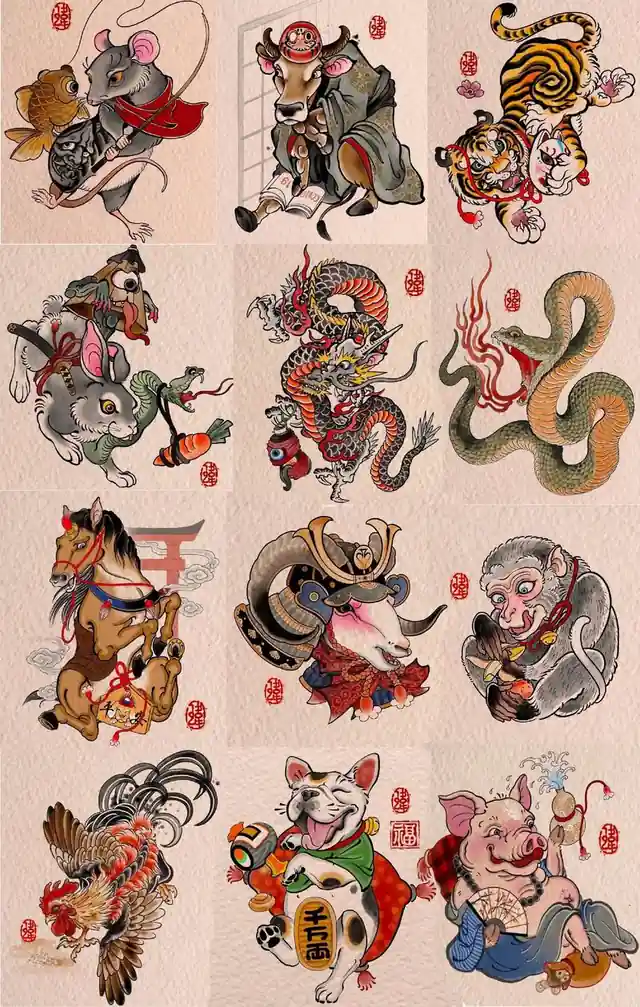
Perhaps due to the rabbit's small and delicate body, along with its inherently gentle and kind nature, it is widely loved by people. Although it does not have as great an influence as other zodiac animals, traces of the zodiac rabbit can still be found in totem worship, traditional festivals, and even daily life taboos.
Wild hares did not have a significant impact on the lives of ancient peoples, and the domestication of wild hares into domestic rabbits occurred relatively late. As a result, the reverence for the Rabbit zodiac sign was not as widespread as that for other animals in the twelve zodiac signs. Nevertheless, in folk customs, the beliefs surrounding the Rabbit zodiac sign are still diverse and varied.
Rabbit Totem and Rabbit Deity
In Chinese history, rabbit totems were rarely found among the totemic worship of Chinese ethnic groups, and the deification of the rabbit appeared relatively late. In Daoism, among the "Sixty-Year Tai Sui Star Lords" (also known as the "Ben Ming Yuan Chen Star Lords"), five are protective deities for those born in the Year of the Rabbit. They are: the Ding Mao Tai Sui, General Shen Xing; the Ji Mao Tai Sui, General Long Zhong; the Xin Mao Tai Sui, General Fan Ning; the Gui Mao Tai Sui, General Pi Shi; and the Yi Mao Tai Sui, General Wan Qing. These five generals all appear in the form of rabbits, either dressed in wide-sleeved robes or wearing helmets and armor. In Buddhist scriptures, the rabbit appears as a divine beast. For example, the mount of the Vajra deity (Fazheluo Shenjiang) is a rabbit; and in the Jingdao Cave on the Eastern Sea Golden Mountain, there is a rabbit dwelling inside.
Among some ethnic minorities in China, examples of the rabbit being regarded as a totem or a deity can be found. The village flags of the De'ang ethnic group mostly evolved from primitive totems, and the rabbit is one of them. The Lisu ethnic group has over 50 clan totems, including the rabbit totem. Among the 24 surnames of the Lisu people on Biluo Snow Mountain, which are totemic surnames, the rabbit appears. The Mosuo people of the Naxi ethnic group also once used the rabbit as a totem. Although the rabbit's status as a totem or immortal is not particularly high, its history of being listed among the celestial beings is very ancient. In early times, the rabbit resided in heaven, standing alongside the gods. On a stone relief from a Han Dynasty tomb gate in Mixian County, Henan Province, a scene is carved where rabbits play music in the sky together with immortals: two immortals, two celestial rabbits, one flying horse, and one bear. Among them, the two celestial rabbits sit kneeling, each holding a pipe-like musical instrument with its right front paw, raising it to its lips to play a tune.
Customs of the Rabbit
In ancient Han Chinese culture, there was a seasonal custom called "hanging rabbit heads" that was popular in many regions across the country. On the first day of the first lunar month each year, people would make rabbit heads from flour, collect snow water in bamboo tubes, and hang these items along with New Year banners and masks above the door lintel to ward off evil and dispel disasters. Additionally, there was a parenting custom of giving rabbit-themed paintings, in which six children were depicted surrounding a table, with a person standing on the table holding a rabbit auspicious symbol, wishing the recipient child a life of peace and steady advancement in the future.
The Lantern Festival on the fifteenth day of the first lunar month, also known as the Festival of Lanterns, features the rabbit lantern as a standout among animal-shaped lanterns, deeply beloved by children. In some areas of Shandong, people make lanterns out of bean flour, called mian deng (flour lanterns). These flour lanterns are often crafted by the children's grandmother or mother, who mold one for each family member according to their zodiac sign, inevitably including a rabbit lantern. At night, the whole family lights them together, symbolizing family reunion, while also carrying the meanings of warding off illness and disaster and praying for prosperity and population growth.
Due to the legend of the Jade Rabbit Pounding Medicine, people often regard the rabbit as the essence and soul of the moon. As a result, the rabbit became associated with the Mid-Autumn Festival moon worship and was frequently offered as a sacrifice by the folk. Ji Kun of the Ming Dynasty recorded in his work "Huawangge Sheng Gao" (Remaining Manuscripts of the Flower King Pavilion): "During the Mid-Autumn Festival in Beijing, clay is often molded into the shape of a rabbit, dressed in clothes and sitting upright like a human figure, while children worship and bow to it." This describes the Rabbit Lord (Tu'er Ye). By the Qing Dynasty, the function of the Rabbit Lord had shifted from a moon worship offering to a children's toy for the Mid-Autumn Festival.
During the Ming and Qing Dynasties (1368-1912), it was already very common to paint rabbits on Mid-Autumn Festival mooncakes. Peng Yunzhang, a late Ming Dynasty scholar, wrote in "Customs of Youzhou": "The moon palace cake is made with the shadow of the Silver Toad and Purple Palace, a pair of toad and rabbit fill the human world. How regretful was Chang'e, who stole the elixir of immortality, fled to the vast cold palace never to return, leaving only the pestle pounding elixir in vain to preserve her youthful face." Fucha Dunzhong of the Qing Dynasty recorded in "Record of the Seasons of Yanjing": "Mooncakes are offered everywhere, with the largest ones over a foot in diameter, painted with scenes of the moon palace, the toad, and the rabbit."
Taboos and Customs Related to the Rabbit in the Chinese Zodiac
In many places across China, there exists a taboo against pregnant women eating rabbit meat. People believe that if a pregnant woman consumes rabbit meat, the fetus will develop a cleft lip resembling a rabbit's mouth, a belief that appeared as early as the Eastern Han Dynasty in Wang Chong's "Lunheng (Discourses Weighed in the Balance), Chapter on Fate and Destiny," which states: "If a pregnant woman eats rabbit, the child will be born with a harelip." In some rural areas of western Inner Mongolia, a saying circulates: "Hunt foxes and snare rabbits, and you'll never wear good pants in your life," implying that harming creatures like rabbits will bring bad luck, lead to just retribution, and cause the perpetrator to be reborn as the very animal they killed.
In fact, these claims are completely without scientific basis. They are merely subjective conjectures based on the image and characteristics of the rabbit, and are not credible.
Further Reading
Why Was the Rabbit God Once Expelled from the Heavenly Court
Among the Naxi people, a branch called the La clan believes that the tiger is their ancestor, while the rabbit was once their deity. Legend has it that the heavenly god Ge'ermei created heaven, earth, and all things but had not yet created humans. Ge'ermei wanted to send a god down to earth to create humanity, but all the gods were afraid to respond, fearing that the earth's foundation was still unstable and disasters were numerous. So Ge'ermei had to assign the task by name. He said to the Rabbit God: "You are the most clever god in heaven, eloquent and persuasive. It seems that sending you to create humans is the most suitable choice." The rabbit shook its head and twitched its ears, making a crying face, and said: "I have been suffering from an eye disease these past few days. I cannot see anything clearly. Not to mention going down to earth to create humans, even eating and sleeping require other gods to take care of me. It is better to send another god." Hearing this, the heavenly god Ge'ermei became very angry and said: "It seems you are nothing but a coward who only talks big. How can you still qualify to be a god in heaven, enjoying celestial fruits and delicacies? You are only fit to eat grass." The words of Ge'ermei, the king of all gods, all came true. From then on, the rabbit became a timid herbivore.