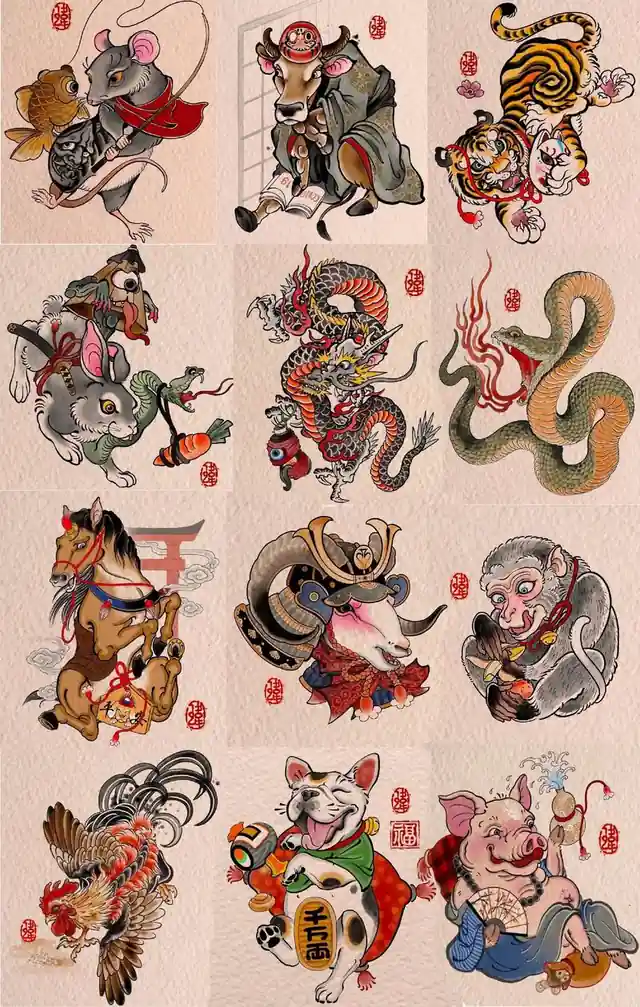
As time flies like a rabbit running and the sun crow flying, the zodiac Rabbit has always held an important position in traditional Chinese culture. Its powerful vitality has continuously influenced people's consciousness and concepts, giving rise to many long-standing cultural phenomena.
In traditional Chinese culture, the zodiac sign of the Rabbit has left its traces everywhere. As early as the beginning of China's feudal society during the Shang Dynasty, people created the pictographic character for rabbit through observation and understanding, which gradually evolved into the modern character "兔" (tù, rabbit). Many Chinese characters are related to the rabbit, such as 免 (miǎn, to avoid), 娩 (miǎn, childbirth), 冤 (yuān, injustice), and 逸 (yì, escape).
The original meaning of "mian" (免) is "rabbit escaping." Shuowen Jiezi (说文解字, Explaining Graphs and Analyzing Characters), Chapter Tu Bu, annotates: "When a rabbit is not caught by humans, it is called mian (免)." Later, through extension, any instance of evading or avoiding disasters or other unfavorable events came to be referred to as "mian" (免).
The character "娩" originally referred to rabbit reproduction. The Erya (尔雅, Ancient Chinese Lexicon), Chapter Shi Shou states: "兔子曰娩" (rabbit birth is called mian). Later, through linguistic development, "分娩" (fenmian) came to specifically refer to human childbirth. This shows that from the very beginning of human life, people encountered a cultural phenomenon related to rabbits. Moreover, every twelve years brings a Rabbit Year, and those born under the Rabbit sign are accompanied by this zodiac animal throughout their lives.
People sometimes feel wronged by certain things they encounter. The character "冤" (yuān, meaning injustice or grievance) has "兔" (rabbit) as its main component. To discuss "冤," we need to explore the relationship between "冤" and "兔." In the Eastern Han Dynasty, Xu Shen's Shuowen Jiezi explains "冤" as: "冤 means to be bent or constrained. It is composed of '兔' (rabbit) and '冖' (cover). A rabbit under a cover cannot escape, thus it is bent and twisted." "冖" means "to cover." From this perspective, the original meaning of "冤" refers to a trapped rabbit that cannot move freely. By extension from the covered rabbit to humans, the term "冤枉" (yuānwang, to be wronged) came into use.
The character "yi" (逸) is derived from "rabbit" (兔). Its original meaning is "the rabbit cunningly escapes and is lost," implying indulgence, speed, and similar concepts. From indulgence came meanings of comfort, leisure without toil, and other connotations. Today, the commonly used term "anyi" (安逸, ease and comfort) carries this layer of meaning.
China has many idioms and allusions related to rabbits, such as: "Stand by a tree stump waiting for a rabbit" (waiting idly for a stroke of luck), "Cook the hound after the hare is caught" (get rid of someone once they have served their purpose), "A wily rabbit has three burrows" (multiple plans for self-protection), "The fox mourns the death of the hare" (sympathy for a fellow sufferer), "Move like a startled hare" (swift and agile), "A turtle's hair and a rabbit's horns" (something that does not exist), and "A hawk swoops down on a rabbit" (swift action). The idiom "A wily rabbit has three burrows" uses the cunning rabbit's multiple dens to metaphorically suggest that people should have multiple hiding strategies and contingency plans to protect themselves. It originates from the famous "Feng Xuan Serves Lord Mengchang" in the "Strategies of the Warring States" (Zhanguo Ce). Lord Mengchang, the prime minister of the state of Qi, had a retainer named Feng Xuan, who was sent to collect debts in Xue. Feng Xuan asked Lord Mengchang what he should buy after collecting the debts, and his master replied: "Buy whatever I lack." Upon arriving in Xue, Feng Xuan saw that all the debtors were poor farmers, so he immediately announced in Lord Mengchang's name that all debts were canceled and burned the debt contracts. When Feng Xuan returned, Lord Mengchang asked him what he had bought, and Feng Xuan said: "You have plenty of wealth, horses, and beauties, so I only bought 'benevolence and righteousness' for you." When Lord Mengchang learned the truth, he was both angry and frustrated, but it was too late to undo what had been done, leaving him helpless. Later, the king of Qi dismissed Lord Mengchang from his position as prime minister, forcing him to retire and live in Xue. When the people of Xue heard that Lord Mengchang was coming, they came out in droves, the elderly supporting the young, walking dozens of li to line the road and welcome him. Only then did Lord Mengchang realize the value of the benevolence and righteousness that Feng Xuan had bought for him, repeatedly thanking him. Feng Xuan said: "A wily rabbit has three burrows, only then can it avoid death. Now you have only one place of refuge, so you cannot sleep peacefully without worry." This means that a cunning rabbit needs three burrows to escape the danger of death; with only one refuge, you cannot rest easy.
Beyond idioms and allusions, myths and legends about rabbits, such as the rabbit dwelling in the Moon Palace and the Jade Rabbit pounding medicine, have also been passed down through generations. In classical Chinese opera, rabbits also appear as characters. During the 12th century, the four great Southern Operas were popular in Jiangnan, two of which are related to the moon and rabbits: "The Pavilion for Moon Worship" (Baiyue Ting) and "The Story of the White Rabbit" (Baitu Ji). "The Pavilion for Moon Worship" is a love story centered around the custom of moon worship, while "The Story of the White Rabbit" tells of a family reunion triggered by a white rabbit. Based on a folk legend, "The Story of the White Rabbit" follows Liu Zhiyuan, who leaves his impoverished home to join the army. His wife, Li Sanniang, suffers discrimination and torment at her wealthy family's home, who despise poverty. After giving birth to a son, she sends him to be raised by Liu Zhiyuan. Over a decade later, Liu has become a prominent official. While hunting, his son tracks a white rabbit and encounters Li Sanniang, leading to an end to her hardships and a joyful family reunion.
China has long been an agricultural nation, so the emotional attitudes of the ancients toward rabbits rarely involved economic factors. In daily life, people's fondness for rabbits' lively and adorable appearance, as well as their dislike of rabbits' timidity and cleft lips, stem only from considerations of the rabbit's appearance and habits, as well as the degree to which these traits align with people's inner preconceptions. Therefore, in traditional Chinese culture, people's likes and dislikes regarding the Rabbit zodiac sign are primarily determined by the symbolic meanings that the rabbit represents.
Further Reading
Hunting hare was a common activity among ancient people.
Hunting rabbits was a recreational activity for high-ranking officials and nobles since the Qin and Han dynasties. Fan Li once said, "When the cunning rabbit dies, the running dog is cooked," which reflects that ancient people used dogs to catch wild rabbits. During the Warring States period, people in the Chinese region gradually learned to ride horses, making rabbit hunting more convenient and its entertainment nature more prominent. When Li Si, the Chancellor of the Qin Dynasty, was falsely accused by Zhao Gao and sentenced to death, he said to his son on his way to the execution ground: "I wish I could once again lead a yellow hound out of the east gate of Shangcai to chase the cunning rabbit — is that still possible?" On the verge of death, he still longed for the joy of rabbit hunting in the past. While hunting rabbits could certainly represent pleasure, what Li Si felt most deeply at that moment was probably the freedom he had during those hunts — a freedom he had long lost, as he became Zhao Gao's prey in the arena of political intrigue.