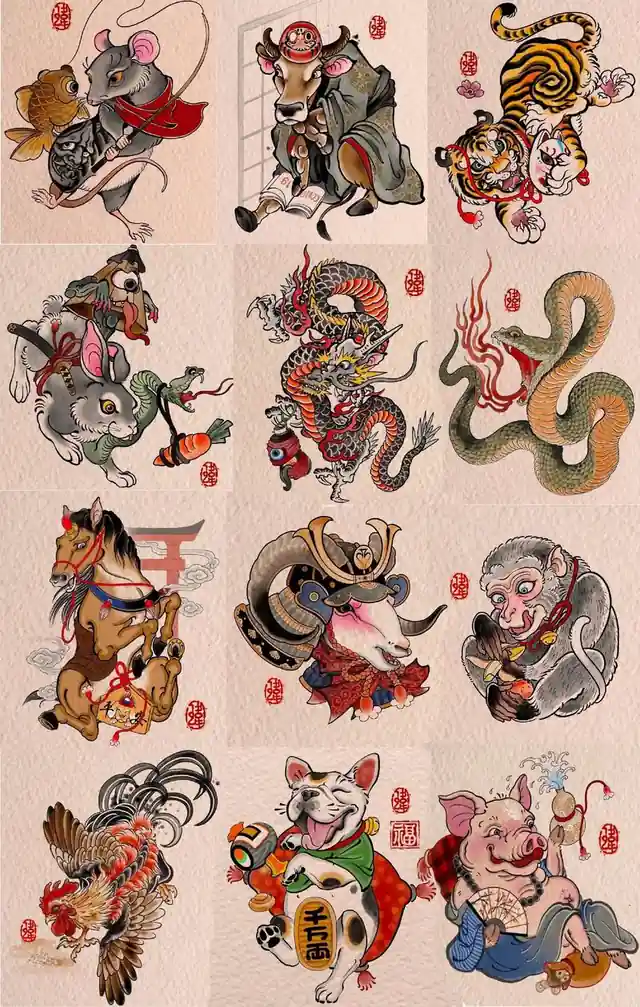
People born in the Year of the Rabbit have intricate connections with the other eleven zodiac animals. Some share similar or closely related attributes, while others are opposites. Through these comparisons, one can observe both the differences between them and the many commonalities they contain.
All living beings exist within certain biological chains, influencing and constraining one another to maintain the balance of nature. The Rabbit in the Chinese zodiac is no exception, as it has various connections with other zodiac animals. Whether in appearance or living habits, the Rabbit and the Rat are highly similar. In legend, the "Flying Rabbit" is even directly referred to as the "Flying Rat." Some biologists have concluded through research that rats and rabbits share a common origin and are closely related. To this day, some rabbit species are still classified under the "Pika" family (Ochotonidae), demonstrating the close relationship between rabbits and rats.
Both the Rabbit and the Ox are friends of humanity, embodying kindness and goodness. In early unearthed Han Dynasty stone reliefs, there are works depicting the Rabbit and the Ox together in the same scene, suggesting a deep cultural connection between them. In the past, in the Nanzhang and Changyang areas of Hubei Province, China, the fifteenth day of the eighth lunar month was celebrated as the Ox King's birthday, and on this day, scriptures were recited during the Mao hour (5:00-7:00 AM). Locals believed that Mao corresponds to the Rabbit, and in Chinese, "Rabbit" (tù) is homophonous with "thorough" (tòu), meaning that the scriptures must be recited thoroughly to ensure the oxen become plump and healthy. Coincidentally, this day also falls on the Mid-Autumn Festival, when the Rabbit in the moon and the Ox on earth shine in harmony, making it a shared auspicious day for both the Rabbit and the Ox.
The Rabbit and the Tiger stand at opposite poles, representing softness and strength respectively. Most people know that there is a rabbit in the moon, but there is also a saying that a tiger resides there: In Qu Yuan's "Tianwen (Questions to Heaven)," the line "And Gu Tu is in its belly" appears. One interpretation holds that "Tu" means "Rabbit," thus a rabbit is in the moon, while another believes that "Gu Tu" is actually "Wu Tu," which in the Chu dialect refers to the "Tiger." Although the Rabbit and the Tiger are vastly different, their distinctions become blurred here. In Beijing folk art, there is also a clay sculpture called "Lord Rabbit," depicting a rabbit riding on a tiger's back—an imagination bold and unique enough.
The reason why the Rabbit can rank before the Dragon has been discussed earlier: one dwells in the sky or water, while the other lives on land. People imagine a race between them, with the Rabbit emerging victorious, likely out of sympathy for the physically weaker creature.
Both the Rabbit and the Snake have extremely wide ranges of habitation, and their different habits instead lead people to believe that the two can complement each other. Additionally, superstitious beliefs such as "where the Snake coils around the Rabbit, wealth is sure to follow" have further strengthened the connection between them.
Both rabbits and horses are known for their swift running, but in reality, rabbits can be several times faster than horses. People wished for horses to be as quick as rabbits, which gave rise to the concept of using rabbits to name horses. For example, names like Fei Tu (Flying Rabbit) and Chi Tu (Red Rabbit) are both derived from the rabbit.
Like the goat, the rabbit is a symbol of kindness. Among the Yao ethnic group, there is a folk legend that both a goat and a rabbit reside on the moon: the hero Yala shot a large embroidered tapestry depicting a white goat and a white rabbit onto the moon. Unexpectedly, the white goat and white rabbit stepped out of the tapestry and began to leap about playfully. Later, Yala also ascended to the moon, where he remains to guard the lovely white goat and white rabbit.
The Rabbit's cunning and agility correspond to the Monkey in the Chinese zodiac, yet in people's perception, the Rabbit seems even more clever than the Monkey. Additionally, the tradition of "the Rabbit carries the bright moon" and the image of the Monkey King Sun Wukong were both influenced to some extent by Indian culture, which further strengthened the Rabbit's status in traditional Chinese culture.
There is also a deep cultural connection between the Rabbit and the Rooster. The Rabbit symbolizes the moon, while the Rooster is the herald that calls the sun to rise, making them opposites. However, the moon is associated with water, and since the Rabbit is linked to the moon, it is also connected to water. According to the "Rijian" (Daily Records), it is recorded: "You (the tenth Earthly Branch) corresponds to water, and also to the Rooster." Thus, the Rabbit and the Rooster share common ground. The mathematical problem of "chickens and rabbits in the same cage," which often appears in arithmetic, likely has its own unique cultural background.
Since ancient times, the Rabbit and the Dog have been natural adversaries; in the wild, when a dog attacks a rabbit, the rabbit has no means of fighting back. However, in Chinese zodiac culture, these two signs actually get along well with each other, and in marriage matching, there is a saying: "A Green Rabbit and a Yellow Dog have been a good match since ancient times, bringing vast wealth and a hundred bushels of fortune."
Due to their different living habits, there seems to be no necessary connection between the Rabbit and the Pig. However, in some regions, old beliefs considered the Rabbit and the Pig to be compatible. For example, in the traditional marriage customs of the Hehuang area of Qinghai, the Pig, Rabbit, and Goat were regarded as a compatible combination.
It is evident that among the twelve zodiac animals, the Rabbit is one that is well-liked and adept at building harmonious relationships, which also reflects people's fondness for the zodiac Rabbit.
Further Reading
Folk "Snake Coiling Rabbit" (蛇盘兔) Belief
In real life, snakes and rabbits have little direct connection and are not commonly seen together. However, in traditional Chinese folk culture, the two animals are intricately linked. In ancient times, when selecting burial sites, people considered locations where snakes and rabbits were found together to be the most auspicious. It was believed that if a grave site featured a "snake coiling around a rabbit" (she pan tu), it would not only bring great wealth to the family but also ensure population growth. To obtain such a burial ground, people would go to great lengths, including fighting over land and even resorting to grave theft, leading to years of litigation. In Chinese folk marriage customs, a union between a man born in the Year of the Snake and a woman born in the Year of the Rabbit was regarded as the most ideal match. In the paper-cutting and lantern-making traditions of Shanxi and Shaanxi provinces, the snake and rabbit are still depicted together in a design known as "She Pan Tu" (Snake Coiling Rabbit). The saying goes, "Where the snake coils around the rabbit, wealth is certain," and this motif is considered a rare and auspicious omen.