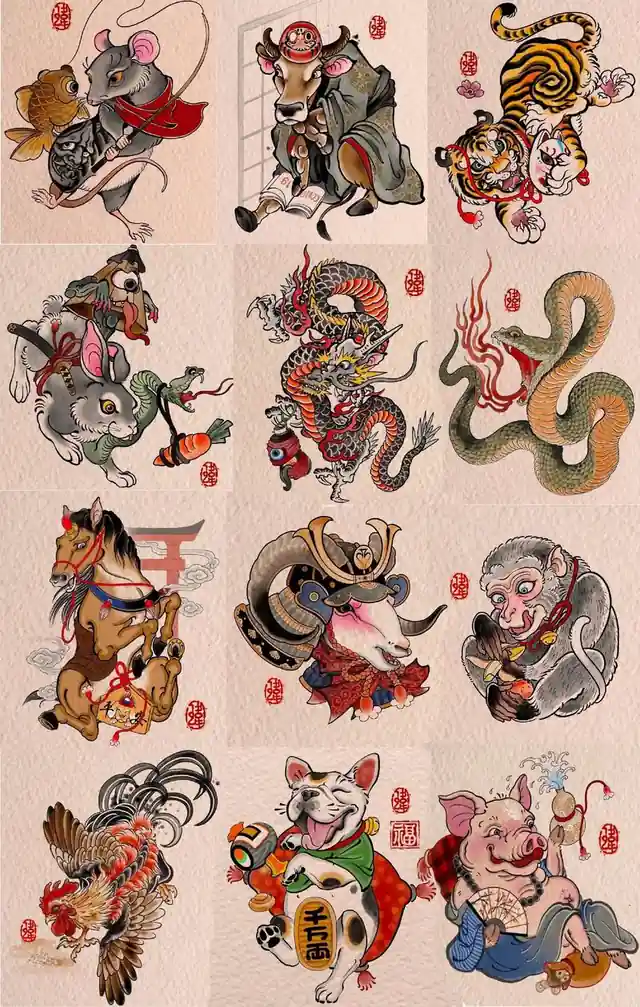
For a long time, people have regarded the Jade Rabbit as a divine creature descending from the moon palace fairyland. Therefore, in the mortal world, the rabbit is seen as an auspicious symbol. In the arts and crafts of every dynasty, the image of the Jade Rabbit has appeared, which also demonstrates the significant influence of the zodiac rabbit culture on the development of arts and crafts.
As early as the Shang and Zhou dynasties in China, jade carving had already reached a highly mature level. Over 700 jade artifacts were unearthed from the tomb of Fu Hao at the Yinxu site in Anyang, Henan Province, featuring a wide variety of types and forms. Among them, the jade rabbit pendants are particularly striking. These jade rabbits are generally depicted in a crouching posture, as if arching their bodies to forage for food. Some are carved in an arc of about one-third of a circle to capture the rabbit's running motion. Carving rabbits from jade aptly expresses the purity and gentleness of the white rabbit. Ancient people used jade rabbit pendants to ward off evil spirits, and they also carried the auspicious significance of the rabbit god totem.
Realistic rabbit patterns on Shang and Zhou Dynasty bronze vessels are extremely rare. A Zhou Dynasty rabbit-patterned zhi (a wine vessel) unearthed at Beiyao in Luoyang, Henan Province features a band of rabbit motifs around its neck. The rabbits are depicted in a semi-crouching posture, as if searching for something, with erect ears, large eyes, and short tails, rendered in a highly realistic style. Among excavated artifacts, rabbit-shaped bronze vessels are the least common. Four crouching rabbit ornaments from the Warring States period were discovered at Lijiapan in Shenmu, Shaanxi Province. Standing rabbit-shaped bronze staff heads unearthed at Shizhaishan in Jinning, Yunnan Province and from a Han Dynasty tomb in Shanxi Province are exceptionally exquisite artworks. These rabbits raise their tall, long ears, glare forward with round eyes, and slightly retract their hind legs, as if ready to kick off and flee the moment danger approaches—truly a vivid portrayal of alertness and agility.
Rabbits frequently appear in Han Dynasty stone reliefs, mostly associated with the myths of the Queen Mother of the West (Xiwangmu) and Chang'e. The most common depiction is the divine rabbit holding a pestle and pounding medicine, though there are also images of ordinary rabbits with raised heads and pricked ears in a running posture. Rabbit motifs can also be found on Han Dynasty bronze mirrors, and Han Dynasty painted murals feature standing and running rabbits. A Northern Zhou Dynasty stone relief from Xianyang, Shaanxi, depicts a running rabbit carved using the intaglio chiseling technique. The rabbit has a slender form, with four floating clouds beneath it and a ribbon fluttering around its neck, illustrating the white rabbit's swift and galloping motion — a masterpiece among rabbit images in stone reliefs. Rabbit images also appear in Dunhuang murals, the most famous being the three-connected rabbit pattern as the central decorative motif in the caisson ceiling paintings, which exudes a mysterious aura. The painting shows three rabbits chasing each other in a circular motion. While three rabbits should have six ears, the design features only three ears, as the artist skillfully employed the "shared form" technique to create the motif of three rabbits sharing ears. Why this chasing, circular rabbit pattern appears at the center of the celestial caisson ceiling and what its symbolism truly conveys remains an unsolved mystery.
In Tang Dynasty stone carvings, images of the Rabbit are frequently found, including the Rabbit pattern among the twelve zodiac animals on the lid of Li Sibei's tomb epitaph, the Rabbit depiction in the twelve zodiac stone carvings of Yang Zhiyi's tomb epitaph, the Rabbit among the twelve zodiac animals on Li Jingyou's tomb epitaph stone carvings, the Rabbit in the twelve zodiac stone carvings of Yuchi Jingde's tomb epitaph, the Rabbit image in the stone carvings of Princess Yongtai's tomb at the Qianling Mausoleum, the Rabbit among the twelve zodiac animals on Li Yanzhen's tomb epitaph lid, as well as the Rabbit patterns in the stone carvings of Wang's tomb epitaph from the Southern Tang Dynasty of the Five Dynasties period and the Rabbit patterns in the stone carvings of Yang's tomb epitaph from the Song Dynasty. The Rabbit images vary in form and posture, including a Rabbit dashing swiftly, a Rabbit crouching with its body curled up, and a Rabbit lifting its hind legs while looking back. During the Sui and Tang Dynasties, the twelve zodiac animal images were highly popular, and anthropomorphic zodiac figurines also emerged. Among the zodiac figurines unearthed from a tomb dated to the sixth year of the Daye reign period of the Sui Dynasty in Xiangyin, Hunan, the Rabbit figurine features a rabbit head on a human body, wearing a long robe and holding its hands in a respectful gesture. Tang Dynasty Rabbit zodiac figurines have also been excavated multiple times, generally similar in form to their Sui Dynasty counterparts, with the difference being that Tang Dynasty Rabbit figurines appear more slender and elongated, with larger, slanting ears, combining both rabbit and human features in a vivid and lifelike manner.
The rabbit is also a favorite subject for painters throughout Chinese history, with many masters emerging and producing numerous masterpieces. Cui Bai, a renowned rabbit painter of the Northern Song Dynasty, had seven of his rabbit paintings stored in the imperial collection according to the Xuanhe Huapu (Xuanhe Painting Manual). One surviving work, "Two Birds Teasing a Rabbit," depicts an old rabbit resting on a slope while a pair of paradise flycatchers chirp at it from a tree, with the rabbit turning its head in a playful pose, its expression vivid and lifelike. Cui Bai's younger brother, Cui Yi, also enjoyed painting rabbits and developed his own distinctive style. An anonymous painting, "Ink Rabbit Among Mountain Flowers," breaks from the typical depiction of a rabbit with its head tucked and body curled, instead showing the rabbit with its hind legs bent on the ground, stretching its neck and looking upward, with a white rabbit rendered in ink, which is also quite rare. In the Ming Dynasty, notable rabbit painters include Tao Cheng, who created "Chrysanthemums and Two Rabbits," and Xu Lin, who painted "Chrysanthemums, Rocks, and a Wild Rabbit." In the Qing Dynasty, Shen Quan produced "Plum Blossoms in Snow with a Group of Rabbits," and Ma Qizhou painted "Mountain Rabbit." Folk artists also incorporated rabbits into their works, such as the Shanxi Datong window painting "Radishes and Two Rabbits," which depicts the joy of a rural garden after the radish harvest. In the quiet field, a white rabbit with red ears and frost-like fur and a black rabbit with a dark body and white paws hop forward, crouching down to happily eat radishes, full of charm and natural vitality.
Further Reading
"Lord Rabbit," a traditional craft of Beijing.
The Lord Rabbit (Tu'er Ye) is a folk craft gifted to children during the Mid-Autumn Festival by people living in northern China, originating in Beijing and spreading to Tianjin. According to the Qing Dynasty (1644-1912) text "Yanjing Suishi Ji" (Record of Seasonal Customs in Beijing), it is recorded: "Every Mid-Autumn Festival, clever market vendors mold clay from yellow earth into the shapes of toads and rabbits for sale, calling them Lord Rabbit." The earliest Lord Rabbit toys imitated the image of the Jade Rabbit pounding medicine on the Moon Palace, featuring a human body with a rabbit face, a three-lipped mouth, rosy cheeks, a pair of long ears, holding a medicine mortar in the left hand and a pestle in the right, wearing thick-soled boots, making it extremely endearing. Later, the Lord Rabbit evolved into various characters from operas and daily life. Accompanying the Lord Rabbit is Lady Rabbit (Tu Nainai), modeled after a woman's image, with a serene expression. Every Mid-Autumn Festival, families eagerly visit temple fairs to buy Lord Rabbits for their children, preparing for the reunion celebration.