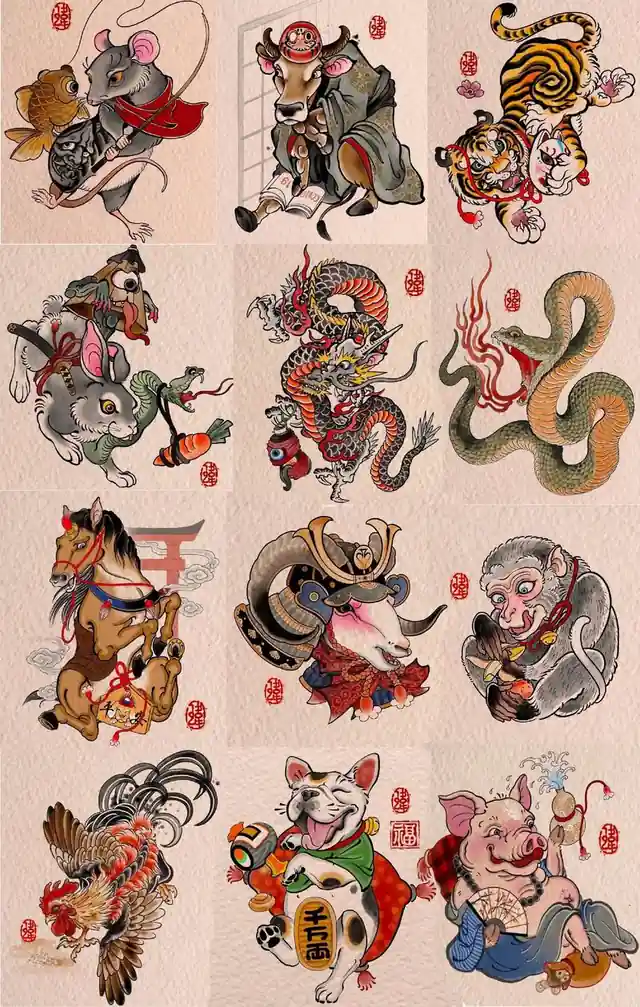
For thousands of years, Chinese people have believed that a rabbit lives on the moon. How did the rabbit enter the Moon Palace? And why can the rabbit on the moon achieve immortality? The answers to these questions relate to the status and influence of the Rabbit zodiac culture in people's lives, as well as the further development and refinement of traditional folk culture.
Among the traditional cultural stories about the Rabbit, the legend of the Moon Rabbit is perhaps the most deeply impressed upon people's minds. The origin of the Moon Rabbit begins with the tale of the Rabbit entering the Moon Palace.
According to legend, after Hou Yi shot down nine suns, he obtained the elixir of immortality from the Queen Mother of the West (Xiwangmu). Consuming this elixir would allow one to ascend to heaven and become an immortal. One day, while Yi was out hunting, his wife Chang'e, driven by curiosity, secretly swallowed the elixir of immortality. She became as light as a swallow and floated gracefully up into the sky. Just before she flew away, a little white rabbit she had raised leaped into her arms. Holding the rabbit, Chang'e flew all the way to the Guanghan Palace on the moon. The Guanghan Palace was as pure and clear as ice and jade. The white rabbit that entered the moon palace was called the Jade Rabbit (Yutu). With its snow-white fur, long ears, and ruby-red eyes, it embodied the same gentle, yin beauty as the Guanghan Palace itself.
This legend expresses people's deep-seated aversion to the sun's scorching heat, irritability, and ferocity, while the moon's coolness, gentleness, and kindness became a place of longing and pursuit. This also reflects the survival and production conditions of ancient people: when humanity first emerged, lifespans were very short. To sustain reproduction, people had to prioritize their own procreation, thus worshipping the moon, which symbolized vigorous vitality. The rabbit, being highly prolific and associated with the moon's ability to die and resurrect, was seen as a symbol of the moon and revered by people. This inspired prayers for fertility and longevity. Therefore, it is not surprising that the rabbit was selected as one of the twelve zodiac animals.
In ancient times, the rabbit was also called "tu zi," which may be closely related to its living habits. Before giving birth, a rabbit digs a burrow, delivers its young inside, and then covers the newborns with soil while sealing the burrow entrance. Observing this behavior, people believed that rabbits had a particularly strong connection with Mother Earth, thus calling them "tu zi," meaning "children of the earth." The moon was also regarded as an earthly essence in ancient times; according to the "Shuo Gua" section of the Zhou Yi (The Book of Changes), the crescent moon resembles an ox horn, symbolizing the Earth Mother. The relationship between the rabbit and the moon may have been established on this foundation. In the eyes of ancient people, the earth was the mother of all things and was deeply revered. Since the rabbit was considered a child of the earth, it naturally deserved a place in the Chinese zodiac.
In ancient times, rabbits were also called "Tu Zi" (spitting offspring). Wang Chong's Lunheng (Discourses Weighed in the Balance), in the chapter "Strange Phenomena," states that when a female rabbit gives birth, the young "emerge from the mouth." In reality, rabbits, like other mammals, are viviparous. Female rabbits sometimes bite and eat their own newborn offspring, which is a special behavior after giving birth. People witnessing this situation mistakenly believed that the young were born from the mother rabbit's mouth, thus naming the rabbit "Tu Zi" (spitting offspring).
Coincidentally, the waxing and waning of the moon was also regarded as pregnancy and childbirth in ancient times. According to the Zhuang ethnic myth "The Sun, the Moon, and the Stars" from Guangxi, the sun is the father, the moon is the mother, and the stars are their children. The sun devours stars every day and passes the seeds of life to the moon. The moon absorbs the nutrients of the stars daily and becomes pregnant and gives birth each month. As the new moon gradually waxes into a full moon, the stars become sparser because the moon absorbs their nutrients, causing the fetus in its womb to grow. When the moon reaches fullness, the fetus matures and is gradually delivered. The stars are the moon's children, and as more stars are born, the moon wanes day by day until it completely disappears at the new moon, after which a new cycle begins.
"The Jade Rabbit Pounding Medicine" is a story and legend very familiar to us. However, what exactly does the Jade Rabbit "pound"? A Han Dynasty Yuefu poem provides an answer: "The white rabbit kneels upright, pounding medicine to make toad pills." The toad (or frog) entered the moon palace together with the rabbit. Frogs are hibernating animals, lying stiff in the soil during winter and awakening in spring. In the eyes of ancient ancestors, this represented death and resurrection. Frogs were also symbols of femininity. To primitive peoples, the round, fertile belly of a frog symbolized the female womb, and its bent legs resembled the birthing posture of women. Thus, the female genitalia were also called "frog mouth," and the goddess Nüwa was sometimes referred to as "Frog Wa." In some parts of Vietnam, statues of Nüwa are depicted with frog-like leg postures. Through the ancient mindset of blending and mutual correspondence, similar shapes were believed to possess similar functions. Consequently, the rabbit and the frog became linked on the basis of fertility, entering the moon together to jointly pound the elixir of immortality, ultimately becoming symbols of the moon. From this perspective, the rabbit's inclusion in the Chinese zodiac is not only related to the moon but also aided by the magical power of the toad.
Further Reading
The "Moon Rabbit" in Classical Poetry
After centuries of cultural development, the Jade Rabbit has long become a synonym for the moon. The story of Chang'e (the Moon Goddess) in the moon palace and her companion the Jade Rabbit pounding medicine has moved generations of poets and scholars. In the Tang Dynasty (618-907), Li Bai wrote in his poem "Drinking Alone Under the Moon": "The white rabbit pounds medicine in autumn and spring; who lives beside the lonely Chang'e?" In the Song Dynasty (960-1279), Wang Anshi wrote in "The White Rabbit of Xindugong": "The palace is made of crystal, the fields of jade; Chang'e in plain silk washes away her rouge and lead. The old rabbit in the palace does not bathe in the sun; heaven makes it pure white, fitting its graceful beauty." In his poem "Dreaming of Heaven," the Tang poet Li He also brought the rabbit and Chang'e into the moon: "The old rabbit and the cold toad cry at the sky's color; the cloud towers half white, the slanting wall shines white." These exquisite ancient verses were profoundly influenced by the zodiac Rabbit culture, and in turn, they played a significant role in promoting the development of this cultural tradition.