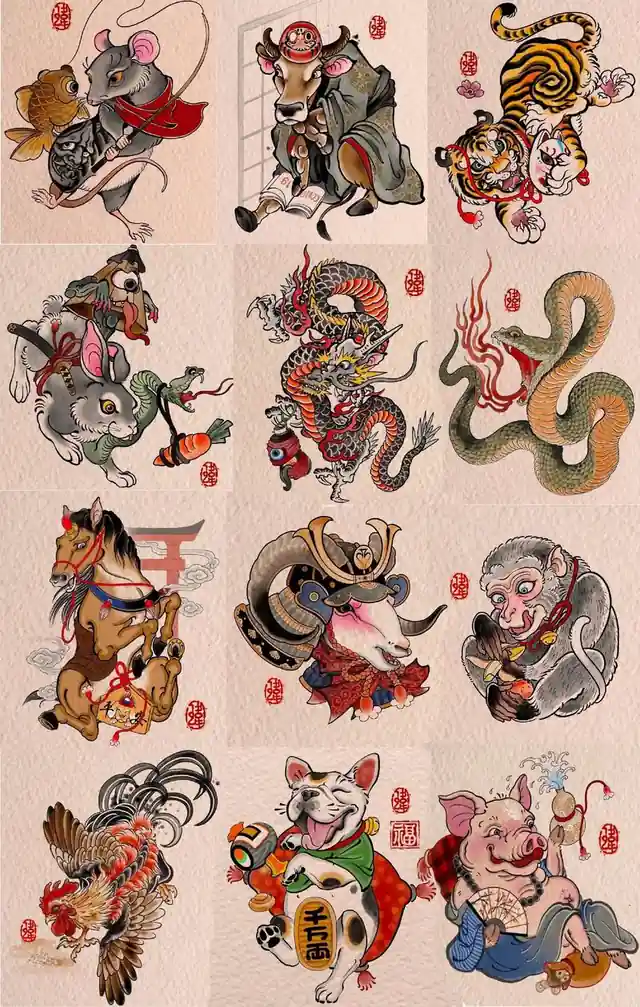
Due to the rooster's unique attributes and its intersection and integration with human language, it holds specific symbolic meanings in people's lives. The broad scope of the rooster's symbolism and its profound impact on daily life represent a significant treasure within folk zodiac culture.
Through humanity's long-term interaction with roosters, not only has the relationship between people and roosters grown increasingly close, but roosters have also transcended their simple avian form. As society has developed, they have been endowed with rich symbolic meanings by people.
The crowing of the rooster at dawn symbolizes the arrival of light.
The opening of "The Cock Crows" (Nü Yue Ji Ming) from the Book of Songs (Shijing) states: "The woman says the cock crows, the man says it is still dawn." As roosters crow with the rising sun, they naturally became people's daily timekeepers, and the crowing of roosters became an important boundary between day and night.
In the first volume of his work Guangyang Zaji (Miscellaneous Records of Guangyang), Liu Xianting of the Qing Dynasty (1644-1912) quoted Li Changqing's Songxiaguan Zhuiyan (Supplementary Remarks from the Pine Cloud Pavilion), stating: "The You hour is the time when the moon rises. The moon itself is a Kan body, and within it contains the essence of the sun's golden rooster, therefore the You hour is assigned to the Rooster." The You hour refers to the period from 17:00 to 19:00 in modern time, which is exactly the time when the moon rises within the twelve two-hour time periods of the ancient Chinese timekeeping system. In the Eight Trigrams (Bagua), the trigram for the moon is Kan, which symbolizes water. Its shape consists of two yin lines with one yang line in the middle, which is why Li Changqing said it "contains the essence of the sun's golden rooster."
However, why is the Rooster not associated with the Mao hour (5-7 AM) when the sun rises, but instead linked to the You hour (5-7 PM) when the moon appears? The ancients believed that the sun and moon are each other's resting places: during the day, the moon rests in the sun's home, so the Mao hour of sunrise is associated with the Rabbit, "containing the essence of the lunar jade rabbit"; at night, the sun rests in the moon's home, so the You hour of moonrise is associated with the Rooster, "containing the essence of the solar golden rooster." The Rooster's ability to enter the twelve zodiac animals and correspond with "You" ultimately depends on its relationship with the sun.
In fact, people recognized the relationship between birds and the sun very early on. From bone daggers and painted pottery of the Neolithic period to portrait bricks of the Han Dynasty (206 BCE - 220 CE), related patterns have been discovered: some feature two birds flying symmetrically around a radiant sun at the center, others show a single bird or three birds carrying the sun while flying, and still others depict a three-legged crow inside the sun. The "crow" (wu) is a mythical bird in people's imagination, also known as the three-legged golden crow (san zu jin wu), or simply golden crow (jin wu) or sun crow (yang wu). What kind of bird is this that flies carrying the sun? It is precisely the rooster; indeed, the rooster itself is the sun. According to Taiping Yulan (Imperial Reader of the Taiping Era), citing the Chunqiu Shuojie Ci (Spring and Autumn Explanations of Phrases): "The rooster accumulates yang energy, symbolizing the south. Fire is the essence of yang, and things rise with heat. Therefore, when yang emerges, the rooster crows, responding to the same category."
The sun rises in the east and sets in the west, while the rooster crows early and roosts late, repeating this cycle endlessly. Because its crowing seems to summon the sun, the rooster naturally became associated with the sun, which symbolizes light.
Eggs and chicken feathers symbolize reproduction and love.
Among the twelve zodiac animals, the Rooster corresponds to the Earthly Branch "You," which possesses both Yin and Yang attributes. Based on this, the ancients regarded the Rooster as a symbol of reproduction and worshipped it accordingly. The Rooster has been seen as a symbol of masculinity and, from ancient times to the present, has served as a euphemism for male genitalia. In the Qing Dynasty, a New Year painting from Fengxiang, Shaanxi, titled "Rarely Has Anyone Lived to Seventy Since Ancient Times," depicts an old man holding his grandson and playing with the child's genitals, accompanied by a poem: "Rarely has anyone lived to seventy since ancient times; holding my grandson, I touch his rooster." The illustration expresses the old man's satisfaction and pride in having descendants and a prosperous family.
Eggs carry the symbolism of fertility in Chinese culture. According to folk customs, when a child is born, families give red-shelled eggs to relatives and neighbors as a token of celebration. Married women who wish to have more children are encouraged to eat plenty of eggs. On their wedding night, a bride would secretly hide several eggs in her clothing and deliberately trip as she enters the bridal chamber, causing the eggs to fall out as a symbolic act demonstrating her ability to bear children.
Chicken feathers could also convey love. During the festive activities held during the Spring Festival, Miao ethnic young men and women most enjoy the game of "playing chicken feathers": young men and women toss "chicken feathers" to each other as a way to test each other's intentions and exchange feelings. If a girl is not interested in a young man, after a few rounds of courteous play, she will claim to be tired or have something to do, stop the chicken feather, and leave. If she has taken a liking to the young man, she will play with increasing joy. Here, the chicken feather becomes a bridge for conveying mutual affection.
The Rooster, as the tenth Earthly Branch (You), is believed to ward off evil spirits and serves as a messenger bridging the realms of yin and yang.
The rooster crows at dawn, marking the beginning of daylight. Thus, the rooster's crow became the boundary between night and day, darkness and light. By extension, the ancients also attributed the start of the new year to the rooster's crowing, believing that the rooster could sense the "qi" (vital energy) of the old year's end, sending away the winter cold and welcoming the spring warmth of the new year. With further development, the rooster also became a messenger bridging yin and yang, as well as the living and the dead. For this reason, the ancients would often paste the character "酉" (You, Earthly Branch for Rooster) on their doors at the end of the year to ward off evil spirits. New Year's Eve is a time when ghosts and spirits are active, requiring the rooster, which can communicate with the supernatural, to guard the doorway. It would distinguish between good and evil, allowing ancestors to return home for family reunions while keeping outsiders of a different lineage out.
Further Reading
Wedding customs related to the Rooster in Chinese zodiac culture.
In Chinese marriage customs, customs related to the Rooster are ubiquitous: in ancient times, Han Chinese wedding processions would have one person carry a rooster at the very front, commonly known as the "road-opening rooster"; in the northwestern regions, when a daughter marries, her mother would cut out a rooster pattern as a dowry, symbolizing the union of yin and yang and the early birth of a son; among the Buyi people, if a couple remained childless after marriage, they would hold a prayer ceremony for children, during which the officiant would place a large rooster on the supplicant's back, as it was believed that if the supplicant could carry the rooster home, they would conceive; the Hakka people of Guangdong also have the custom of "substituting a rooster for the groom," where if the groom is unable to attend the wedding ceremony, a large rooster would take his place in the bowing and worship rituals. These marriage customs essentially embody the rooster as a symbol of reproduction and fertility.