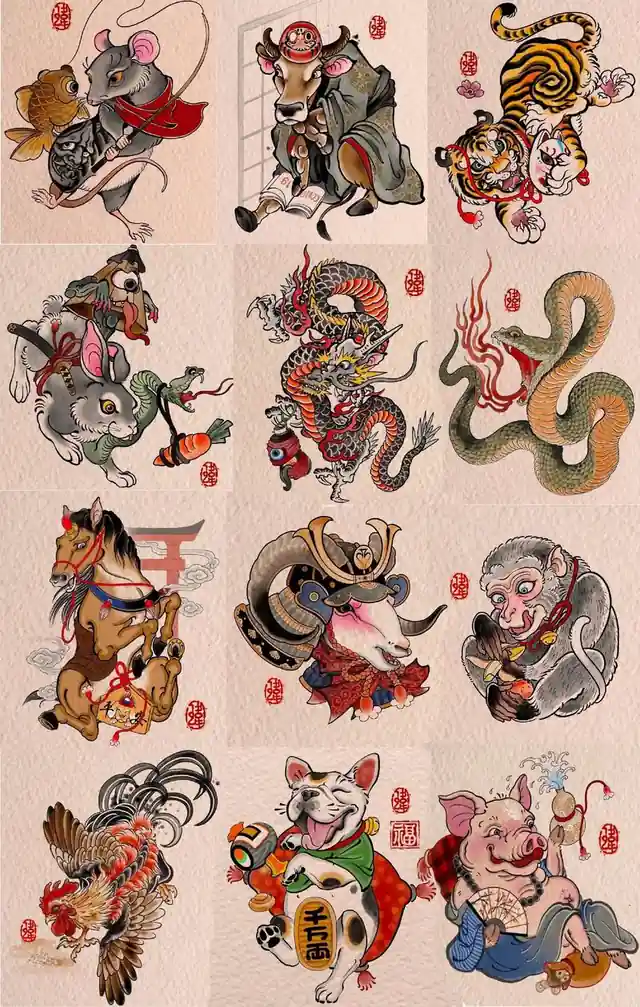
From the rooster's unique appearance and special habits, people have imprinted it with the mark of "virtue," namely civility, martial prowess, courage, benevolence, and trustworthiness. The concept of "the rooster's five virtues" essentially serves as a metaphor urging humans to learn certain good habits and moral qualities from the rooster.
The saying "the Rooster possesses five virtues" originated from Han Ying of the Han Dynasty, who stated in "Hanshi Waizhuan (Han's Outer Commentary on the Book of Songs)": "One who wears a comb on its head represents civility; one who has spurs on its feet represents martial prowess; one who dares to fight when facing an enemy represents courage; one who calls others when finding food represents benevolence; one who keeps time without fail represents trustworthiness." With the virtues of civility, martial prowess, courage, benevolence, and trustworthiness, the rooster is thus called the "virtuous fowl."
"The one wearing a crown represents civility (wen): in ancient times, headwear included civil caps and military helmets; besides the homophonic connection between 'crown' (guan) and 'official position' (guan), the red comb of a rooster closely resembles a civil official's cap, symbolizing 'adding rank upon rank of officialdom.' 'The one with spurs on its feet represents martial prowess (wu), and the one that dares to fight when facing an enemy represents courage (yong)': the posture of two roosters fighting and a hen protecting her chicks vividly depicts martial prowess and courage. 'The one that keeps time without fail represents trustworthiness (xin)': regardless of sunny or cloudy weather, wind or rain, the rooster crows at dawn without ever shirking its duty—this is 'trustworthiness.'"
The Five Virtues of the Rooster should not be underestimated. Although ancient China had the eight-character principles of propriety, righteousness, integrity, shame, filial piety, fraternal duty, loyalty, and trustworthiness, their influence was not as great as the Five Virtues of benevolence, righteousness, propriety, wisdom, and trustworthiness. While the Five Virtues of the Rooster are not exactly the same as these Five Virtues, they share a common cultural background, namely, their intricate connections with the Five Elements (Wu Xing).
The theory of the Five Elements (Wu Xing) first appeared in the "Hong Fan" (The Great Plan) chapter of the Shangshu (Book of Documents). After King Wu of the Zhou Dynasty raised a righteous army to overthrow King Zhou of the Shang, he consulted Ji Zi about the fundamental principles of governing the state. The first principle Ji Zi discussed was the Five Elements: Water, Fire, Wood, Metal, and Earth. Ancient Chinese believed that these five substances constituted all things in the universe and served as an important foundation for philosophy, politics, thought, customs, and more. The renowned scholar Gu Jiegang also stated in his work "A Brief History of Han Dynasty Scholarship" (Han Dai Xue Shu Shi Lue): "The theory of the Five Elements uses the five substances—Wood, Fire, Earth, Metal, and Water—and their functions to govern seasons, directions, deities, musical tones, colors, foods, smells, morals, and even the lineage of emperors and state systems." The morality governed by the Five Elements mentioned here refers specifically to the Five Virtues (Wu De).
The approach of depicting animals through the theory of Five Virtues (Wu De) can already be seen in Shan Hai Jing (Classic of Mountains and Seas). In the "Classic of Mountains: Southern Mountains" section of Shan Hai Jing, when describing the fenghuang (Chinese phoenix), which is said to resemble a rooster, it states: "The pattern on its head represents De (Virtue), the pattern on its wings represents Yi (Righteousness), the pattern on its back represents Li (Propriety), the pattern on its chest represents Ren (Benevolence), and the pattern on its belly represents Xin (Fidelity)." Unlike the rooster, whose Five Virtues are based on its habits and behavior, the fenghuang's Five Virtues are derived from its beautiful feather patterns.
Following the method of summarizing the Rooster's Five Virtues, the ancients also distilled the Five Virtues from the wild goose's habits. In the one hundred and tenth chapter of the classical novel "Water Margin" (or "Outlaws of the Marsh"), titled "Yan Qing Shoots Wild Geese at Qiulin Ferry," Song Jiang delivers a discourse: "This bird embodies all five constants of benevolence, righteousness, propriety, wisdom, and faithfulness. When it sees a dead goose in the sky from afar, it shows a mournful cry; it never encroaches upon a lone goose that has lost its mate—this is benevolence. Once a pair is lost, the survivor remains chaste unto death and does not remate—this is righteousness. They fly in order without overtaking one another—this is propriety. They preemptively avoid hawks and eagles, carrying reeds in their beaks to cross passes—this is wisdom. They go south in autumn and north in spring, never straying from this migration—this is faithfulness. This bird is a creature fully endowed with the five constants; how could one bear to harm it?"
The five virtues of the Rooster essentially embody people's aspirations for an ideal moral character, representing the hope that humans should possess these five qualities. In ancient times, poets often used the Rooster as a metaphor to express their feelings, composing numerous poems and essays about it. Wu Shu of the Song Dynasty wrote a piece titled "Ode to the Rooster," which states: "Behold the colorful plumage of the rooster, truly a gem among the celestial jade. It takes the image of the Xun trigram, endowed with the essence of fire. Its crowing is heard as a signal, and its name is given as the night-lighter. Both Binmeng observed the severed tail, and Zhoubi also heard its first crow... Jigan boasted of its mustard-seed feathers, while Qiushi praised its intact spurs. Some raised it to ward off fire, others painted it to paste on doors. Mengchang imitated it to escape harm, and Yandan used it to cross safely. As for the three-foot crow, it is killed at the door on New Year's Day, its nature to guard the night, its duty to announce the dawn, awaiting the celestial stars to grant amnesty..."
This passage contains numerous allusions to classical texts: The first sentence cites the "Erya" (Approaching the Correct) definition of chickens, stating that "large chickens are called Shu, and their chicks are called Naiye... Naiye is pronounced as Nai," referring to both large and small chickens. The second sentence says that chickens are formed from celestial stars, as recorded in the "Chunqiu Wei: Yundou Kui" (Spring and Autumn Apocrypha: Pivot of the Dipper): "The jade pivot star disperses to become chickens." The trigram "Xun" representing chickens appears in the "Yijing: Shuogua" (Book of Changes: Discussion of Trigrams), which states: "Zhen represents the dragon, Xun represents the chicken, Kan represents the pig, and Li represents the pheasant." The story of a chicken breaking off its own tail is found in the "Guoyu: Zhouyu, Part 2" (Discourses of the States: Discourses of Zhou, Part Two), which describes that sacrificial chickens must have intact heads and tails. A certain rooster, to avoid being sacrificed, broke off its own tail. The tale of imitating a rooster's crow to trick the guards into opening the city gate and escape pursuers is associated with both Lord Mengchang and Prince Yandan of Yan, who each experienced such an incident.
A piece titled "Rooster Rhapsody" (Ji Fu) encompasses all the allusions related to roosters, which are manifestations of civility, martial prowess, courage, benevolence, and trustworthiness.
Further Reading
Zu Ti danced upon hearing the rooster crow.
During the Jin Dynasty (265-420 CE), Zu Ti had great ambitions. Later, he and his childhood friend Liu Kun both served as chief secretaries of Sizhou. They shared a deep bond, often sleeping in the same bed under the same blanket, and both harbored the lofty ideal of making contributions and restoring the Jin Kingdom. One night, Zu Ti woke up because he dreamed of a rooster crowing. Excitedly, he woke Liu Kun and said, "Others consider hearing a rooster crow at midnight unlucky, but I think differently. How about we get up and practice swordsmanship whenever we hear the rooster crow from now on?" Liu Kun gladly agreed. So every day after hearing the rooster crow, they got up to practice swordsmanship, continuing without interruption through spring and winter, cold and heat. Their hard work paid off. After long-term diligent study and training, they became versatile talents skilled in both civil and military affairs, capable of writing excellent essays and leading troops in battle. From then on, their story of "rising at cockcrow to practice the sword" became widely circulated among the people. This can also be seen as an aspect of the rooster's virtue of "fidelity."