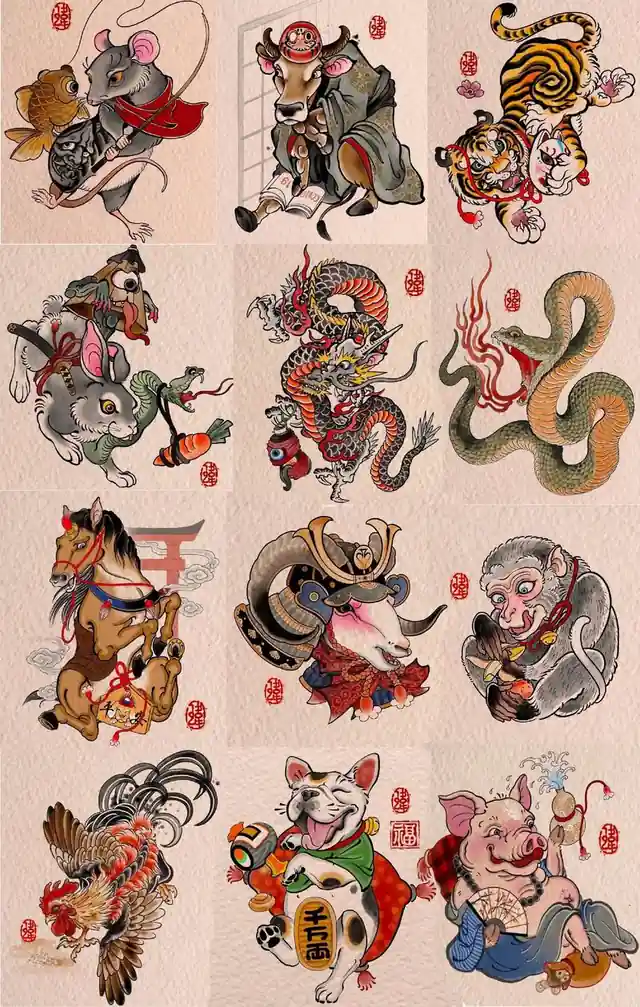
Through their long history of raising chickens, ancient people gradually discovered the rooster's instinct for fighting, and from then on, cockfighting became a form of entertainment that has endured for thousands of years without decline. People not only deliberately cultivated aggressive roosters but also developed various forms of cockfighting in response to changing times and entertainment needs.
Han Ying, a scholar of the Western Han Dynasty, wrote in his work "Hanshi Waizhuan" (The Outer Commentary to the Book of Songs by Master Han) that the rooster possesses five virtues: "civil, martial, courageous, benevolent, and trustworthy." Among these, "having spurs on its feet represents martial virtue, and daring to fight when facing an enemy represents courage." Cockfighting perfectly embodies the rooster's dual virtues of martial prowess and courage. The practice of cockfighting has a long history, having already become widespread as early as the Spring and Autumn and Warring States periods (770-221 BCE). In "Zhuangzi, Chapter on the Mastery of Life," there is a record of a skilled cockfighting trainer who was specifically tasked with training fighting cocks for the king. Additionally, "Strategies of the Warring States, Strategy of Qi" records that among the seventy thousand households in Linzi, all took delight in cockfighting.
Those who enjoy cockfighting also place great importance on the selection of rooster breeds. Guo Pu's commentary on the Erya (Approaching Correctness) states: "The roosters from Yanggou are the finest in ancient times." To enhance the combat effectiveness of fighting roosters, ancient people also devised various winning strategies. According to the Zuo Zhuan (Commentary of Zuo), in the 25th year of Duke Zhao of Lu's reign: "Ji and Hou fought their roosters. Ji powdered his rooster with mustard, while Hou fitted his with metal spurs, enraging Pingzi." Both Ji and Hou had their own tricks: Ji sprinkled mustard powder on the rooster's feathers to blind the opponent's eyes, while Hou attached sharp metal covers to the rooster's claws to increase its lethality. Some even smeared badger fat on the rooster's head. The badger is an animal skilled at catching domestic fowl, and applying its fat to a rooster's head would terrify the opposing rooster upon catching its scent. Some literati even composed poems about the methods used in cockfighting. For instance, Wang Bao of the Northern Zhou Dynasty wrote in "Watching Cockfighting": "The jealous rooster's golden spurs rise, the suspicious flock's mustard powder spreads." Cao Zhi's poem "On Cockfighting" reads: "I hope to receive the help of badger fat, so I can always dominate this arena." These are all descriptions of the techniques employed in cockfighting.
The custom of cockfighting was particularly prevalent during the Han Dynasty. According to "Xijing Zaji" (Miscellaneous Records of the Western Capital) by Ge Hong of the Jin Dynasty, Liu Bang's father, Liu Ji, loved cockfighting all his life and became quite depressed after being unable to engage in it as the Grand Emperor. Emperor Cheng of Han often traveled incognito due to his fondness for cockfighting, and the Jiaozhi Kingdom catered to his interest by presenting long-crowing roosters with "long spurs skilled in attack." Prince Gong of Lu in the Han Dynasty did not hesitate to spend an annual salary of two thousand shi of grain to train fighting cocks. Many scenes of cockfighting have been unearthed on Han Dynasty portrait bricks and stones, reflecting the special passion people of that time had for this activity.
By the Tang Dynasty (618-907), as national power reached its peak, people's recreational activities gradually increased, and cockfighting became a widespread trend. Princes, nobles, and chivalrous youths even boasted about cockfighting as a symbol of their personal skills and character. Li Bai, in his poem "Recalling the Past Presented to Lu Diao, Magistrate of Jiangling," claimed, "I was once a cockfighting disciple, roaming with the heroes of the Five Mausoleums." Zhang Ji, in his poem "The Young Man's Journey," wrote, "Daily cockfighting in the city market, winning a treasured sword with newly engraved characters." During the Tang Dynasty, not only were cockfighting arenas opened among the common people, but even within the imperial palace, special "cockfighting quarters" were established. Emperor Xuanzong, known as the "Cockfighting Emperor," loved cockfighting even when he was a prince. After ascending the throne, he went so far as to select five hundred imperial guards specifically to train and raise fighting cocks. According to Chen Hong's "Biography of the Old Man of the Eastern City," Jia Chang, the young manager of the Tang imperial cockfighting quarters, was only thirteen years old but was already a cockfighting prodigy. He also understood how to raise the birds, earning deep favor from Emperor Xuanzong and wielding immense power and influence. As a result, a popular folk song at the time went: "A son need not learn to read; cockfighting and horse racing surpass book learning. The Jia family's boy, just thirteen years old, enjoys wealth and honor unknown to others." This vividly illustrates the extreme prevalence of the cockfighting craze during that era.
The cockfighting culture of the Song and Ming dynasties was no less prosperous than that of the Tang Dynasty. According to the "Yang Gong Biji" (Records of Duke Yang) by Yang Yanling of the Song Dynasty, "People regard cockfighting as a display of valor." Zhou Qufei, also of the Song Dynasty, provided a detailed description of the training and winning strategies of gamecocks in his work "Lingwai Daida" (Answers from Lingnan).
By the Ming Dynasty (1368-1644), not only had professional cockfighters emerged in the markets, who carried their roosters daily to challenge others to fights, but specialized cockfighting associations also appeared. According to Zhang Dai's "Tao'an Mengyi" (Dream Recollections of Tao'an): "During the Tianqi reign (1621-1627), there was a fondness for cockfighting, and a Cockfighting Society was established at the foot of Dragon Mountain." The "Cockfighting Society" was a dedicated association for studying cockfighting techniques and exchanging skills.
By the Qing Dynasty (1644-1912), in addition to the continuation of the traditional cockfighting activity, cockfighting was also performed as a form of folk art. From Li Shengzhen's "Poem on Cockfighting" in his "Bai Xi Zhu Zhi Ci" (Bamboo Branch Songs of a Hundred Performances) during the Kangxi reign (1662-1722), and Li Diaoyuan's "Cockfighting Poem" in his "Nong Pu Bai Yong" (A Hundred Poems on Farming and Entertainment), it is evident that the trend of cockfighting remained highly prevalent during the Qing Dynasty.
To this day, the entertainment activity of cockfighting remains popular in most areas of Han Chinese life, as well as in certain ethnic minority regions of Yunnan, though the timing and format vary slightly from place to place. For example, Kaifeng in Henan Province holds a cockfighting festival on the 22nd day of the first lunar month each year, while in Luocheng, Guangxi, cockfighting takes place after autumn or during the Spring Festival.
It is evident that cockfighting, as a form of entertainment, has a long history and cultural background. Its flourishing greatly enriched people's recreational lives, while also playing a positive role in preserving and spreading zodiac culture.
Further Reading
The origin of the idiom "dai ruo mu ji" (literally "dull as a wooden chicken," meaning to be stunned or petrified with fear or surprise).
The activity of cockfighting had already spread widely as early as the Spring and Autumn and Warring States periods. In the "Da Sheng" chapter of Zhuangzi, there is a story about training fighting cocks: Ji Lizi trained fighting cocks for King Xuan of Zhou. After ten days, King Xuan asked, "Can the cock fight?" Ji Lizi replied, "Not yet, it is still proud and restless." After another ten days, the king asked again, and Ji Lizi replied, "Not yet, it still reacts to sounds and sights." Ten days later, the king inquired once more, and Ji Lizi answered, "Not yet, it is still full of anger and glaring." On the fourth ten-day period, Ji Lizi responded, "It is ready now. When it hears other cocks crowing, it remains calm and composed, neither flustered nor impatient, appearing as if made of wood. With its spirit so deeply focused and still, other cocks dare not challenge it; they flee at the sight of it." This is the origin of the idiom "dumb as a wooden chicken" (dumbstruck or motionless with fear). Thus, while ancient people engaged in cockfighting for entertainment, they also sought methods for training fighting cocks and discovered life philosophies embedded in the activity.