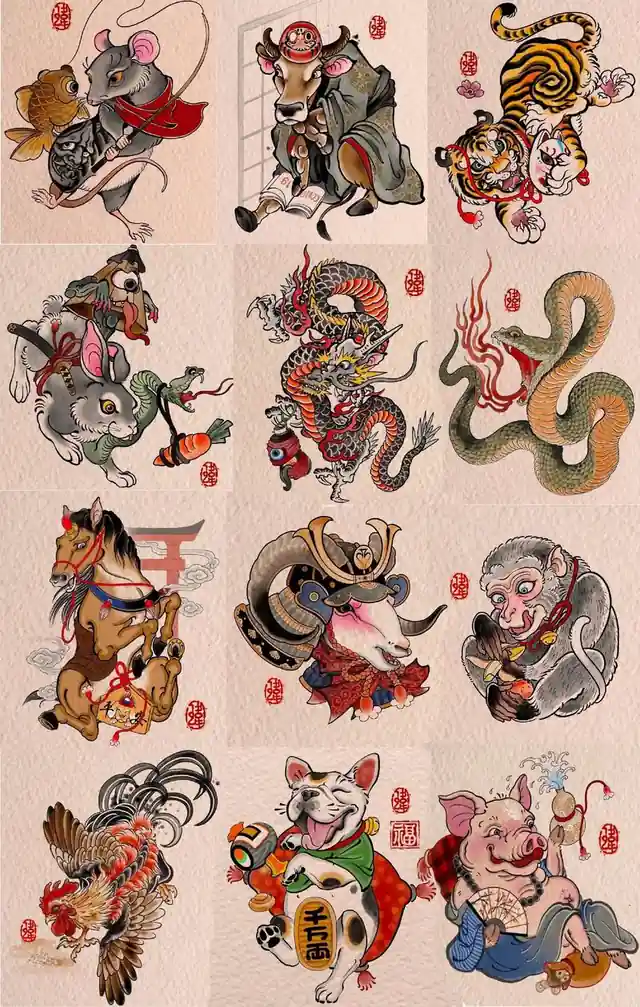
Poultry represented by the rooster appeared very early, and the rooster was also one of the first livestock used by humans for sacrificial rituals. In these rituals, not only were roosters directly offered, but other cultural practices related to roosters also emerged, all of which represent important extensions of folk zodiac culture.
Whether in ancient or modern times, the rooster has been the most common sacrificial offering in China's vast rural areas. As early as the Neolithic cultural site at Cishan in Hebei Province, archaeologists had already discovered large quantities of chicken bones. According to expert research, most of these bones belonged to roosters and were used for sacrificial purposes. This shows that the custom of rooster sacrifice already existed over 8,000 years ago during the Neolithic Age. The use of roosters in sacrificial rituals was so widespread that it even developed into a special culture of rooster sacrifice.
The sacrificial rooster is called Han Yin (a poetic term for rooster in ancient Chinese rituals).
In ancient times, there were many types of sacrificial animals used for rituals. In addition to the "Six Domestic Animals" (liù chù: horse, ox, goat, pig, dog, and rooster), there were also other animals beyond these six. According to the "Zhouli (Rites of Zhou), Xiaozongbo" (Ministry of Rites): "They sorted the six sacrificial animals, distinguished their names and types, and distributed them among the five officials for offering." Regarding these "six sacrificial animals," Zheng Xuan of the Han Dynasty (206 BCE-220 CE) annotated: "The Minister of Agriculture (Situ) was in charge of the ox, the Minister of Works (Sibo) was in charge of the rooster, the Minister of War (Sima) was in charge of the horse and goat, the Minister of Justice (Sikou) was in charge of the dog, and the Minister of Public Works (Sikong) was in charge of the pig." The ancients believed that sacrificial animals were offerings to the spirits and should differ from animals consumed in daily life. Therefore, to distinguish them, a separate set of names was given to sacrificial animals. According to the "Liji (Book of Rites), Quli Xia" (Summary of the Rules of Propriety, Part 2): "In the rituals of offering at the ancestral temple, the ox is called 'Yiyuan Dawu' (One Great Martial One), the pig is called 'Ganglie' (Bristly Mane), the suckling pig is called 'Tufei' (Plump and Fat), the goat is called 'Roumao' (Soft Fur), the rooster is called 'Hanyin' (Long Sound), the dog is called 'Gengxian' (Broth Offering), the pheasant is called 'Shuzhi' (Sparse Toes), and the rabbit is called 'Mingshi' (Bright Sight)." The rooster was called "Hanyin," where "Han" means long. One explanation is that "when a rooster is fat, its crowing sound is long," so the rooster was named "Hanyin," implying that its prolonged crowing could communicate with the spirits and bring blessings.
The vessel used for rooster sacrifices is called "Yi" (ritual bronze vessel).
Modern scholar Guo Moruo conducted research starting from the ancient character form of "yi" (彝, sacrificial vessel) — "two hands holding a chicken" — and concluded that this character originated from chickens used in sacrifices, with chickens being the earliest sacrificial animals. Guo Moruo pointed out in his work Zhongguo Gudai Shehui Yanjiu (中国古代社会研究, Study of Ancient Chinese Society), Chapter Gudai Shehui in Buci (卜辞中的古代社会, Ancient Society in Oracle Bone Inscriptions): "The trace of using chickens can be seen in the character yi. In ancient bronze inscriptions and oracle bone inscriptions, the character yi is consistently written in the form of two hands holding a chicken. Among the six domestic animals (liuchu, 六畜, the six main livestock: horse, ox, goat, pig, dog, and chicken), the chicken should be the first to be domesticated by humans. Therefore, the character yi, commonly used for sacrificial vessels, was exclusively designated for the chicken. This indicates that the chicken was the earliest sacrificial animal used, which is why the sacrificial vessel was represented by the character 'yi' depicting two hands holding a chicken."
In the ancient classic "Liji·Mingtang Wei" (Book of Rites·Positions in the Bright Hall), there is also a record about the "Ji Yi" (Chicken Ritual Vessel), stating: "For libation vessels, the Xia dynasty used Ji Yi (chicken-shaped vessels), the Shang dynasty used Jia (tripod cups), and the Zhou dynasty used Huang Mu (yellow-eyed vessels)." "Ji Yi" refers to the chicken-shaped ritual vessel. During the Zhou dynasty, in addition to "Huang Mu," chicken-shaped vessels were also used. According to the "Zhouli·Chunguan·Sizun Yi" (Rites of Zhou·Spring Offices·Directors of Ritual Vessels), it is recorded: "For spring and summer sacrifices, the libation uses Ji Yi (chicken vessel) and Niao Yi (bird vessel)," and it notes that Ji Yi, Niao Yi, Hu Yi (tiger vessel), Jia Yi, Huang Yi (yellow vessel), and Yi are collectively called the Six Yi (Six Ritual Vessels).
The discovery of the ancient ritual vessel Ji Yi (chicken-shaped ritual vessel) at the Dawenkou and Longshan cultural sites in Shandong has further confirmed the inferences of experts and scholars, as well as the records found in ancient texts. Additionally, the discovery of the Ji Yi vessel holds great significance for the study of ancient cultural history. According to scholar Zou Heng: "The confirmation of the Ji Yi, a Xia Dynasty ritual vessel among pouring vessels, is naturally important for the determination of Xia culture in archaeology. Since the Erlitou culture prominently features the prevalence of Ji Yi as its most distinctive characteristic, there should be no doubt that its cultural nature is that of Xia culture."
The ceremony of the Great Amnesty (Da She) involved erecting a chicken pole (Ji Gan) as a ritual symbol.
In ancient times, during dynastic changes or when encountering a wise ruler who loved and cared for the people, the sovereign would often grant a general amnesty to pray for national peace and prosperity, and this type of amnesty was commonly referred to as the "Golden Rooster Amnesty." According to the "Sanguo Dianlue" (A Brief Account of the Three Kingdoms), as quoted in Volume 36 of the "Gujin Tushu Jicheng" (Complete Collection of Ancient and Modern Books), it is recorded: "When Emperor Wu of Northern Qi, Gao Zhan, ascended the throne, he declared a general amnesty at the Southern Palace and changed the era name. Before the amnesty, he ordered a golden rooster to be erected at the palace gate. Song Xiaowang, not understanding its meaning, asked the Grand Master of Splendor, Sima Yingzhi: 'For the amnesty, a golden rooster is erected; what is its meaning?' Yingzhi replied: 'According to the "Haizhong Xingzhan" (Marine Astrological Divination), it says: When the Heavenly Rooster Star moves, there should be a rescue; thus, emperors use the rooster as a sign.'" In the Song Dynasty, Wang Dang's "Tang Yulin" (Anecdotes of the Tang Dynasty) also states: "During the Northern Qi period, whenever an amnesty was granted, a golden rooster column was erected in front of the Changhe Gate." The pole used for the amnesty was called the "Rooster Pole Head." According to the "Xin Tang Shu·Baiguan Zhi San" (New Book of Tang·Treatise on Officials, Part Three): "On the day of the amnesty, a golden rooster was erected on the pole, with the pole being seven zhang long (approximately 23 meters), and a rooster four chi high (about 1.3 meters), with its head adorned in gold."
During grand amnesties in the Song Dynasty, a rooster pole was also erected. According to "Dongjing Meng Hua Lu" (The Dream of Splendor of the Eastern Capital), it is recorded: "The imperial carriage ascended the Xuan De Tower, with several large banners erected in front of the tower. A rooster pole was set up, approximately over ten zhang (about 30 meters) in height. At the tip of the pole was a wooden tray, on which sat a whole rooster holding a red banner in its beak, inscribed with the words 'Long Live the Emperor.' Four colored cords hung down from the bottom of the tray. Four individuals in red headscarves competed to climb up the cords. Whoever swiftly obtained the red rooster banner would shout 'Long Live' in gratitude. From the tower, a red silk cord was connected to a colorful tower below. A golden phoenix carrying the amnesty decree descended to the colorful tower, where the ceremonial attendant received the decree and read it aloud."
Thus, the "chicken pole" had already become a symbol of amnesty. It is no wonder that the great poet Li Bai wrote in his poem "To Judge Xin on My Exile to Yelang": "I grieve over my distant banishment to the clouds of Yelang, when will the golden chicken be released to signal my pardon and return."
Further Reading
The ancient Chinese would smear chicken blood as a covenant when forming alliances.
Swearing a blood oath was an ancient ritual used by people to signify that they would never go back on their word or break a covenant. This form of oath-taking could involve smearing blood on the lips, holding blood in the mouth, or dripping blood into wine and drinking it all, with the rooster being a commonly used animal in such ceremonies. In the "Biographies of Lord Pingyuan and Yu Qing" chapter of the Records of the Grand Historian (Shiji), when recounting the story of Mao Sui recommending himself, it mentions the swearing of a rooster blood oath: Mao Sui accompanied Lord Pingyuan of Zhao to the state of Chu to persuade the King of Chu to resist Qin. After the King of Chu was moved by the argument, Mao Sui immediately said, "Bring the blood of a rooster, dog, and horse." He then presented the blood to the King of Chu and said, "Your Majesty should seal the alliance by smearing blood, next will be my lord, and then myself." According to Sima Zhen's commentary, the reason for using rooster, dog, and horse blood was: "The sacrificial animals used in alliances varied by rank; the Son of Heaven used cattle and horses, feudal lords used dogs and pigs, and officials below the level of grand master used roosters." In olden times, another form derived from the rooster blood oath involved using a needle to prick the bright red comb of a rooster in certain ceremonies to collect its fresh blood for writing. Characters written with rooster blood were believed to possess a certain magical power. "Swearing a rooster blood oath" reflects the important status of the rooster in people's minds.