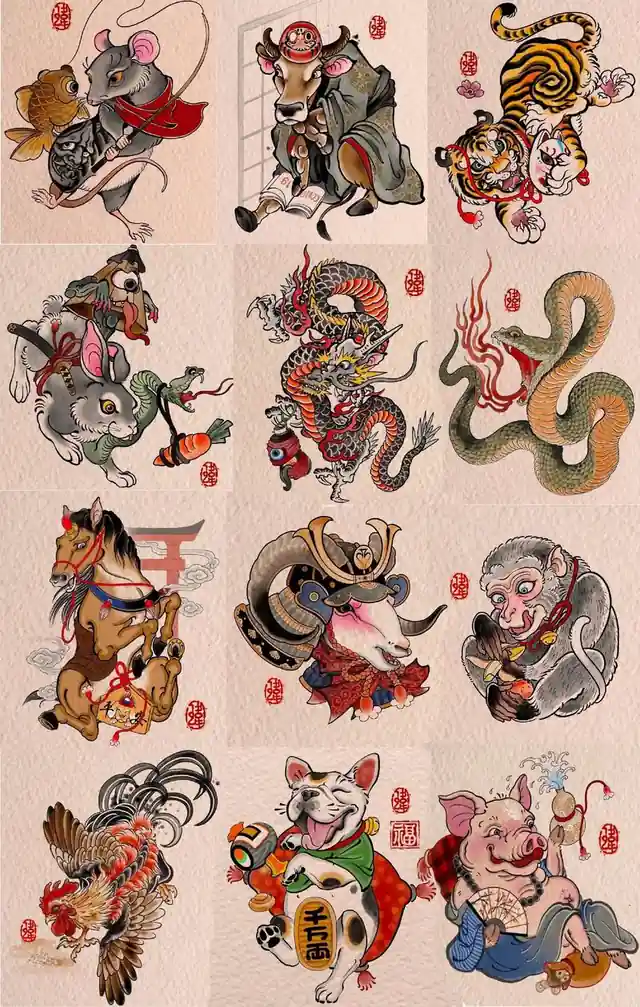
China has a history of raising chickens spanning several thousand years. Through long-term interaction with chickens, many customs related to chickens have gradually developed. These chicken customs are an important part of the Rooster zodiac culture. They are also indispensable elements in people's daily lives and a true reflection of traditional Chinese folk culture.
The rooster is a well-known fowl in people's daily lives and, during China's long agricultural society, it even once influenced people's living standards. Due to the rooster's importance to daily life, customs related to roosters are abundant everywhere.
Ji Gao (Chicken Cake) and Ji Xin Dai (Chicken Heart Pouch).
The tradition of celebrating Zhonghe Festival (Festival of Harmony) is a folk custom in North China, held on the first day of the second lunar month each year, with the popular practice of eating Sun Rooster Cake. Regarding Zhonghe Festival, there is a detailed record in Pan Rongbi's "Dijing Suishi Jisheng · Zhonghe Festival" (Record of Seasonal Customs in the Imperial Capital) from the Qing Dynasty (1644-1912), which states: "The first day of the second month is Zhonghe Festival, which originated in the Tang Dynasty (618-907). Li Mi proposed that the first day of the second month be designated as Zhonghe Festival, where the emperor would give the people small bags filled with seeds of various fruits, grains, melons, and plums to exchange as gifts, called 'Xian Sheng Zi' (offering offspring), and officials were ordered to present agricultural books. On this day in the capital, people would make cakes from glutinous rice, stamped with a circular image of the Golden Crow (three-legged sunbird), used to worship the sun, and vendors would walk through the streets and alleys shouting to sell them, calling them Sun Rooster Cakes." The circular image stamped on the glutinous rice cake represents the sun, while the Golden Crow symbolizes the rooster.
This also reflects the connection between the Rooster and the sun. During the Qing Dynasty (1644-1912), Fu Cha Dunchong recorded the specific form of the "Sun Rooster Cake" in his work "Yanjing Suishi Ji" (Record of Seasonal Customs in Beijing), stating: "On the first day of the second lunar month, market vendors shape rice flour into small cakes, stacking five as one layer, topped with a small rooster about an inch tall, which is called the Sun Cake. Residents of the capital who worship the sun purchase these cakes as offerings, buying three or five stacks as they wish."
In the Jinhua area of Zhejiang Province, it is popular to wear chicken-heart-shaped pouches during the Dragon Boat Festival. On the fifth day of the fifth lunar month, people make small pouches from red cloth in the shape of a chicken heart, filling them with rice, tea leaves, and realgar powder. These are hung on children's chests to ward off evil and disasters. Additionally, "chicken heart" (jixin) sounds similar to "memory" (jixing) in Chinese. Thus, hanging a chicken-heart pouch on a child also reflects the parents' wish that their child will have a good memory for studying and achieve success in the future.
Tiji (Kicking the Rooster) and Tiji (Crowing Rooster).
The Tujia people refer to shuttlecock kicking as "kicking the chicken." In the "kicking the chicken" activities held by the Tujia ethnic group, young men and women often participate. When someone kicks the "chicken" into the air, everyone rushes to catch it. The person who catches the chicken can use the rooster feathers on the shuttlecock to chase and hit anyone, and the ones they chase are often their own romantic interests of the opposite sex. Here, the feathered shuttlecock has become a medium for young people to express love and affection, while also revealing traces of chicken symbolism related to fertility worship.
"Crowing Chicken" is a competition where roosters compete in crowing. In this activity, the winner is determined by how many times a rooster crows within a set period. Contestants use various methods to encourage their roosters to crow more: some place the rooster together with hens, using the hens' attraction to stimulate more crowing; others isolate the rooster from hens, making it crow frantically out of frustration or "heartbreak"; some mix alcohol into the rooster's feed, believing it relaxes the vocal cords and improves crowing ability; and others gently stroke the rooster's throat before the contest, thinking that emotional connection can make the rooster more willing to crow.
The Welcoming Spring Rooster and the Guyu Rooster King.
In the old days, there was a custom in northern Shanxi and some areas of Shandong to wear a "Welcoming Spring Rooster" on the day of Lichun (the Beginning of Spring). This rooster, also known as the Spring Rooster, was a decorative accessory sewn from scraps of cloth by women before Lichun and hung on children, symbolizing good fortune for the new year. In certain regions such as Hunan, Hubei, and Zhejiang, where the lunar calendar is still followed, the first day of the first lunar month is called "Rooster Day." People use the weather on Rooster Day—whether it is sunny or overcast—as an omen for the prosperity of chicken farming in the coming year, with sunshine considered auspicious and overcast skies indicating misfortune. Additionally, it is taboo to beat or scold chickens on this day.
In the Shaanxi region, a custom of posting the "Rooster King Guards the House" picture remains popular around the time of Guyu (Grain Rain, the 6th solar term). On the day of Guyu, locals rise early to collect dew, which they grind into ink and use to paint a picture of a rooster with a red comb, holding a scorpion in its beak. The scorpion's body is painted red to symbolize blood, indicating it has been killed. This picture is posted on the wall, believed to ward off evil and venomous creatures and protect the family's safety. Even today, the traditional New Year painting "Rooster King Guards the House" can still be found.
The belief that roosters can drive away poisonous insects and ward off evil spirits has long been a deeply ingrained concept among people. During the Han Dynasty, Ying Shao stated in his "Fengsu Tongyi" (风俗通义, Comprehensive Meaning of Customs and Habits) that if someone suffered from ghost-induced itching, applying rooster blood to the heart could cure it; for wind-evil disease, the head of an eastern gate rooster could be used as a treatment. Around the Wei and Jin Dynasties, roosters began to be regarded as sacred objects guarding doors against evil. The Jin Dynasty "Shiyi Ji" (拾遗记, Records of Gleanings) explains that roosters can ward off evil, "causing demons and all kinds of evils to be unable to cause harm," and "making monsters and ugly creatures naturally retreat and submit." It also records the custom of the time: "Today, on New Year's Day, people either carve wood or cast metal, or draw pictures of roosters," placing them on doors and windows. The Southern Dynasty "Jingchu Suishi Ji" (荆楚岁时记, Record of Seasonal Customs in Jingchu) records the custom of the first day of the first lunar month: "Paste a picture of a rooster on the door, hang reed ropes above it, and insert peach charms beside it; all ghosts fear this." This practice, combined with the ancient custom of calling the first day of the first lunar month the Rooster Day and the tradition of posting You (酉, Earthly Branch for Rooster) symbols to welcome the New Year, has merged into one. This custom has been passed down to the present day; in villages around the Datong area of Shanxi Province, the ancient tradition of pasting paper-cut roosters on doors during the Spring Festival is still preserved.
Further Reading
The Rooster King Guards the House.
"Chicken King Guards the House" (Ji Wang Zhen Zhai) is one of the oldest works in Chinese auspicious patterns. Regarding its origin, the book "Shi Yi Ji" (Records of Gleaned Omissions) by Wang Jia of the Jin Dynasty (265-420) contains written records: During the reign of Emperor Yao, governance was harmonious, people were content, and customs were simple and honest. However, ferocious tigers often descended from the mountains, and demons emerged from the forests, wreaking havoc and causing great suffering for the people. Later, a bird called "Chongming Niao" (Double-Eyed Bird), also known as "Shuang Jing" (Double Eyes), appeared. It looked like an ordinary rooster but sang with a voice like a phoenix and fed on fine cream. This bird detested evil and, with its vigorous wings, sharp beak, and claws, would fight and drive away fierce beasts and demons, preventing them from causing harm. Some said this bird was the king of all chickens, so they carved wooden chickens in its likeness and placed them on doors or rooftops, which surprisingly also served to scare away evil spirits and ugly monsters.