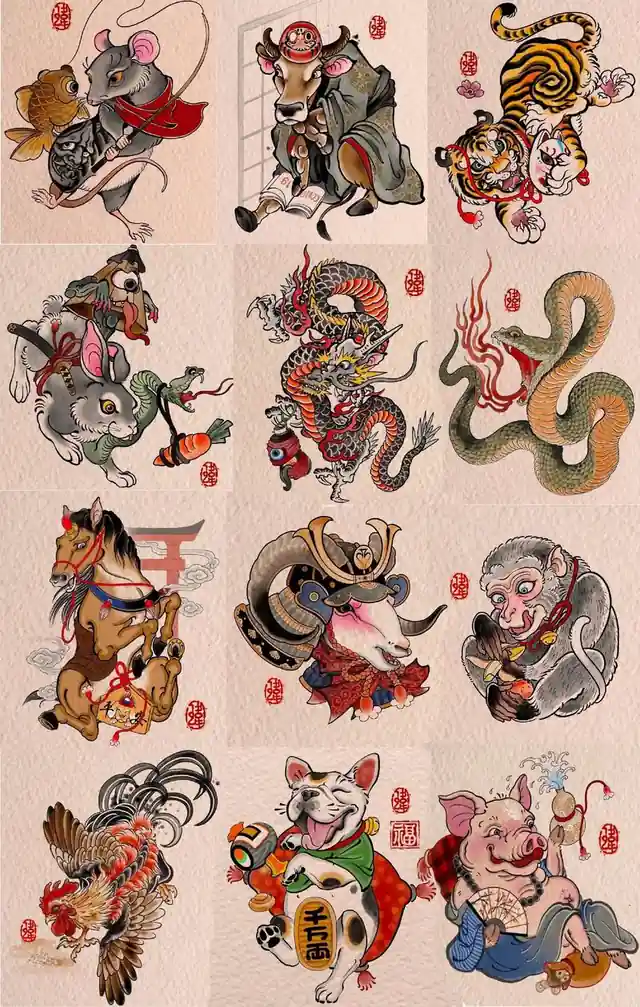
Although the Rooster ranks toward the end of the twelve zodiac animals, it still holds a unique and irreplaceable position. The Rooster occupies the "You" (the tenth Earthly Branch) position not only due to its "background" — a long history of Rooster zodiac culture — but also because of its "social connections" — the deep roots shared between zodiac culture and the vast, profound Chinese civilization.
The Rooster ranks tenth among the twelve zodiac animals, that is, third from last, and is paired with the "You" (酉, Earthly Branch for Rooster) among the twelve Earthly Branches. The reason the Rooster was chosen by humans as one of the twelve zodiac animals has profound cultural origins.
The Rooster represents the avian category among the twelve zodiac animals.
According to the "Erya" (Approaching Correctness), which states that "creatures with two feet and feathers are called fowl, while those with four feet and fur are called beasts," among the twelve zodiac animals, the Dragon and Snake belong to one category, the other nine animals except for the Rooster belong to another category, and the Rooster is the unique fowl. Ancient people were always fascinated by creatures with fluttering wings that soared through the sky, leading to the creation of the Phoenix, known as the king of birds. However, the Phoenix was fundamentally based on the rooster as its prototype, further refined through human subjective imagination. The extraordinarily beautiful appearance of the Phoenix can be seen in the colorful rooster or the splendid pheasant. According to the "Taiping Yulan" (Imperial Readings of the Taiping Era), it says: "During the time of the Yellow Emperor, the Phoenix was regarded as the rooster." The "Liuzi Xinlun" (New Discourses of Liu Xie) also states: "The Phoenix of Chu was actually a pheasant." Thus, it is evident that the Rooster was selected into the twelve zodiac animals as the representative of all fowl.
When a Man Achieves Power, His Followers Benefit
In daily life, people often associate the Rooster and the Dog together, yet the Rooster always comes before the Dog in expressions, such as in Laozi's (The Classic of the Way and Virtue) phrase "the sounds of roosters and dogs are within hearing of each other," and the saying "when one person achieves immortality, even his rooster and dog ascend to heaven." If these were phrased as "the sounds of dogs and roosters" or "when one person achieves immortality, even his dog and rooster ascend to heaven," they would feel awkward. Initially, when the Rooster and Dog were paired together, the Dog came before the Rooster. Taking the example of "when one person achieves immortality, even his rooster and dog ascend to heaven," according to Wang Chong's Lunheng (Discourses Weighed in the Balance) from the Eastern Han Dynasty (25-220 CE): "Liu An achieved immortality and his entire household ascended to heaven, with all livestock becoming immortals; dogs barked in the heavens, and roosters crowed among the clouds. This means that the immortal elixir was abundant, and when the dogs and roosters ate it, they followed the king in ascending to heaven." By the Eastern Jin Dynasty (317-420 CE), this story had changed, shifting from "dogs and roosters ascending to heaven" to "roosters and dogs ascending to heaven." According to Ge Hong's Shenxian Zhuan (Biographies of Immortals): "People of that time said that when the Eight Lords and Liu An were about to depart, they left their elixir vessels in the courtyard; the dogs licked and roosters pecked at them, and all ascended to heaven. Thus, roosters crowed in the heavens, and dogs barked among the clouds."
"Chicken Crows, Dog Steals" (an idiom describing petty skills or tricks, literally "rooster crows and dog burgles").
According to the "Records of the Grand Historian: Biography of Lord Mengchang," Lord Mengchang was imprisoned after entering the state of Qin. He sent someone to seek help from a favored concubine of King Zhao of Qin. The concubine demanded a fox-fur coat identical to the one Lord Mengchang had presented to King Zhao. Lord Mengchang no longer had such a coat, but one of his retainers, who was skilled in "dog-like thievery," sneaked into the Qin palace and stole the coat, satisfying the concubine's condition. The concubine then pleaded with King Zhao to release Lord Mengchang. Lord Mengchang planned to flee Qin that very night, but King Zhao soon regretted his decision and sent troops to pursue him. When Lord Mengchang arrived at Hangu Pass, the gate was tightly shut. Another retainer, who could "mimic a rooster's crow," imitated a rooster's call, prompting nearby roosters to crow and tricking the gatekeepers into opening the pass. From this historical story, the sequence begins with "dog thievery" followed by "rooster crowing," so the idiom "ji ming gou dao" (rooster crowing and dog thievery) should actually be "gou dao ji ming" (dog thievery and rooster crowing). In reality, whether "rooster" or "dog" comes first is merely a matter of linguistic convention.
The Egg and Rooster Riddle
Which came first, the egg or the rooster? This is an ancient and difficult question to resolve. The "rooster-first faction" believes that eggs are laid by roosters, so the rooster came first. The "egg-first faction" believes that roosters are hatched from eggs, so the egg came first. This presents a major logical dilemma: while eggs are indeed laid by roosters, are roosters not hatched from eggs? Truly, the rooster has its reasoning, and the egg has its logic! Both sides fall into a cyclical trap, much like running inside a circle, unable to tell who is ahead and who is behind.
The Rooster as the First of the Twelve Zodiac Animals
The Li ethnic group, who live in Hainan, have their own traditional calendar system. They use the twelve zodiac animals to mark days, treating twelve days as one cycle, beginning with the Rooster and ending with the Monkey, in the order: Rooster, Dog, Pig, Rat, Ox, Insect, Rabbit, Dragon, Snake, Horse, Goat, and Monkey. Regarding why the Rooster is the first of the twelve zodiac animals, a legend has been passed down among the Li people: the ancestor of the Li had a daughter whose mother died shortly after her birth. Later, a heavenly bird came carrying grains to raise the infant. To never forget the heavenly bird's nurturing kindness, Li women still practice tattooing to this day, applying various colors to imitate the bird's appearance. Some scholars believe that the prototype of this "heavenly bird" is the Rooster, and that this worship of the Rooster is a continuation of ancient totem worship, carrying the meaning of tracing one's ancestry and reflecting the totemic beliefs of the Li ancestors.
Further Reading
The allusion of "Chicken's Crow Cuts Off Love" (Ji Sheng Duan Ai)
Roosters crowing at dawn is a natural instinct, yet whenever loved ones part, the fear that "a rooster's crow severs love" inevitably stirs deep resentment toward the sound. A classic tale is recorded in "Kaiyuan Tianbao Yishi (Anecdotes of the Kaiyuan and Tianbao Eras)": During the Kaiyuan reign (713-741 CE), Liu Guorong, a famed courtesan of Changchun, and Guo Zhaoshu, a jinshi (imperial examination graduate), were deeply in love. When Guo was reassigned to a post far away, he had no choice but to bid Liu a reluctant farewell, setting off at dawn. As Guo reached Xianyang Bridge, Liu sent a messenger with a letter that read: "Our joy in bed was at its peak, and I resent the rooster's crow for severing our love; our affection had not yet waned, and I lament the horse's relentless steps, which weary my heart. I look forward to our next meeting, hoping for a life of mutual respect." The phrase "a rooster's crow severs love" has since become a celebrated tale passed down through the ages. Ancient folk songs and ballads also frequently mention this theme, such as Xu Ling's "Wuqi Qu (Song of Wu Perch)," which says: "Embroidered curtains and silk veils hide the candlelight; a single night feels like a thousand years, yet it is still not enough. I only hate that meddlesome rooster of Runan, crowing before the Milky Way has even set." These are all expressions of anger from lovesick men and women toward the rooster's crow, reflecting, from another angle, the profound influence of the Rooster zodiac sign on people's lives and thoughts.