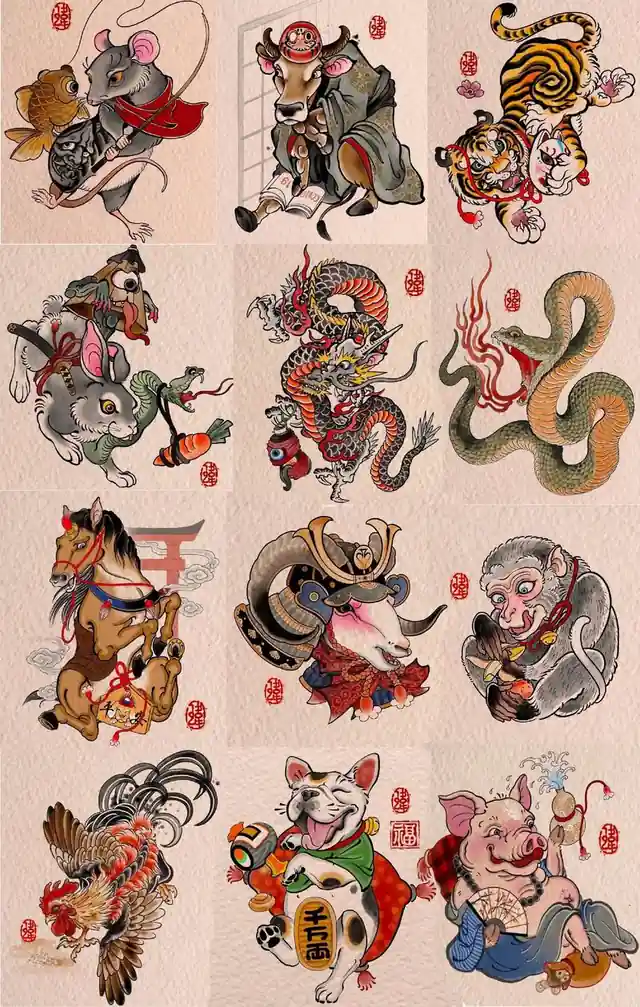
Similar to the reverence and awe people hold for the Rat, the psychological fear of Snakes gradually evolved into Snake worship. Over the course of a long historical process, this veneration for Snakes deepened further, eventually even coloring the understanding of ancestral origins with the characteristics of the Snake zodiac sign.
For humans, snakes have always been filled with a mysterious and eerie quality, yet they are a tangible existence, which further intensifies people's fear and reverence toward them, thus leading to the emergence of the image of a human-snake hybrid as the primordial ancestor of humanity.
In Chinese mythology, Pangu is the great god who separated heaven and earth. Volume 9 of Guang Bowu Zhi (Extensive Records of the Myriad Things) cites the Wuyun Linian Ji (Chronicles of the Five Cycles) by Xu Zheng of the Three Kingdoms period (220-280 CE), stating: "The lord Pangu had the head of a dragon and the body of a snake." Thus, from the very beginning, people associated snakes with the gods of the primordial cosmos.
Nüwa (the goddess who repaired the sky and created humanity) is said to have smelted five-colored stones to patch the heavens, making her a deity who built the cosmos and also a mother who gave birth to humanity. According to the "Imperial Century" (Diwang Shiji), "Nüwa, whose clan name was Feng, succeeded the system of Baoxi (Fuxi), with a human head and a snake's body." Wang Yi, in his commentary on Qu Yuan's "Questions to Heaven" (Chu Ci Tian Wen) from the "Songs of Chu," also states, "Legend says Nüwa had a human head and a snake's body, and underwent seventy transformations in a single day." Here, "seventy" signifies a multitude, while "transformation" refers to creation and generation, indicating that she brought forth many things daily, including gods and humans, thus highlighting Nüwa as a tribal leader with immense reproductive power.
Nüwa's elder brother was Fuxi, the first human king among the "Three Sovereigns and Five Emperors." Regarding Fuxi's birth, there are also many records related to snakes: a note in the "Lushi Houji" (Historical Records, Later Annals) cites the "Baodu Ji" (Precious Casket Records), stating: "The emperor's daughter roamed by Huaxu Marsh, was moved by a snake and became pregnant, giving birth to Fuxi after thirteen years."
"Shiyiji (Records of Gleanings)" also states: "The divine mother roamed above it, and a green snake coiled around her, only disappearing after a long time. When she awoke, she found herself pregnant, and after twelve years, she gave birth to Fuxi." Regardless of how Fuxi was born, the common element in these accounts is their connection to snakes. Consequently, Fuxi is often depicted with a human head and a snake's body. Sima Zhen of the Tang Dynasty wrote in "Shiji Buzan Sanhuang Wudi (Supplementary Records of the Three Sovereigns and Five Emperors in the Records of the Grand Historian)": "Fuxi has a snake's body and a human head, possessing sacred virtue."
Among the Han Dynasty (206 BCE-220 CE) images excavated from archaeological sites, there are patterns depicting Fuxi and Nüwa, a brother and sister who married to propagate the human race. Both Fuxi and Nüwa are depicted with human heads and serpent bodies, their hair styled in coiled buns, wearing robes, with their lower bodies as snake tails tightly intertwined. In some images, Fuxi and Nüwa do not have their snake tails intertwined, but instead, a boy and a girl stand on either side, with the boy pulling Fuxi's sleeve and the girl pulling Nüwa's sleeve, both children also having serpent bodies. This represents a further development of the ancestral images of Fuxi and Nüwa. In a Suirenshi (Fire-Drill Man) image from Fei County, Shandong, Fuxi and Nüwa simply clasp their serpent bodies together with their hands to symbolize union, while they themselves are detached from this act of coupling. In the Tang Dynasty (618-907) tomb excavated in Xinjiang, the image of Fuxi and Nüwa in union shows Fuxi transformed into a handsome man with a mustache and double eyelids, while Nüwa's face exhibits the typical plump characteristics of Tang Dynasty women, yet below their waists, they still have intertwined serpent bodies.
The second of the "Three Sovereigns" was the Flame Emperor (Yan Di), who is identified in some historical records as Shennong (the Divine Farmer). According to legend, he had the head of an ox and the body of a snake, or alternatively, the head of a dragon and the body of a snake. The third of the "Three Sovereigns" was the Yellow Emperor (Huang Di). According to the "Classic of Mountains and Seas: Classic of Regions Beyond the Seas - The West" (Shan Hai Jing: Hai Wai Xi Jing), it is recorded: "The kingdom of Xuan Yuan... had human faces and snake bodies, with tails intertwined above their heads." Thus, the Yellow Emperor also had a human face and a snake body.
Furthermore, in addition to the Chinese tribes, the land of China was also home to the Dongyi, Miaoman, and Beidi tribes, each with their own totemic worship — some revered dragons or snakes, others oxen or goats, and still others birds or the sun, all differing from one another. However, every tribe once held a worship of the snake totem, and as these tribes gradually integrated and developed, the snake totem evolved into a shared object of veneration among them. This was one of the internal driving forces that ultimately enabled these tribes to merge into the Chinese nation and to endow the ancestral figure with a snake-like image.
The Goguryeo people, who lived in the northeastern and southeastern regions from the Han to the Sui and Tang dynasties, incorporated Nüwa and Fuxi into their culture. In Ji'an, Jilin Province, over 10,000 ancient tombs from the Goguryeo period are distributed across historical sites. The murals within these tombs feature rich content, including the worship of the Four Divine Beasts (Azure Dragon, White Tiger, Vermilion Bird, and Black Tortoise), depictions of Fuxi and Nüwa, Shennong (the Divine Farmer), and Taoist immortals in feathered robes, all reflecting the comprehensive influence of Chinese culture on Goguryeo. Among them, the images of Fuxi and Nüwa are exceptionally exquisite, holding significant artistic and research value.
It is evident that Pangu (the creator of heaven and earth), Nüwa (the creator of humanity), along with the three supreme rulers Fuxi, Yandi (the Flame Emperor), and Huangdi (the Yellow Emperor), as well as other human ancestors, are all depicted with human faces and serpent bodies. This clearly reflects the status of snakes in the minds of ancient people and the supreme worship their ancestors held for snakes.
Further Reading
The legend of the snake's creation of the world
In the mythology of the Wa ethnic group in China, the snake is regarded as a creator deity. It is said that when the world first formed, its shape was constantly changing, with mountains suddenly rising, plains appearing, or oceans forming, making it impossible for all beings to live peacefully. Later, the toad claimed to be a messenger of the gods and used magic to stabilize the earth's form, making it as flat as its own back. Soon after, a great flood erupted and engulfed the land, leaving all beings without high ground to take refuge. At that moment, the snake emerged and commanded the earth to become uneven like its own back. Immediately, the floodwaters receded, and the land became varied with mountains, plains, rivers, and lakes, allowing all beings to find their proper places. This myth of the snake as a creator undoubtedly enriches people's understanding of the snake as a primordial ancestor.