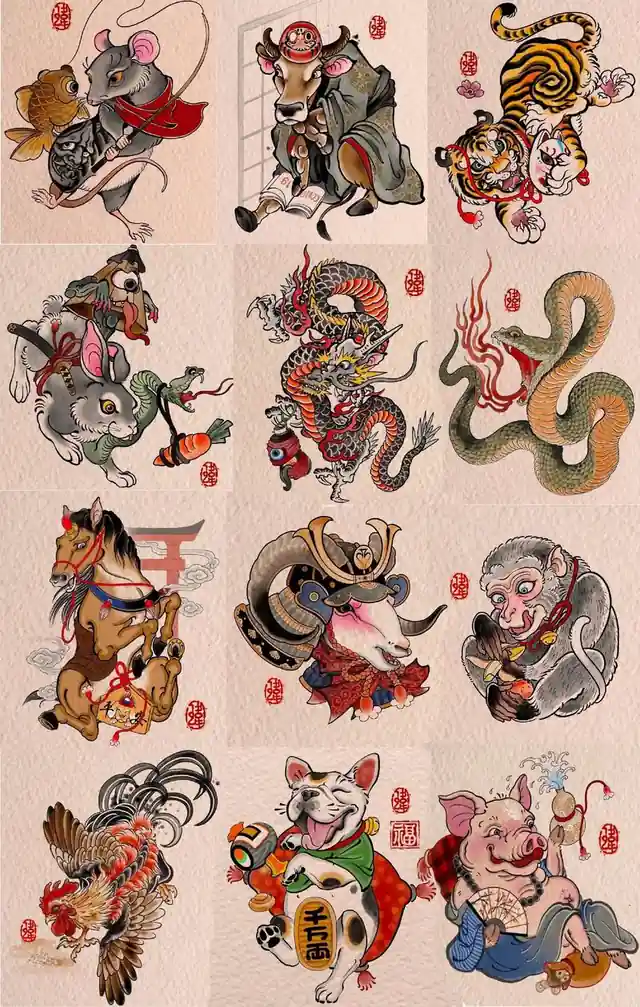
The snake is a real animal that exists in the human world, while the dragon is an imaginary creature born from people's imagination. However, not only do snakes and dragons share many physical similarities, but they are also intricately connected in the long-standing human perceptions of both animals. Therefore, it is only natural that the snake is called the "Little Dragon."
When people ask about the zodiac sign of those born in the Snake Year (Si Year), they may receive three different answers: some say it is the Snake, some say it is the "Great Worm," and the third says it is the "Little Dragon." "Little Dragon" is precisely an alternative name for the Snake.
The boundary between Dragon and Snake seems to have never been clear from the very beginning. The "Discourses Weighed in the Balance" (Lunheng) of the Eastern Han Dynasty states in the "Chapter on Auspicious Creatures" (Jiangrui Pian): "Sometimes a dragon resembles a snake, and sometimes a snake resembles a dragon." The transformation between dragon and snake appears almost natural. In the ancient understanding of the Earthly Branches and their corresponding zodiac animals, the dragon and snake were already considered one entity. The "Biography of Guan Lu" from the "Records of the Three Kingdoms" (Sanguozhi) says: "The snake corresponds to the positions of Chen and Si, while the crow perches on the essence of the sun..." Since there was no actual dragon in the world, it was reasonable for the ancients to use the snake as the dragon in the zodiac.
In the first chapter of Liu E's "The Travels of Lao Can, Second Collection (Posthumous Manuscript)" titled "A Prophetic Inn Transmits Dragon Words," people born in the Year of the Snake are further categorized into different types of dragons. Hui Sheng said: "...How could such lofty individuals adopt names that sound just like those of common fortune-tellers? Since there are the Azure Dragon Master and the Yellow Dragon Master, there must surely also be a White Dragon Master, a Black Dragon Master, and a Red Dragon Master. These kinds of Taoist titles are truly tiresome." Lao Can replied: "You are quite right, I think the same way. I once asked the Yellow Dragon Master about this, and he said: 'You say my name is vulgar, and I know it is vulgar, but I do not understand why it must be elegant... Back then, we did not originally use these as formal names. Because I was born in the year Jisi, the Azure Dragon Master was born in the year Yisi, and the Red Dragon Master was born in the year Dingsi. In those days, friends casually called us these names for fun, and before we knew it, as time passed, others started calling us by them as well...'"
The titles "Yellow Dragon Child," "Azure Dragon Child," and "Crimson Dragon Child" originate from the Yin-Yang and Five Elements colors associated with the Heavenly Stems and Earthly Branches: Jia and Yi correspond to Wood, with the color azure; Yi-Si is the Azure Snake, thus called the Azure Dragon Child. Bing and Ding correspond to Fire, with the color crimson; Ding-Si is the Crimson Snake, thus called the Crimson Dragon Child. Wu and Ji correspond to Earth, with the color yellow; Ji-Si is the Yellow Snake, thus called the Yellow Dragon Child. Simply because they were born in the year of the Si Snake, they directly adopt Yellow Dragon, Azure Dragon, and Crimson Dragon as their names, even omitting the word "small" from "Small Dragon."
However, why is the snake considered a "dragon"? From the perspective of primitive totem worship, the snake clearly has a much older pedigree than the dragon. Before the image of the dragon was created, it is very likely that the snake had already become an object of primitive worship. Wen Yiduo, in his work "Fuxi Kao" (A Study of Fuxi), argues that "the main trunk and basic form of the dragon are derived from the snake." Evidently, during an era when numerous totems flourished, the snake totem was the most powerful.
From an emotional perspective, the Snake and the Dragon are complete opposites. The so-called "poisonous snakes and ferocious beasts" — snakes are not considered benevolent creatures, so people avoid mentioning them directly. In contrast, the Dragon is deeply cherished, as it is regarded as a divine being, revered by all, and honored as an "auspicious beast."
Beyond emotional distinctions, the development of feudal society further differentiated the status of the Dragon and the Snake, revealing additional differences between them. According to "Qin Cao (The Music of the Qin)" by Cai Yong of the Eastern Han Dynasty (25-220 CE), during the Spring and Autumn Period (770-476 BCE), when Duke Wen of Jin was in exile and in dire straits, Jie Zitui "cut flesh from his own thigh to feed the Duke." Later, when Duke Wen gained power and rewarded his followers during exile, Jie Zitui alone was left out. In anger, Jie Zitui retreated to the mountains and left behind a poem titled "Song of the Dragon and Snake": "A dragon soars high, grieving the loss of its place; several snakes follow it, wandering across the world. When the dragon hungers and lacks food, one snake cuts its thigh; the dragon returns to the abyss, content with its soil. Many snakes enter caves, each finding a peaceful home; one snake has no cave, crying out in the wilderness." This uses the Dragon as a metaphor for the ruler and the Snake as a metaphor for the self, a vivid and fitting comparison.
In summary, whether considering the similarities or differences between the Snake and the Dragon, the two are inextricably linked. This relationship has enriched the culture of the Chinese Zodiac and given rise to many folk customs associated with the Snake.
Further Reading
"Little Dragon" escort
In Volume 20 of Dream Pool Essays (Mengxi Bitan), Shen Kuo also recorded an account of the "Little Dragon": "The Little Dragon of Pengli (Poyang Lake) manifested many miracles, which everyone could recount, but one incident was most famous. During the Xining reign period (1068-1077), when the imperial army campaigned in the south, there were dozens of ships carrying military equipment sailing down the Yangtze River. Shortly after leaving Zhenzhou (modern Yizheng, Jiangsu), a small snake climbed aboard one of the ships. The boatman recognized it and said: 'This is the Little Dragon of Pengli; it must have come to protect the military equipment.' The officer in charge placed it in a clean vessel. The snake coiled inside the vessel, and with favorable winds, the ships traveled several hundred li (about 50 km) each day, never experiencing any fear of waves or storms, reaching Dongting Lake in no time... This dragon would swim among the boats, indistinguishable from ordinary snakes, except that snakes always move in a winding, sinuous manner, while this one moved straight ahead, which is how the river people could distinguish it." In reality, the "Little Dragon of Pengli" placed in the clean vessel was simply a snake. However, due to the superstition of the boatmen, sailors, and officers that it could provide escort protection, the snake was transformed into a "Little Dragon."