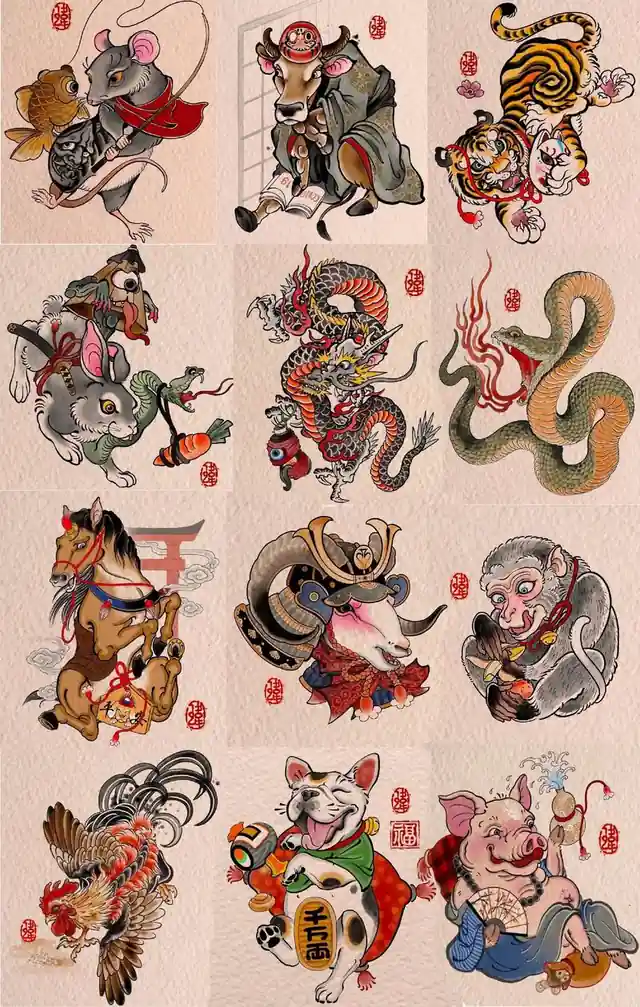
Due to the unfathomable nature of snakes and the special symbolic meanings people have bestowed upon them, it is only natural that the Snake of the Chinese Zodiac features prominently in folklore and legends. These rich and diverse tales vividly illustrate the fascinating culture of the Snake zodiac, while also reflecting the complex emotions people hold toward snakes.
The snake is a very important character in mythological stories and legends, often with the relationship between snakes and humans as the main storyline, which can generally be divided into the following aspects.
The Snake Protects Its Owner
The "Shui Jing Zhu (Commentary on the Water Classic)" records in the section on the Turbid Zhang River a story of a strange snake named Dan Sheng: A man once saw a small snake on the road, took it home to raise, and named it Dan Sheng. After Dan Sheng grew up, it began to devour villagers, so the authorities arrested its owner and imprisoned him. Dan Sheng used its powers to help its owner escape and turned the entire city into a lake, while the county magistrate and jailers all became fish.
Soushen Ji (In Search of the Supernatural) also contains a story: A kind old woman raised a small snake with horns. When the snake grew up, it devoured the county magistrate's horse. The magistrate then brutally killed the old woman. Filled with grief and anger, the snake summoned wind and rain, turning an area of forty li (about 20 kilometers) into a lake, yet the old woman's house remained completely unharmed.
These two snakes, one saving its master and the other seeking revenge, reflect people's longing and imagination regarding the supernatural nature of snakes, as well as a psychological exploration of the desire to unveil the mystery surrounding them.
Human-Snake Marriage (a folklore motif in which a human marries a serpent, often associated with the Snake zodiac sign in Chinese mythology).
"Snake Husband and Snake Wife" is a widely circulated mythological story in Chinese folklore. According to "Selected Oral Literature of the Puyuma People in Taitung," it is recorded: "In Danan Village, there was a beautiful young woman. Many handsome young men proposed to her, but she refused them all because she had fallen in love with a snake. Later, the snake approached the woman's parents to ask for her hand in marriage and took her as his wife. The snake's home was in a lake deep in the mountains, where they gave birth to many birds, snakes, and other animals, thus bringing all kinds of rare and exotic creatures into the world." The Rukai people's story "Snake Husband" belongs to the same type, except it concludes that the woman and her snake descendants became the ancestors of humanity, receiving annual sacrifices from people. In these tales, the snake husband is typically young, handsome, kind, and immensely powerful, serving as a reflection of the ideal male figure in real life. From this, it is not difficult to discern remnants of ancient snake totem worship, revealing people's reverent belief in the Snake King.
Among the stories of women born in the Year of the Snake marrying, the most widely influential is "The Legend of the White Snake" (Baishe Zhuan). This tale has multiple versions, with the most popular one being: During the Shaoxing reign period (1131–1162) of the Southern Song Dynasty, a young man named Xu Xian from Hangzhou went to pay respects to his ancestors on Qingming Festival. After finishing the rites and stepping out of the temple, it began to rain. Xu Xian met the beautiful Lady White (Bai Niangzi) and her maid Xiao Qing by West Lake, sharing a boat to take shelter from the rain and developing feelings for her. Lady White was precisely the benefactor Xu Xian was seeking. Subsequently, Xu Xian and Lady White fell deeply in love and were married. Later, the elder monk Fahai from Jinshan Temple in Zhenjiang traveled here and told Xu Xian that the woman in white was not human but a snake spirit, teaching him a method to reveal the demon's true form. Xu Xian followed these instructions, and upon seeing his wife's true form, he was so terrified that his life hung in the balance. To save her husband, Lady White risked her life to steal the celestial herb, moving the immortals to compassion and reviving Xu Xian. Afterwards, Xu Xian was captured by Fahai and detained at Jinshan Temple. To reclaim her husband, Lady White and Xiao Qing flooded Jinshan Mountain with water. In the end, Lady White fulfilled her wish to repay her benefactor but was subdued by Fahai and imprisoned beneath Leifeng Pagoda, while Xu Xian, under Fahai's coercion, converted to Buddhism.
In this story, Lady White Snake (Bai Niangzi) is gentle, virtuous, deeply emotional, and yet chivalrous, kind, and brave — she embodies all forms of beauty. As a figure originally taking the form of a snake, Lady White Snake has become a symbol of women courageously pursuing true love and a happy life. For this reason, her legend has endured for centuries, gaining widespread recognition and affection from people.
The Conflict Between Humans and Snakes
In folklore and legends, the relationship between humans and snakes is not always harmonious, as there are also many stories of conflict between them. Jin Dynasty scholar Gan Bao’s "Soushen Ji" (In Search of the Supernatural) contains the tale of "Li Ji Slays the Serpent": It is said that in the Dongyue region of Minzhong, there was a serpent demon that demanded a young virgin as tribute every August to be devoured. A brave girl named Li Ji volunteered to go, luring the snake out with glutinous rice, setting a dog to bite it, and then killing it with her sword. This image of a clever and courageous young heroine became widely celebrated among the people. In addition, there are many other stories about shooting and slaying snakes, such as Hou Yi shooting and killing the Giant Serpent, Liu Bang slaying a snake to start his uprising, and Jiang Wu shooting a snake. These tales reveal that humans gradually recognized their own growing strength, their self-awareness steadily increased, and they achieved decisive victories in their confrontations with snakes.
Among these stories, there are both harmonious interactions between humans and snakes as well as conflicts and clashes between them. This essentially reflects the complex emotions of love and hate that people hold toward snakes, manifested through sensory narratives.
Further Reading
The origin of the idiom "Mistaking a Bow Shadow for a Snake" (or "Seeing a Bow Shadow in a Cup as a Snake").
According to the "Book of Jin: Biography of Yue Guang," it is recorded that Yue Guang had a very close friend who fell ill after drinking at Yue Guang's home. Yue Guang found this strange and wanted to ask for an explanation. The friend replied, "Last time at your house, when I was about to drink, I saw a snake in the cup, which made me feel nauseated. After drinking that cup of wine, I fell ill." Yue Guang could not understand how there could be a snake in the wine cup. It turned out that a horn bow was hanging on the wall of Yue Guang's living room, and what the friend had seen in the cup was actually the reflection of the bow in the water. Yue Guang invited his friend to drink again and demonstrated this situation to him. The friend suddenly realized the truth, and soon recovered from his illness. From the story of "Mistaking a Reflection of a Bow in the Cup for a Snake," one can also glimpse people's fear of snakes at that time.