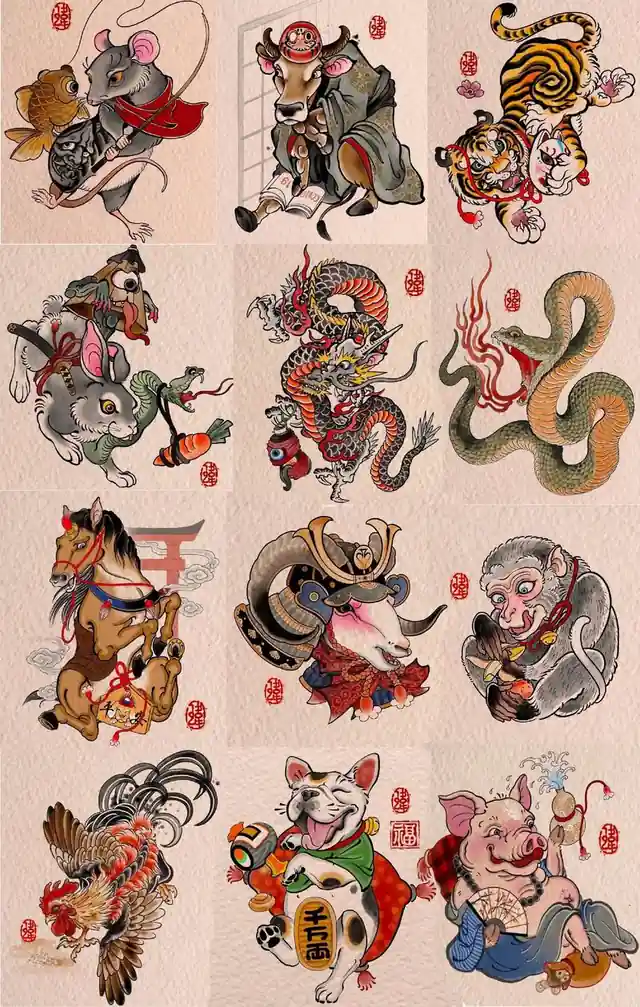
People's contradictory psychology of both fearing and revering snakes is fully reflected in Chinese folk culture. The rich and diverse snake culture reflects the significant role snakes play in people's cultural life, embodying their wishes for safety and longevity.
From the totem worship of ancient times to the increasingly important customs and culture in people's lives today, the Snake has never left the stage of history. It occupies a significant place in people's beliefs, influencing their faith and shaping their daily lives.
Snake worship and snake taboos.
In the Zhejiang and Fujian regions of China, people often divide snakes into two categories: house snakes and wild snakes. House snakes are also called Canglong (Azure Dragon), Tianlong (Heavenly Dragon), Daxian (Great Immortal), or Manjia (Domestic Guardian). People believe that house snakes are auspicious signs and must not be killed. Additionally, grain that a house snake has coiled over is thought to be inexhaustible. In the Yixing area, rituals to honor house snakes are held on the second day of the second lunar month, Qingming Festival, Double Ninth Festival, Winter Solstice, and New Year's Eve. Among these, the Double Ninth Festival is the most important, as it is considered the birthday of the house snake. On the days of these rituals, people use rice flour to make coiled snake shapes or human-headed snake-bodied figures, which are then steamed in bamboo steamers. These are called rice flour snakes. Around the snake, many small rice flour balls symbolizing snake eggs are placed, representing the wish for many offspring.
There were also many taboos regarding snakes. In the old days, Han Chinese people considered it a great offense against morality to witness snakes mating. If one saw this, they would have to quickly pull out a strand of hair, tear off a button to show repentance, and immediately walk away. The Miao people in Guizhou also regarded two snakes mating as an ill omen. If it was seen, one would have to enter a toilet before going home or ask a shaman to recite spells to ward off the bad luck, otherwise, disaster would be brought into the household. The Li people in Hainan considered it unlucky to see a snake on the day of rice transplanting. If they encountered one, they would insert a bundle of straw above the doorframe upon returning home to indicate that visitors were not welcome.
The game of the Snake Lantern and the competition of the Snake God are traditional folk activities.
Each year from the sixth to the twenty-first day of the first lunar month, the town of Zhanghu in Nanping City, Fujian Province, holds a grand parade of snake lanterns in which every household participates, with the procession taking place each night. The snake lantern is composed of three parts: the head, the body, and the tail. The head and tail are made from bamboo strips, covered with colored paper, and mounted on a wooden board about four meters long, with scales affixed on the outside, creating a rustic yet exaggerated form.
The snake body is made up of a long series of lantern panels, each also constructed from bamboo strips. Every panel holds three lanterns, which are covered with white paper and decorated all around with patterns of flowers, insects, birds, and fish, as well as many auspicious sayings written on them. Candles are inserted inside the lanterns. A small snake lantern consists of over 30 panels, while a large one can have more than 700 panels, connecting to form a length of several hundred meters. When danced, it flows with brilliant light and color, presenting a magnificent spectacle.
The Snake Worship Festival is generally held on the seventh day of the seventh lunar month each year. People raise live snakes in snake caves in advance. On the day of the festival, participants carry mountain-crossing flags, strike clearing-the-path gongs, and parade from the Snake King Temple carrying the live Snake King, a statue of the Snake King, and the Snake King seal. Some people coil snakes around their necks, others play with snakes on their arms, and some wear shackles and pretend to be criminals, believing this can eliminate disasters and prevent illness. The parade procession walks through every street in the village, and after reaching the riverside, they release the snakes back into the wild.
Snake toys and snake-shaped boxing.
Those who like and worship snakes naturally have snake toys, with common ones being bamboo snakes and iris-leaf snakes. The bamboo snake is made from sections of bamboo connected together, with flexible joints that give it both the softness and hardness of a real snake. When you hold the handle at the tail, the bamboo snake will twist and sway, poking its head left and right, almost looking real enough to be mistaken for a live snake. The iris-leaf snake is a grass snake woven from iris leaves, and its mouth can be controlled by people; as long as you gently pull the snake's body, its mouth will close, which is also quite amusing.
A snake's entire body is highly flexible: if its head is attacked, its tail comes to the rescue; if its tail is attacked, its head comes to the rescue; if its waist is attacked, both its head and tail come to the rescue together. Ancient military strategists believed that in warfare, all units of an army should coordinate with each other like a snake, leveraging the overall effect to defeat the enemy. The traditional Chinese martial art of Tai Chi (Taijiquan) was inspired by the confrontation between an eagle and a snake. Additionally, the Snake Form in Baguazhang (Eight Trigrams Palm), the Snake Form in Xingyiquan (Form and Will Boxing), and the Snake Fist in Shaolin Boxing all incorporate references to snake movements.
Whether it is the worship of snakes through snake sacrifices, snake lantern parades, and snake deity competitions, or the snake-shaped boxing used for physical fitness and snake-themed toys for entertainment, these are all concrete manifestations of Snake zodiac culture in folklore, as well as expressions of people's deep affection for snakes.
Further Reading
The cultural connotation of the Min-Yue people's worship of snakes.
Folklorists and scholars often explore the cultural significance of the snake worship ceremony practiced by the Min people, represented by the Zhanghu Town in Nanping City, from two perspectives: the legacy of the Baiyue people and reproductive worship. They believe that "the historical and cultural accumulation of snake worship in Zhanghu Town, Nanping City, is relatively profound, and its cultural connotations are also quite deep, serving as a living record of the Minyue people's snake worship." "Placing a jar containing live snakes in the Snake King Temple for worship, and parading bamboo snake lanterns with lit candles throughout the village" are actions intended to pray for prosperity in offspring. Meanwhile, those in the parade who call themselves "sinners" and wear cangues "may be childless, have insufficient offspring, be threatened by illness or other ominous disasters that prevent them from safely bearing descendants, or have children of marriageable age who have not yet married." These practices still retain traces of primitive reproductive worship.