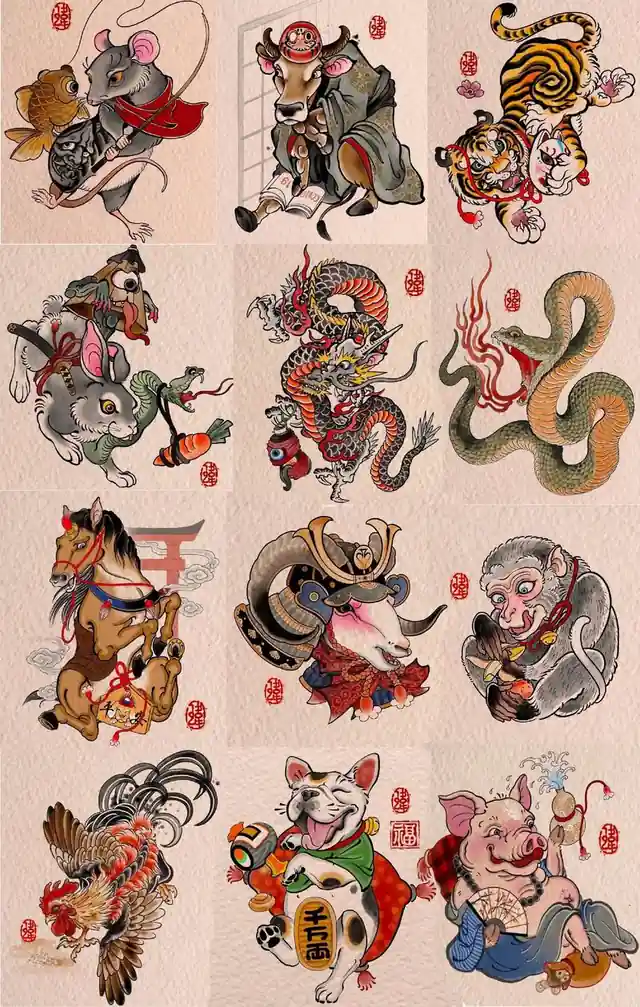
Although people have endowed the snake with a mysterious and fantastical aura, within this mixture of fear and admiration, the snake has long since shed its mere animal form and taken on special symbolic significance.
Like humans, snakes are also living creatures in the natural world. However, certain attributes of snakes can be startling and chilling to behold: their flexible bodies that can stretch and coil freely, their winding and twisting movements, and their long tongues that flick in and out. Yet, snakes are not necessarily symbols of absolute evil. On the contrary, through a long history of reverence and belief, snakes have long been endowed by people with many positive and auspicious meanings.
A Symbol of Eternal Youth
Shedding skin is a unique physiological phenomenon of snakes. Almost every year, when a snake reaches a certain stage of growth, it sheds its old skin and replaces it with a new one. Ancient people observed that after shedding, a snake appeared reborn, and they interpreted this as resurrection from death. However, humans cannot replace their wrinkled faces when they grow old or restore their youthful appearance, so they inevitably felt envy toward snakes. The reason why snakes were selected among the twelve zodiac animals is also a manifestation of entrusting the image of immortality and eternal youth to the snake.
There is also a legend about this: In ancient times, it is said that humans originally shed their skin every three years, which allowed them to live forever without aging. However, the process of shedding skin was extremely painful, causing unbearable suffering. People complained, saying, "Rather than enduring the pain of shedding skin, it would be better to die." Unexpectedly, a snake hiding in the grass overheard this and crawled out to say to the humans, "I can live for fifty or sixty years. If shedding skin could grant me immortality, I would do it not just once every three years, but three times a year. Since you are afraid of the pain, let us trade." Thus, the snake exchanged its skin with the humans. From then on, the snake shed its skin two to three times a year and gained eternal life, while humans, fearing pain, traded their skin with the snake and could only live to be fifty or sixty years old. Because they feared hardship and pain, they lost the chance for immortality, and could only place their hopes for resurrection and eternal youth on the snake, which had exchanged skin with them.
Auspicious Symbol
Although people's fear of snakes has reached the point where "once bitten by a snake, one fears a straw rope for three years," in the eyes of the ancients, snakes were largely considered auspicious symbols. The poem "Si Gan" from "Xiaoya" section of the "Book of Songs (Shijing)" writes: "Below rush mats, above bamboo mats, thus one sleeps in peace. One sleeps and rises, then divines the dream. What is the auspicious dream? It is bears and brown bears, it is vipers and snakes."
The great ones divined it: the bear and the brown bear are signs of a male child; the viper and the snake are signs of a female child. This is a song of praise sung at the completion ceremony of a noble's palace. Among these, "hui" refers to a type of snake, and the ancients believed that dreaming of a viper or snake was an auspicious omen. In contrast to the bear and brown bear, which were seen as omens of giving birth to a boy, the viper and snake were considered omens of giving birth to a girl.
Ancient Chinese used the term "weiyi" (graceful and winding) to describe beautiful things, which is closely related to the snake being a symbol of auspiciousness. The "Xiaoya · Gaoyang" chapter of the Book of Songs (Shijing) states: "After retiring from public duties, I return home with weiyi, weiyi," and Zheng Xuan's commentary explains: "Weiyi describes a relaxed and self-contented appearance." Zhu Xi also said: "Weiyi describes a dignified and self-contented appearance," while Xuan Ying added: "Weiyi describes the beauty of virtue," all of which are very close in meaning to auspiciousness. It is likely for this reason that ancient people often described women as graceful and slender, like the crescent moon.
The symbol of sexual union between male and female.
The ancient depictions of Fuxi and Nuwa with human heads and serpent bodies actually represent the worship of snakes' reproductive and procreative abilities, symbolizing the matching of yin and yang as well as the union of male and female, implying that they were the progenitors of humanity. The union of yin and yang is a form of sexual reproduction that mixes the genes and chromosomes of both parties, giving each biological individual its own unique characteristics — a tremendous leap in biological evolution. The ancients believed that double-headed or double-bodied forms symbolized copulation, representing vigorous vitality, which led to the worship of animals with two heads on one body or two bodies sharing one head. In reality, double-headed snakes are extremely rare in nature; however, because some snakes have head and tail shapes and patterns that are very similar, they appear to have two heads if not carefully examined, and people often refer to such snakes as double-headed snakes.
The double-headed snake, as a symbol of the union of two sexes, naturally gave rise to many beautiful love stories. In some areas of Inner Mongolia, there is a custom: if a young man witnesses a pair of male and female snakes mating, he can take out a handkerchief and cover the two snakes with it, thereby imbuing the handkerchief with special magical powers. Thereafter, when the young man meets the girl of his heart, he only needs to wave the handkerchief at her, and she will fall deeply in love with him as if under a spell. This is precisely the symbolic meaning of the snake's union of the two sexes.
Although most of these symbolic meanings are merely wishful thinking on people's part, they nevertheless reflect humanity's complex feelings toward snakes, as well as people's curiosity about snakes and their desire to seek hope and blessings from them.
Further Reading
Negative Symbolism of the Snake
When discussing the negative symbolic meanings of snakes, people first think of their venomous nature. Among these legends, the fable of "The Farmer and the Snake" is deeply ingrained and widely known. In other snake-related folklore, there are also many stories about snakes stirring up waves and harming humans, which undoubtedly deepens people's negative impression of snakes. People use snakes to describe someone's venomous nature, such as saying a person has a "snake's heart and scorpion's guts" (ruthless and malicious). The second negative symbolic meaning of snakes is insidiousness and coldness. This is roughly related to snakes being so-called "cold-blooded animals." Women with beautiful appearances but sinister and venomous hearts are called "beauty snakes" (seductive but dangerous women). The third negative symbolic meaning of snakes is unpredictability. Snakes have no feet yet can crawl, and they often come without shadow and go without trace, appearing very mysterious. This mystery leads to people's worship of snakes, and there are many taboos associated with the snake's mystique, some of which remain popular to this day.