
After occupying Hanzhong, Liu Bei and Zhuge Liang began planning a campaign against Cao Cao, marching their forces northward. After some discussion, Zhuge Liang decided to dispatch troops from Jingzhou, catching the Cao army off guard before they could regroup.
Jingzhou had always been under Guan Yu's command, and this time he also led the troops on the campaign. When it came to fighting on the battlefield, Guan Yu could take on ten enemies single-handedly. Although he was a military general, he actually possessed considerable strategic wisdom. His only shortcomings were that he was prone to arrogance, underestimated his enemies, and had a narrow-minded temperament. After Liu Bei declared himself the King of Hanzhong, he granted Guan Yu a seal and appointed him as the Front General. Guan Yu was very displeased, feeling that Liu Bei had undervalued him, and he became less respectful toward Liu Bei than before. Later, someone flattered Guan Yu in his presence, saying that he was the most valued person by the King of Hanzhong, and only then did Guan Yu gradually change his attitude.
This time, Guan Yu personally led his main force to attack Fancheng, leaving only two minor generals to guard Jiangling and Gong'an, which shows how seriously he took this battle. As Guan Yu's army gradually approached Fancheng, the defending general Cao Ren urgently requested reinforcements from Cao Cao. Knowing Guan Yu's strength, Cao Cao ordered Generals Yu Jin and Pang De to lead seven elite units to rush to the rescue. After Yu Jin and his men arrived at Fancheng, Cao Ren had them set up camp on the flat ground north of the city, planning to coordinate with the city's troops to encircle and annihilate Guan Yu's entire army.
What Yu Jin did not expect was that both he and Cao Ren had overlooked a critical factor, one that would ultimately inflict heavy losses on their army. Cao Ren ordered Yu Jin to set up camp on the flat ground north of the city, and since Yu Jin had always been stationed in the north and was unfamiliar with the southern geography and climate, he saw nothing wrong with Cao Ren's decision. Soon, his troops had pitched their tents on the northern plains.
Guan Yu led his massive army to the outskirts of Fan City, and upon seeing that Yu Jin had stationed his troops north of the city, he felt a surge of delight. The two sides soon engaged in battle, but as they were evenly matched, neither could gain the upper hand, so they had to conserve their strength and await the next clash. It was the eighth month of the lunar calendar when a sudden torrential rain fell one night, causing rivers to swell and overflow, flooding vast areas and nearly destroying all of Yu Jin's army camps. The flatlands north of the city were lower than the surrounding terrain, making them particularly prone to water accumulation, and with the oppressive heat and frequent heavy rains, there was a constant risk of being swept away by floods. Guan Yu had only felt at ease to fight after seeing Yu Jin encamp his forces there. As the camps were submerged, many of the seven armies' soldiers were carried off by the floodwaters, while others who could swim dragged their comrades along, following Yu Jin to higher ground, barely managing to save their lives.
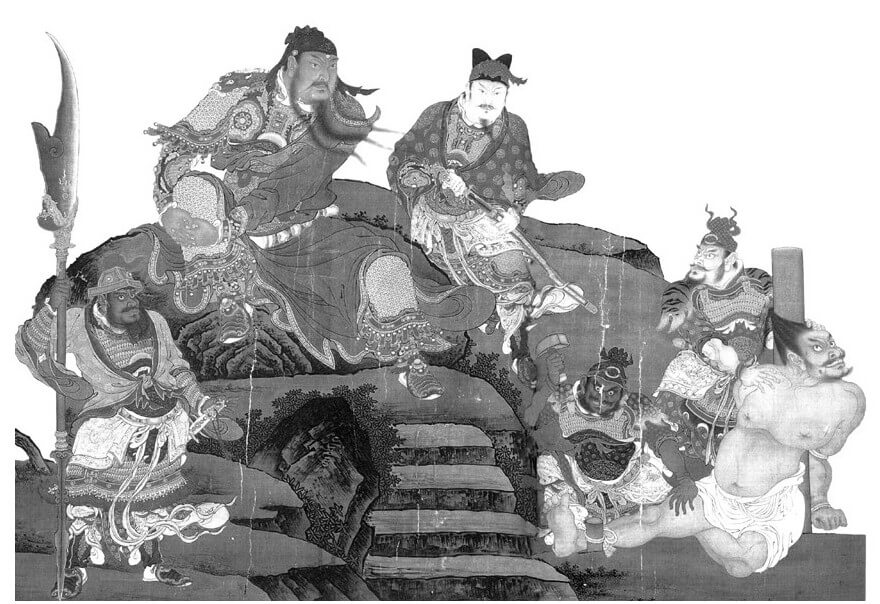
However, it wasn't long before Yu Jin and his men found themselves surrounded by Guan Yu's army. After the river flooded the banks, Guan Yu launched the boats he had prepared in advance into the water and slowly advanced toward the panicked Cao army. Completely encircled and unarmed, Yu Jin and his troops had no choice but to surrender to Guan Yu.
Meanwhile, after the floodwaters rose, Pang De led his soldiers to take refuge on a river embankment. Soon, they were surrounded by Guan Yu's small boats. Guan Yu had placed archers on the boats, and arrows rained down on the embankment like a sudden storm, causing many of Cao Cao's soldiers to be struck and fall into the river. Terrified of being hit, many soldiers begged Pang De to surrender to Guan Yu. Enraged, Pang De grabbed one of those pleading for mercy, drew his sword, and cut off his head. This silenced everyone, and no one dared to speak another word. Pang De then picked up his bow and began to fight back, his arrows hitting their mark every time, causing many of Shu's soldiers to fall into the water one after another.
The battle raged from morning until noon, and when Pang De's arrows were exhausted, he led his soldiers to fight the Shu army with short swords, delivering many impassioned speeches to boost morale. As the two sides clashed fiercely, the floodwaters grew increasingly violent, gradually submerging the riverbanks and greatly expanding the Shu army's area of operation, while the Cao army was trapped in a cramped space, forcing many of them to surrender. Unwilling to be captured, Pang De and a few of his men seized a small boat in the chaos, intending to escape by water. Unexpectedly, a sudden wave capsized the boat, plunging Pang De and his men into the water, where they were soon captured and killed by Guan Yu.
The floodwaters had not yet fully receded, and the walls of Fancheng were breached in several places by the flood, causing great panic among the city's defenders, who urged Cao Ren to abandon the city and flee. Cao Ren himself was also frightened and considered finding an opportunity to escape. However, his subordinate Man Chong insisted on holding Fancheng, arguing that Guan Yu had already shifted his focus elsewhere and was actually afraid of a rear attack from them; if they abandoned the city now, the entire southern bank of the Yellow River would fall to Liu Bei, leaving them with no foothold. After thinking it over, Cao Ren resolutely decided to stay in Fancheng and encouraged the soldiers who wanted to flee to remain as well.
Although Guan Yu did not capture Fancheng, he defeated the Seven Armies alliance of Yu Jin and Pang De, greatly enhancing his reputation.